

No HRA From Your Employer? Section 134 of the Income-tax Act 2025 Still Lets Old-Regime Tenants Deduct Up to Rs 60,000 a Year
Section 134 of the Income-tax Act 2025, successor to 80GG, lets tenants without HRA deduct rent up to Rs 5,000 a month. Limits, exclusions, new-regime bar and four worked examples.
Key points
- Section 134 of the Income-tax Act 2025, in force from 1 April 2026, replaces Section 80GG and allows a deduction for rent paid on one's own residence.
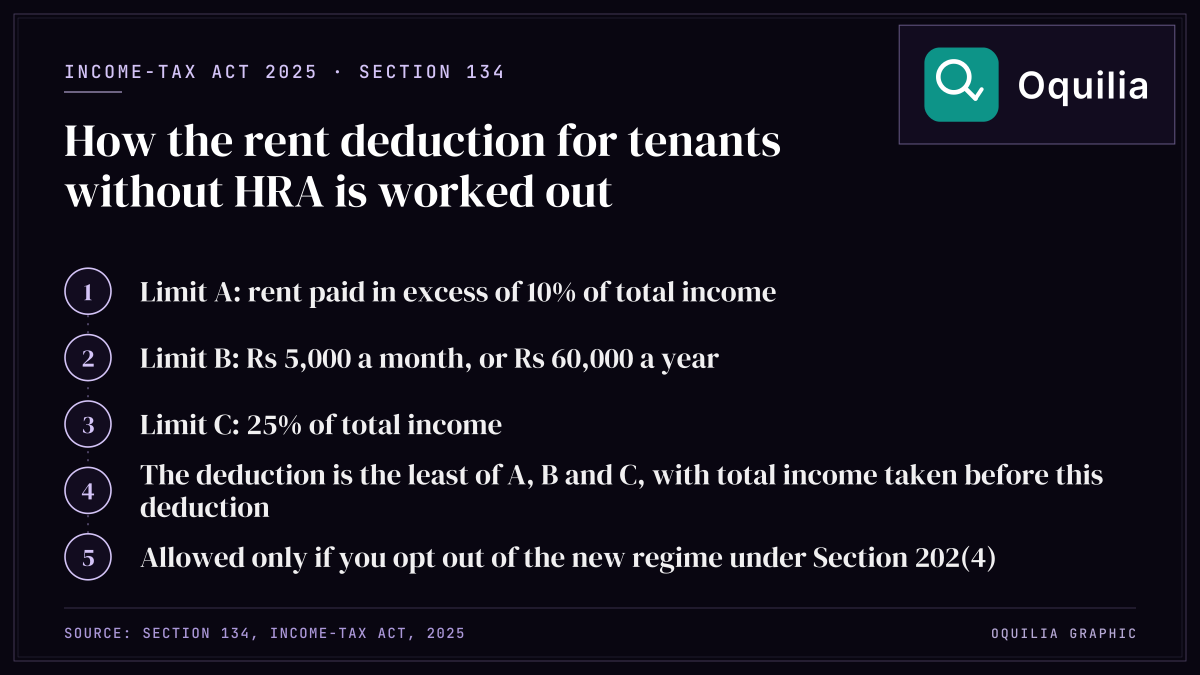
- The deduction is the least of rent above 10% of total income, Rs 5,000 a month (Rs 60,000 a year) and 25% of total income.
- It is available only to taxpayers who opt out of the default new regime under Section 202(4), and owners of a home where they live or work cannot claim it.
Roughly every salaried tenant knows about house rent allowance. Far fewer know what happens when the employer pays no HRA at all, or when the reader is self-employed and has no employer. From 1 April 2026, the answer sits in Section 134 of the Income-tax Act, 2025 (Act 30 of 2025), titled "Deductions in respect of rents paid". It is the successor to Section 80GG of the Income-tax Act, 1961, and it caps the deduction at Rs 5,000 a month, or Rs 60,000 a year.
This guide sets out what the section says, runs the arithmetic on four hypothetical incomes, lists the mistakes that most often cost tenants the deduction, and answers the questions readers ask most. The full statutory text is published on Indian Kanoon and the Act is available on India Code.
What the Section Says
Section 134 has five sub-sections. Sub-section (1) allows a deduction for any expenditure on rent "(by whatever name called)" for furnished or unfurnished accommodation occupied for the taxpayer's own residence. Sub-section (2) sets the limits, sub-section (3) lets the government prescribe further conditions by area or place, sub-section (4) lists who cannot claim, and sub-section (5) defines the base on which the percentages are worked out.
The three-way limit in Section 134(2)
The deduction is the least of three figures, each worked out for the tax year:
| Limit | Statutory wording | Annual figure |
|---|---|---|
| A | Rent paid in excess of 10% of total income | Rent minus 10% of total income |
| B | Maximum of Rs 5,000 per month | Rs 60,000 |
| C | 25% of total income | 25% of total income |
Section 134(5) adds one detail that changes the result: "total income" in limits A and C means total income before allowing the Section 134 deduction itself. That avoids a circular calculation, and it means the reader should work out total income after every other deduction first, then apply the rent test last. Our glossary entry on total income explains how that figure is built.
Who is shut out under Section 134(4)
Sub-section (4) lists three bars. No deduction is allowed if:
- Clause (a)(i): residential accommodation is owned by the taxpayer, the spouse, a minor child, or (for an HUF member) the HUF, at the place where the taxpayer ordinarily resides, works or carries on business or profession.
- Clause (a)(ii): the taxpayer owns accommodation at any other place, occupies it, and its value falls to be determined under section 21(6) or 21(7)(a) of the 2025 Act.
- Clause (b): the taxpayer has any income falling in Schedule III, Table Serial No. 11.
Clause (b) is the HRA-linked bar in spirit. Under the 1961 Act, Section 80GG was barred for anyone with income falling within Section 10(13A), the HRA exemption. The 2025 Act moves exemption entries into Schedule III, and Section 134(4)(b) points to Serial No. 11 of that table. Before claiming, read Serial No. 11 of Schedule III on India Code and confirm whether any allowance you receive falls within it.
The new-regime question
Under the default new tax regime in Section 202 of the 2025 Act, Section 202(2)(a)(xii) disallows Chapter VIII deductions except those under sections 124(1), 124(2), 125(2) and 146. Section 134 is not on that list. So the rent deduction is available only to a taxpayer who opts out of the new regime under Section 202(4). Our old vs new regime calculator shows whether that switch pays for a given income.
| Question | New regime (default) | Opted out under Section 202(4) |
|---|---|---|
| Section 134 rent deduction | Not allowed | Allowed, subject to limits A, B and C |
| Annual maximum | Rs 0 | Rs 60,000 |
| Exception list in Section 202(2)(a)(xii) | Sections 124(1), 124(2), 125(2), 146 only | Not applicable |
Prescribed conditions
Section 134(3) allows the government to prescribe further conditions "having regard to the area or place" of the accommodation. Under the 1961 Act, 80GG claims needed a declaration in a prescribed form. Taxpayers should check the Income-tax Rules notified for the 2025 Act on the Income Tax Department portal for the declaration form currently prescribed, and keep rent receipts and the rental agreement for at least the period during which an assessment can be reopened.
Worked Example
All four cases below are hypothetical and use round numbers for clarity. In each, "total income" is income after all other deductions but before Section 134, as Section 134(5) requires.
Case 1: Rs 8,00,000 total income, Rs 15,000 monthly rent
Annual rent is Rs 15,000 x 12 = Rs 1,80,000.
| Limit | Working | Result |
|---|---|---|
| A: Rent minus 10% of total income | Rs 1,80,000 - Rs 80,000 | Rs 1,00,000 |
| B: Rs 5,000 x 12 | Fixed cap | Rs 60,000 |
| C: 25% of total income | 25% x Rs 8,00,000 | Rs 2,00,000 |
| Deduction (least of A, B, C) | Rs 60,000 |
Taxable income falls from Rs 8,00,000 to Rs 7,40,000. Limit B, the Rs 60,000 ceiling, binds here, which is typical for a mid-income tenant in a metro.
Case 2: Rs 10,00,000 total income, Rs 12,000 monthly rent
Annual rent is Rs 1,44,000. Limit A is Rs 1,44,000 - Rs 1,00,000 = Rs 44,000. Limit B is Rs 60,000. Limit C is Rs 2,50,000. The deduction is Rs 44,000, because only the rent above 10% of income (Rs 1,00,000) counts.
Case 3: Rs 2,00,000 total income, Rs 8,000 monthly rent
Annual rent is Rs 96,000. Limit A is Rs 96,000 - Rs 20,000 = Rs 76,000. Limit B is Rs 60,000. Limit C is 25% of Rs 2,00,000 = Rs 50,000. The deduction is Rs 50,000, capped by the 25% test.
Case 4: Rs 15,00,000 total income, Rs 10,000 monthly rent
Annual rent is Rs 1,20,000 and 10% of income is Rs 1,50,000. Limit A is negative, so the deduction is Rs 0. Higher earners paying modest rent often get nothing from Section 134.
| Case | Total income | Annual rent | Binding limit | Deduction |
|---|---|---|---|---|
| 1 | Rs 8,00,000 | Rs 1,80,000 | B (Rs 60,000 cap) | Rs 60,000 |
| 2 | Rs 10,00,000 | Rs 1,44,000 | A (rent over 10%) | Rs 44,000 |
| 3 | Rs 2,00,000 | Rs 96,000 | C (25% of income) | Rs 50,000 |
| 4 | Rs 15,00,000 | Rs 1,20,000 | A (negative) | Rs 0 |
What the deduction is worth in tax
The cash saving depends on the old-regime slab rate that applies. As a reference point only, under the old-regime slabs for FY 2025-26 held in Oquilia's rate configuration, income between Rs 5,00,000 and Rs 10,00,000 is taxed at 20%, plus 4% health and education cess. On that basis, Case 1's Rs 60,000 deduction would cut tax by Rs 12,000, or Rs 12,480 with cess. Confirm the slab rates notified for the tax year you are filing before relying on this figure, and run your own numbers through the old-regime income tax calculator.
Common Mistakes
1. Claiming while on the new regime. Section 202(2)(a)(xii) excludes Section 134 from the default regime. A claim filed without opting out under Section 202(4) will be disallowed, and the Rs 60,000 maximum becomes Rs 0.
2. Using the wrong income base. Section 134(5) fixes the base as total income before this deduction. Some filers use gross salary, which inflates limit C and deflates limit A, or use income after the rent deduction, which creates a circular figure. In Case 2 above, using gross salary of, say, Rs 11,00,000 instead of Rs 10,00,000 would wrongly cut limit A from Rs 44,000 to Rs 34,000.
3. Ignoring a spouse's flat in the same city. Clause (a)(i) of Section 134(4) bars the deduction if the spouse or a minor child owns residential accommodation at the place where the taxpayer lives or works, even if the taxpayer pays rent elsewhere in that city.
4. Claiming alongside an HRA-type exemption. Under Section 80GG of the 1961 Act, anyone with HRA exempt under Section 10(13A) could not claim. Section 134(4)(b) carries the bar forward through Schedule III, Table Serial No. 11. Receiving even part of the year's allowance can trigger it, so check the payslip and Form 16 first. Readers who do get HRA should use the HRA exemption calculator instead, and the HRA glossary entry explains the difference.
5. Paying rent to a spouse without substance. Rent is deductible only if it is genuinely paid for accommodation occupied as a residence. A rent arrangement inside the family with no bank trail and no agreement is the kind of claim that draws scrutiny. Pay by bank transfer, keep receipts (our rent receipt generator helps), and keep the rental agreement.
6. Forgetting the monthly framing. The cap is Rs 5,000 per month. A tenant who rents for only 7 months of the tax year should not assume the full Rs 60,000; on a strict reading of "per month", the ceiling for 7 months would be Rs 35,000. When in doubt, claim the lower figure.
7. Skipping the prescribed declaration. Section 134(3) allows conditions to be prescribed. Missing a required declaration can lead to disallowance under processing even when the arithmetic is right. Check the current rules on incometax.gov.in before filing.
FAQ
Is Section 134 the same as Section 80GG?
Section 134 of the Income-tax Act, 2025 is the successor to Section 80GG of the 1961 Act. It keeps the same three limits: rent over 10% of total income, Rs 5,000 a month, and 25% of total income, whichever is least. The 2025 Act came into force on 1 April 2026.
Can I claim Section 134 under the new tax regime?
No. Section 202(2)(a)(xii) allows only sections 124(1), 124(2), 125(2) and 146 under the default regime. You must opt out under Section 202(4) to claim the rent deduction, which is worth up to Rs 60,000 a year.
What is the maximum rent deduction under Section 134?
Rs 5,000 a month, which is Rs 60,000 for a full tax year. The actual figure can be lower because of the 10%-of-income and 25%-of-income tests in Section 134(2).
I am self-employed. Can I claim it?
Yes. Section 134(1) applies to "an assessee", not only to salaried employees. A freelancer or business owner who pays rent for a home and meets the conditions in Section 134(4) can claim up to Rs 60,000 under the old regime.
My parents own a house in another city. Does that block me?
Clause (a)(i) of Section 134(4) covers property owned by you, your spouse, your minor child or your HUF. Property owned by parents is not on that list. Clause (a)(ii) bars you only if you yourself own and occupy accommodation elsewhere whose value is determined under section 21(6) or 21(7)(a).
Which figure of total income do I use?
Total income before the Section 134 deduction, per Section 134(5). In Case 1 above, that is Rs 8,00,000, giving a 10% threshold of Rs 80,000 and a 25% ceiling of Rs 2,00,000.
How do I check whether switching regimes is worth it for a Rs 60,000 deduction?
Compare total tax under both regimes with every deduction you are eligible for. The new regime has a standard deduction of Rs 75,000 against Rs 50,000 in the old regime for FY 2025-26, so one Rs 60,000 deduction alone rarely tips the balance. The old vs new regime calculator runs both side by side.
Sources & Citations
- Section 134 in The Income Tax Act, 2025 — Indian Kanoon
- Income-tax Act, 2025 (Act 30 of 2025) — India Code
- Income Tax Department e-filing portal — Income Tax Department