

Truck Owners on Section 44AE: The ITR-3 Validation Rules for AY 2026-27 That Reject Goods Carriage Returns
CBDT's ITR-3 validation rules for AY 2026-27 block 44AE goods carriage returns that break the Rs 7,500-a-month floor, the 120-month cap or the schedule totals. Here is what each rule checks.
Key points
- The CBDT e-Filing Project's ITR-3 validation rules for AY 2026-27, dated 18 June 2026, set at least 11 checks on section 44AE goods carriage income.
- For a vehicle of 12 MT or less, declared income cannot be below months held multiplied by Rs 7,500, and total months across vehicles cannot exceed 120.
- These are Category A rules, so a return that breaks any of them cannot be uploaded until the truck owner corrects the figures.
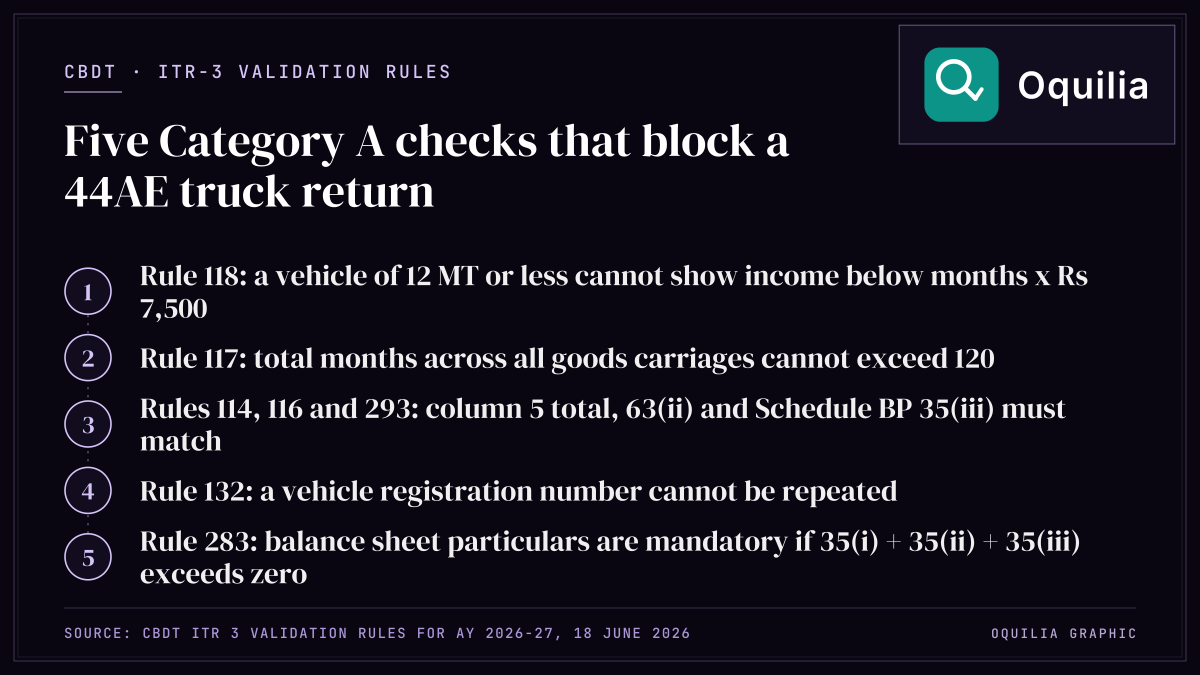
A truck owner who declares presumptive income under section 44AE of the Income-tax Act, 1961 in ITR-3 for assessment year 2026-27 now faces at least 11 specific e-filing checks on that one schedule. They come from the Central Board of Direct Taxes (CBDT) e-Filing Project document "ITR 3 - Validation Rules for AY 2026-27", Version 1.0, dated 18 June 2026, published by the Directorate of Income Tax (Systems) on incometax.gov.in.
Nearly every rule covered below sits in the document's Category A, which the CBDT defines in Table 1 in one line: the "return will not be allowed to be uploaded" and an error message is shown. In other words, a Category A failure is not a notice that arrives months later; the upload stops on the day you try to file. Only one goods-carriage rule in the 73-page document, the 100 MT tonnage ceiling, sits in the softer Category D.
This guide walks through what the 44AE rules ask for, shows a worked example for a three-truck owner, and lists the mistakes that trip the portal most often. If presumptive taxation is new to you, start with the presumptive taxation glossary entry, and use the presumptive tax calculator to rough out your figure before you open the return.
What the Section Says
Section 44AE lets a person who owns goods carriages and runs the business of plying, hiring or leasing them offer a deemed (presumptive) income per vehicle per month, rather than computing actual profit from full books. The text of section 44AE is reproduced on Indian Kanoon, and the deemed figure is linked to how many months in the year each vehicle was owned, leased or hired by you.
For a goods carriage with a tonnage capacity of 12 MT or less, the ITR-3 validation file sets the floor plainly in rule 118: the presumptive income for that vehicle "cannot be less than" the number of months it was owned, leased or hired multiplied by Rs 7,500. One month of a light truck therefore means a minimum of Rs 7,500, and a full 12 months means a minimum of Rs 90,000.
You may always declare more than the floor. Rule 118 checks only the minimum, so a figure above months multiplied by Rs 7,500 passes, while a figure even Rs 1 below it fails for a vehicle of 12 MT or less.
How the 44AE schedule is laid out in ITR-3
The 44AE data lives in Part A of the Profit and Loss schedule at serial number 63, and it is carried into Schedule BP at serial number 35(iii). The table below maps the fields named in the 18 June 2026 document.
| Field | What it holds | Rules that test it |
|---|---|---|
| Table 63(i), column 3 | Tonnage capacity of each goods carriage (in MT) | 118; Category D rule 8 (cannot exceed 100 MT) |
| Table 63(i), column 4 | Months each vehicle was owned, leased or hired | 117 (total cannot exceed 120), 118 |
| Table 63(i), column 5 | Presumptive income for each vehicle | 116, 118 |
| Table 63(i), registration number | Vehicle registration number | 132 (no repeats) |
| Field 63(ii) | Total presumptive income u/s 44AE | 110, 114, 115, 116, 293 |
| Schedule BP 35(iii) | 44AE income carried to business income | 114, 283, 293 |
The 11 rules that apply to goods carriages
The validation rules are numbered in the CBDT document. The ones that touch 44AE, in plain English, are as follows.
| Rule no. | Category | What the portal checks |
|---|---|---|
| 14 | A | You must answer whether you are declaring income only under 44AE, 44AD, 44ADA or the other listed presumptive sections |
| 109 | A | If you pick a 44AE business code, 44AE income must be declared |
| 110 | A | Nature of business is mandatory if 63(ii) is above zero |
| 114 | A | Schedule BP 35(iii) must match 63(ii) |
| 115 | A | If 63(ii) is above zero, table 63(i) must be filled |
| 116 | A | 63(ii) must equal the total of the vehicle-wise column 5 |
| 117 | A | Total months in column 4 cannot exceed 120 |
| 118 | A | For a vehicle of 12 MT or less, column 5 cannot be below months x Rs 7,500 |
| 132 | A | A registration number cannot be repeated |
| 283 | A | Balance sheet particulars ("Regular books of accounts" or "No accounts case") are mandatory if 35(i) + 35(ii) + 35(iii) exceeds zero |
| 293 | A | Schedule BP 35(iii) must equal 63(ii) |
Rules 114 and 293 test the same match from two directions, so a single mismatch between the Profit and Loss schedule and Schedule BP is caught twice. Rule 8 in Category D (page 65 of the document) adds that tonnage cannot exceed 100 MT; under the CBDT's Table 1 a Category D flag lets the return upload but warns that a claim may not be allowed without the supporting particulars.
Worked Example
Take a sole proprietor who files ITR-3 for AY 2026-27 (the assessment year linked to the financial year ending 31 March 2026). The proprietor also has salary from a part-time job, which is why ITR-3 rather than a simpler form is in use, and runs three goods carriages, each of 12 MT capacity or less.
| Vehicle | Tonnage (MT) | Months owned / leased / hired | Floor at Rs 7,500 per month | Income declared (column 5) |
|---|---|---|---|---|
| Truck A | 9 | 12 | Rs 90,000 | Rs 90,000 |
| Truck B | 12 | 12 | Rs 90,000 | Rs 1,00,000 |
| Truck C (bought mid-year) | 7.5 | 7 | Rs 52,500 | Rs 52,500 |
| Total | 31 | Rs 2,32,500 | Rs 2,42,500 |
Run the rules over this table one by one.
- Rule 117: total months are 12 + 12 + 7 = 31, well inside the 120 limit.
- Rule 118: each vehicle is at or above its floor. Truck B is declared at Rs 1,00,000, which is Rs 10,000 above its Rs 90,000 minimum and is allowed.
- Rule 116: field 63(ii) must show Rs 2,42,500, exactly the column 5 total of Rs 90,000 + Rs 1,00,000 + Rs 52,500.
- Rules 114 and 293: Schedule BP 35(iii) must also read Rs 2,42,500.
- Rule 110: because 63(ii) is above zero, the nature of business must be filled in.
- Rule 283: because 35(iii) is above zero, the balance sheet section for either regular books or the no-accounts case must be completed.
- Rule 132: the three registration numbers must all differ.
Where the same return would be rejected
Now change one input at a time. If Truck C is entered at Rs 50,000 instead of Rs 52,500, it falls Rs 2,500 short of 7 months x Rs 7,500 and rule 118 blocks the upload. If the proprietor types 63(ii) as Rs 2,32,500 (the floor total) while column 5 still adds to Rs 2,42,500, rule 116 fails on the Rs 10,000 gap. If Truck C is entered twice under the same registration number to show a later lease, rule 132 fails.
Once the 44AE figure is settled, the Rs 2,42,500 joins the salary and any other income for the slab computation; the income tax calculator and the old vs new regime comparison handle that step, and the advance tax calculator helps plan instalments for FY 2026-27.
Common Mistakes
The CBDT document says in its Purpose section that it was issued because commercially available return software must meet the same data quality as the department's own utility, and that a non-compliant utility is "liable to be blacklisted without any notice". The seven errors below are the ones these 11 rules are written to stop.
1. Months that add up to more than 120
Column 4 is a total across all vehicles, and rule 117 caps it at 120, the equivalent of 10 vehicles held for all 12 months. An owner who lists a sold truck and its replacement both at 12 months, instead of splitting the year between them, can tip the total past 120, and the return will not upload.
2. Rounding the 44AE income down
Rule 118 is a hard floor of months x Rs 7,500 for each vehicle of 12 MT or less, checked vehicle by vehicle, not as a total. Declaring Rs 89,000 for a vehicle held 12 months fails by Rs 1,000 even if another truck is declared well above its own floor.
3. Totals that do not tie across schedules
Three numbers must match: the column 5 total, field 63(ii) and Schedule BP 35(iii). Rules 114, 116 and 293 enforce this, so editing the vehicle table after the totals are filled, without recomputing 63(ii), can leave a gap of a few thousand rupees that blocks the AY 2026-27 upload.
4. Picking a 44AE business code with no 44AE income
Rule 109 works in reverse to rule 115. If the business code selected is a 44AE code, 44AE income must appear; if 63(ii) is above zero, the vehicle table must be filled. A filer who keeps last year's transport business code after selling all trucks, and declares Rs 0 under 44AE, hits rule 109.
5. Skipping the balance sheet because the income is presumptive
Many owners assume presumptive taxation means no balance sheet. Rule 283 says otherwise for ITR-3: where the sum of 35(i), 35(ii) and 35(iii) is above zero, particulars under either "Regular books of accounts" or "No accounts case" are mandatory. Leaving both blank blocks the return.
6. Repeated or mistyped registration numbers
Rule 132 bars a repeated registration number in the 44AE table. Copying a row to save typing, then forgetting to change the number, is enough to fail. Check each entry against the registration certificate before filing.
7. Tonnage typed in kilograms
Column 3 asks for tonnage "in MT". Entering 12,000 (kilograms) for a 12 MT vehicle breaches the Category D ceiling of 100 MT in rule 8 and also takes the vehicle outside the 12 MT test in rule 118, so the Rs 7,500 floor is no longer checked for it.
FAQ
Which CBDT document sets the 44AE checks for AY 2026-27?
The CBDT e-Filing Project's "ITR 3 - Validation Rules for AY 2026-27", Version 1.0, dated 18 June 2026, issued by the Directorate of Income Tax (Systems), New Delhi. The 44AE rules are numbers 14, 109, 110, 114 to 118, 132, 283 and 293 in Category A, plus rule 8 in Category D.
What happens if my return breaks a Category A rule?
Under Table 1 of the 18 June 2026 document, a Category A defect means the return will not be allowed to be uploaded and an error message is displayed. You must correct the data and upload again; nothing reaches the Centralised Processing Centre until all Category A checks pass.
What is the minimum 44AE income for a truck of 12 MT or less?
Rule 118 sets it at the number of months the vehicle was owned, leased or hired multiplied by Rs 7,500. For 12 months that is Rs 90,000; for 7 months, Rs 52,500. You may declare more.
Can the months column ever exceed 120?
No. Rule 117 says the total of column 4 across all goods carriages shall not exceed 120. A total of 121 or more stops the upload.
Do I need a balance sheet if I only declare 44AE income?
In ITR-3, yes. Rule 283 makes balance sheet particulars for either regular books or the no-accounts case mandatory whenever Schedule BP 35(i), 35(ii) or 35(iii) adds up to more than zero.
Why does the portal check the same 44AE total twice?
Rule 114 checks that Schedule BP 35(iii) matches field 63(ii), and rule 293 checks that 35(iii) equals 63(ii). Both rules sit in Category A, so one mismatch of even Rs 1 will be reported and will block the return.
Is there a limit on the tonnage I can enter?
Yes. Rule 8 in Category D, on page 65 of the document, says the tonnage of a goods carriage cannot exceed 100 MT. A Category D flag lets the upload proceed but warns that the related claim may not be entertained.
This explainer is general information based on the CBDT's published validation rules dated 18 June 2026 and is not tax advice. Check your own figures against the e-filing utility before filing, and see the ITR glossary entry for the return forms.
Sources & Citations
- ITR 3 - Validation Rules for AY 2026-27, Version 1.0 (18 June 2026) — CBDT e-Filing Project, Income Tax Department
- Section 44AE in The Income Tax Act, 1961 — Indian Kanoon
- Income Tax Returns downloads — Income Tax Department