

Agniveers Filing ITR for AY 2026-27: The Section 80CCH and 10(12C) Validation Rules That Trigger Errors
CBDT's ITR-2 validation rules for AY 2026-27 block uploads if an Agniveer's 80CCH claim tops 60% of salary, is made in the new regime, or 10(12C) income is entered twice.
Key points
- The CBDT's e-Filing project issued ITR-2 validation rules for AY 2026-27 on 26 May 2026, with five checks aimed at Agniveer claims.
- Section 80CCH is capped at 60% of salary, is barred under 80CCH(1) in the new regime, and needs Central Government employment and age 17 to 27 on 1 April 2026.
- All five are Category A rules, so a return that breaks any of them cannot be uploaded until the figures are corrected.
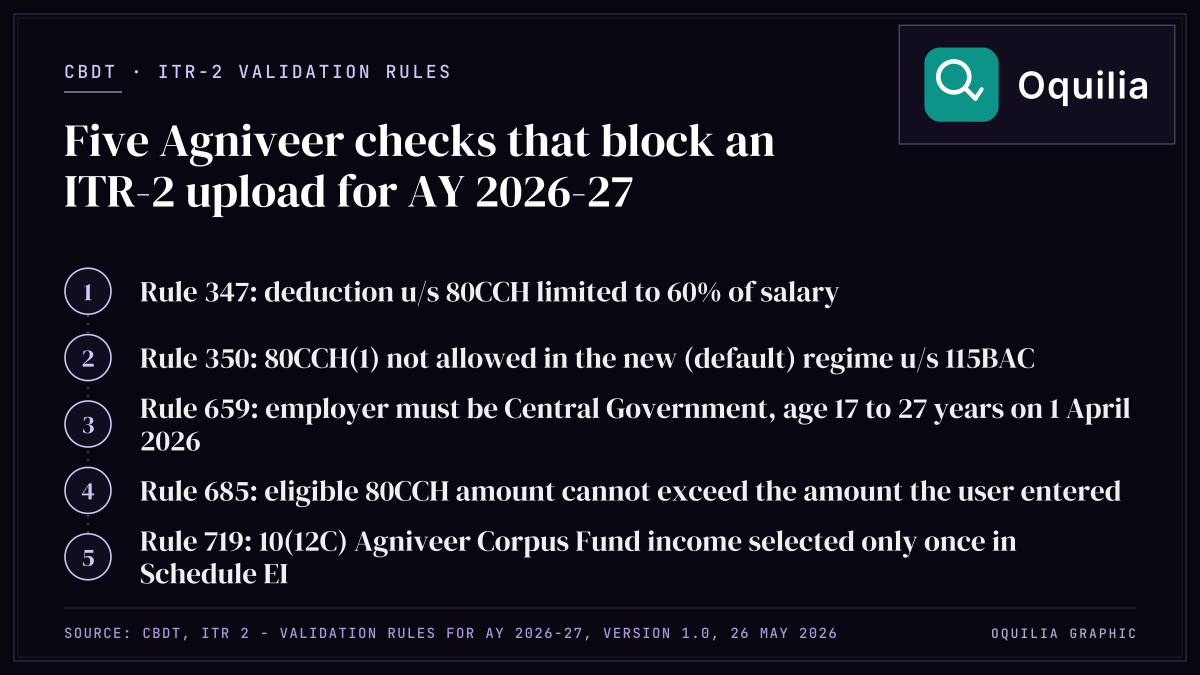
An Agniveer filing an income-tax return for assessment year (AY) 2026-27 now faces five specific checks on the e-Filing portal, each set out in the Central Board of Direct Taxes (CBDT) document ITR 2 - Validation Rules for AY 2026-27, Version 1.0, dated 26 May 2026 and issued by the Directorate of Income Tax (Systems), New Delhi. All five sit in Category A, which the document defines plainly: the "return will not be allowed to be uploaded" and an error message will be displayed.
That makes the Agniveer rows in ITR-2 less forgiving than most of the form. A wrong figure under section 80CCH or a duplicated 10(12C) entry does not produce a notice months later; it stops the return at the upload screen. This guide walks through rules 347, 350, 659, 685 and 719, the two related NPS checks at rules 345 and 598, and how to clear each one before the 2026-27 filing cycle closes.
What the Section Says
AY 2026-27 covers income earned in financial year (FY) 2025-26, and returns for that year are filed under the Income-tax Act, 1961. Two provisions of that Act matter to an Agniveer: section 80CCH, which gives a deduction for contributions to the Agniveer Corpus Fund, and section 10(12C), which treats income from that fund as exempt. The full statutory text is available on India Code, and the validation document is published on the Income Tax Department e-Filing portal.
The CBDT document does not restate the law; it converts it into machine checks. Five of those checks name 80CCH or 10(12C) directly:
| Rule no. | What the portal checks | Category |
|---|---|---|
| 347 | Deduction u/s 80CCH limited to 60% of salary | A (upload blocked) |
| 350 | Deduction u/s 80CCH(1) not allowed in the new (default) regime u/s 115BAC | A (upload blocked) |
| 659 | 80CCH only if nature of employment is "Central Government" and age is 17 to 27 years as on 1 April of the AY | A (upload blocked) |
| 685 | Eligible 80CCH amount cannot exceed the amount the user entered | A (upload blocked) |
| 719 | "10(12C)-Agniveer Corpus Fund income" can be selected only once in Schedule EI under Other Exempt Income | A (upload blocked) |
Three points follow from the table. First, rule 347 sets a ceiling of 60% of salary on the 80CCH claim, so the deduction is tied to what the Agniveer actually earned in FY 2025-26. Second, rule 350 bars sub-section (1) of 80CCH in the new regime under section 115BAC; the rule names sub-section (1) specifically, so anyone relying on any other part of the section should read the statute itself on India Code before filing. Third, rule 659 links eligibility to two data fields elsewhere in the form, the employer category and the date of birth, so an error in Part A General can trigger an 80CCH failure even when the deduction figure is right.
For AY 2026-27, the age window in rule 659 is measured on 1 April 2026. A filer who is at least 17 and not older than 27 on that date passes the age leg of the check; one outside that band does not, whatever the deduction amount.
Two neighbouring rules govern employer NPS contributions under section 80CCD(2), and they often appear on the same Form 16 as Agniveer entries:
| Rule no. | Regime | Employer type | Cap on 80CCD(2) |
|---|---|---|---|
| 598 | New (default) regime | Any | 14% of basic salary plus dearness allowance |
| 339 | Old regime | Central or State Government | 14% of salary |
| 345 | Old regime | Other than Central or State Government | 10% of salary |
These are separate from 80CCH, and mixing them up is one of the errors covered below.
Worked Example
Take a hypothetical Agniveer, aged 22 on 1 April 2026, whose employer category in ITR-2 is "Central Government". Assume gross salary for FY 2025-26 of Rs 6,00,000 and a claimed 80CCH deduction of Rs 1,80,000. These figures are illustrative assumptions for the arithmetic, not official pay or contribution rates.
Step 1 - the 60% ceiling (rule 347). 60% of Rs 6,00,000 is Rs 3,60,000. The claim of Rs 1,80,000 is below that, so rule 347 passes. A claim of Rs 4,00,000 on the same salary would exceed the ceiling by Rs 40,000 and block the upload.
Step 2 - age and employer (rule 659). Age 22 sits inside the 17-to-27 band, and the employer field reads "Central Government", so rule 659 passes.
Step 3 - regime (rule 350). The 80CCH(1) claim survives only if the return opts for the old regime. Under the new regime the claim must be removed.
Step 4 - compute tax in both regimes. The figures below use FY 2025-26 slabs and rebates.
| Line | Old regime | New regime (115BAC) |
|---|---|---|
| Gross salary | Rs 6,00,000 | Rs 6,00,000 |
| Standard deduction | Rs 50,000 | Rs 75,000 |
| 80CCH deduction | Rs 1,80,000 | Not allowed (rule 350) |
| Taxable income | Rs 3,70,000 | Rs 5,25,000 |
| Tax before rebate | Rs 6,000 (5% of Rs 1,20,000 above Rs 2,50,000) | Rs 6,250 (5% of Rs 1,25,000 above Rs 4,00,000) |
| Section 87A rebate | Up to Rs 12,500 (income up to Rs 5 lakh) | Up to Rs 60,000 (income up to Rs 12 lakh) |
| Tax payable | Nil | Nil |
At this salary both regimes produce nil tax, because the rebate in each case covers the full liability. The deduction does not change the bill, but entering it wrongly still blocks the return. That is the practical lesson of the AY 2026-27 rules: the validation layer checks the data whether or not the money is at stake.
The picture changes as income rises. In the old regime, the 87A rebate of up to Rs 12,500 applies only up to Rs 5 lakh of taxable income, so an 80CCH deduction that pulls taxable income below that line can be worth the full slab tax. In the new regime, the rebate of up to Rs 60,000 runs to Rs 12 lakh, which is far above the hypothetical salary here. Run your own figures through the old vs new regime calculator and the income tax calculator before choosing; the new regime calculator shows the 115BAC slab-by-slab breakdown of 0%, 5%, 10%, 15%, 20%, 25% and 30% across the Rs 4 lakh bands.
Step 5 - Schedule EI (rule 719). If the Agniveer also reports income from the Agniveer Corpus Fund as exempt, the drop-down "10(12C)-Agniveer Corpus Fund income" goes into Schedule EI under Other Exempt Income exactly once. If the amount arrives in two tranches, add them and enter one row.
Common Mistakes
Each mistake below maps to a numbered Category A rule, so each one stops the upload outright under the 26 May 2026 document.
1. Claiming 80CCH(1) after switching to the new regime (rule 350). Many filers start in the old regime, then switch to section 115BAC after comparing totals, and forget to delete the deduction. The portal will not accept the return until the 80CCH(1) figure is zero.
2. Using the wrong salary base for the 60% test (rule 347). The ceiling is 60% of salary as computed in the return. If salary is understated in Schedule S, say Rs 2,00,000 entered instead of Rs 6,00,000, the ceiling drops to Rs 1,20,000 and a correct Rs 1,80,000 claim fails.
3. Wrong employer category (rule 659). The rule reads only "Central Government". Choosing "State Government", "PSU" or "Others" in Part A General will reject an 80CCH claim even for a genuine Agniveer.
4. Date of birth outside the band (rule 659). The check is age 17 to 27 years on 1 April 2026 for AY 2026-27. A typing slip in the date of birth, such as 1996 for 2006, makes a 20-year-old appear to be about 30 and fails the rule.
5. Eligible amount above the entered amount (rule 685). Third-party software sometimes computes an "eligible" figure higher than what the filer typed. Rule 685 says the eligible 80CCH amount cannot be more than the user-entered amount; if the two differ, re-enter the claim and let the utility recompute.
6. Two rows for 10(12C) (rule 719). Entering "10(12C)-Agniveer Corpus Fund income" twice in Schedule EI blocks the upload. Combine the amounts into one row.
7. Treating 80CCD(2) limits as 80CCH limits. Rule 598 caps employer NPS contributions under 80CCD(2) at 14% of basic plus DA in the new regime; rule 345 caps them at 10% of salary for non-government employers in the old regime. Neither percentage applies to 80CCH, whose ceiling is 60% under rule 347. For the wider picture on what a deduction can and cannot do, see tax exemption and tax rebate in the glossary.
The CBDT document also warns software vendors that a return utility which breaks these rules "is liable to be blacklisted without any notice", and that no return prepared on blacklisted software will be uploaded until the vendor corrects it. Using the department's own utility, linked from incometax.gov.in, avoids that risk for AY 2026-27.
FAQ
Can an Agniveer claim the section 80CCH(1) deduction in the new tax regime for AY 2026-27?
No. Rule 350 of the CBDT ITR-2 validation rules dated 26 May 2026 states that the deduction under 80CCH(1) is not allowed in the new (default) regime under section 115BAC. The return will not upload with that claim.
What is the maximum 80CCH deduction the portal will accept?
Rule 347 limits it to 60% of salary. On a salary of Rs 6,00,000 that is Rs 3,60,000; on Rs 4,00,000 it is Rs 2,40,000.
Who is eligible to claim 80CCH on the e-Filing portal?
Under rule 659, the nature of employment must be "Central Government" and the filer's age must be 17 to 27 years on 1 April of the assessment year, which for AY 2026-27 is 1 April 2026.
How many times can 10(12C) income be entered in Schedule EI?
Once. Rule 719 says the "10(12C)-Agniveer Corpus Fund income" drop-down cannot be selected more than one time under Other Exempt Income.
What happens if my return breaks one of these rules?
All five Agniveer rules are Category A. The validation document says the return "will not be allowed to be uploaded" and an error message will be displayed, so the fix must be made before filing.
Is the 80CCD(2) cap the same as the 80CCH cap?
No. Under rule 598, 80CCD(2) is capped at 14% of basic salary plus DA in the new regime, and under rule 345 at 10% of salary for non-government employers in the old regime. The 80CCH cap is 60% of salary under rule 347.
Where can I read the official validation rules?
The full document, ITR 2 - Validation Rules for AY 2026-27, Version 1.0, is published on the Income Tax Department portal, and the Income-tax Act, 1961 is on India Code.
This article explains the CBDT validation rules for AY 2026-27 and is not tax advice. The worked example uses hypothetical figures; check your Form 16 and the statute before filing.
Sources & Citations
- ITR 2 - Validation Rules for AY 2026-27, Version 1.0 (26 May 2026) — CBDT, Directorate of Income Tax (Systems)
- Income-tax Act, 1961 — India Code
- Income Tax Department e-Filing portal — Income Tax Department