

Phoenix ARC v Vishwa Bharati Vidya Mandir: Why a Borrower Cannot File a Writ Against an Asset Reconstruction Company
The Supreme Court held on 12 January 2022 that no writ lies against an ARC acting under SARFAESI. Borrowers must challenge ARC measures before the DRT under Section 17 within 45 days.
Key points
- The Supreme Court held on 12 January 2022 in Phoenix ARC v Vishwa Bharati Vidya Mandir that no writ petition lies against an ARC acting under SARFAESI.
- The Karnataka High Court's status quo, kept alive on Rs 1 crore deposits against dues of about Rs 117 crore, was vacated and Rs 1 lakh costs imposed per appeal.
- Borrowers whose loans are sold to an ARC must challenge its measures before the DRT under Section 17 of SARFAESI within 45 days, not by writ.
On 12 January 2022, a two-judge Bench of the Supreme Court of India, M.R. Shah J. (author) and B.V. Nagarathna J., decided Phoenix ARC Private Limited v. Vishwa Bharati Vidya Mandir & Ors. (Civil Appeal Nos. 257-259 of 2022). The reportable judgement, available on Indian Kanoon, settles a question that borrowers facing an asset reconstruction company (ARC) ask often: can you rush to the High Court with a writ petition when the ARC that bought your loan moves to seize your property? The answer, in paragraphs 11 and 12, is no. The Court held that where a borrower is aggrieved by ARC action under the SARFAESI Act, 2002, "no writ petition would lie and/or is maintainable and/or entertainable".
This playbook from the Oquilia Research Desk walks through the statutory position, the procedure a borrower faces, the defences that remain open, and what the 2022 ruling means in practice. The single most important takeaway: when an ARC holds your loan, your forum is the Debts Recovery Tribunal (DRT) under Section 17 of SARFAESI, and the clock is 45 days.
| Case snapshot | Detail |
|---|---|
| Case | Phoenix ARC Pvt Ltd v. Vishwa Bharati Vidya Mandir & Ors. |
| Appeals | Civil Appeal Nos. 257-259 of 2022 |
| Decided | 12 January 2022 |
| Bench | M.R. Shah J. and B.V. Nagarathna J. |
| Original lender | Saraswat Co-operative Bank |
| Sanctioned borrowing | About Rs 105.6 crore and Rs 20 crore |
| Dues claimed | About Rs 117 crore |
| Result | Writs dismissed, interim orders vacated, Rs 1 lakh costs per appeal |
The Statutory Position
The Securitisation and Reconstruction of Financial Assets and Enforcement of Security Interest Act, 2002 (SARFAESI), the text of which is on India Code, lets a secured creditor enforce its security without going to court. Four provisions frame the borrower's position, and a fifth, the Recovery of Debts and Bankruptcy Act, 1993 (RDDB Act), governs the parallel recovery route. For a primer on the statute itself, see the Oquilia glossary entry on SARFAESI.
| Provision | What it does | Time limit |
|---|---|---|
| Section 13(2), SARFAESI | Demand notice after the account is classified as a non-performing asset (NPA) | 60 days to pay |
| Section 13(3A), SARFAESI | Borrower's representation or objection to the 13(2) notice; creditor must reply with reasons | Reply within 15 days |
| Section 13(4), SARFAESI | On non-compliance, creditor may take possession (symbolic or physical), sell, lease or appoint a manager, without court intervention | After the 60-day notice period |
| Section 14, SARFAESI | Creditor applies to the Chief Metropolitan Magistrate or District Magistrate for help taking possession | 30-day disposal mandate (post-2016 amendment) |
| Section 17, SARFAESI | Borrower's application to the DRT against measures under Section 13(4) | 45 days |
| Section 18, SARFAESI | Appeal from the DRT's Section 17 order to the Appellate Tribunal (DRAT) | 30 days, with pre-deposit |
| Section 20, RDDB Act | Appeal from a DRT order in a recovery application to the DRAT | 45 days |
Two features matter for the Phoenix ARC analysis. First, an ARC that acquires a loan steps into the shoes of the original lender as the secured creditor, so it can use all of the Section 13 measures above. In Phoenix ARC, the debt moved from Saraswat Co-operative Bank to the ARC by assignment in March 2014, and the ARC then pursued the same Section 13 machinery the bank had started with its 01.06.2013 notice.
Second, Section 17 gives the borrower a remedy before a specialised tribunal, the DRT. According to the statutory brief, a deposit is not mandatory at the Section 17 stage, though the Tribunal may direct one. The pre-deposit bites at the next level: under Section 18, no appeal to the DRAT is entertained unless the borrower deposits 50% of the debt due (as claimed by the creditor or determined by the DRT, whichever is less), which the Appellate Tribunal may reduce to not less than 25% for reasons recorded in writing.
Because Section 17 exists, the Supreme Court has repeatedly told High Courts to stay their hand under Article 226 of the Constitution. Phoenix ARC applied that line, following United Bank of India v. Satyawati Tondon, and added a second, independent reason specific to ARCs, discussed below.
Procedure Step by Step
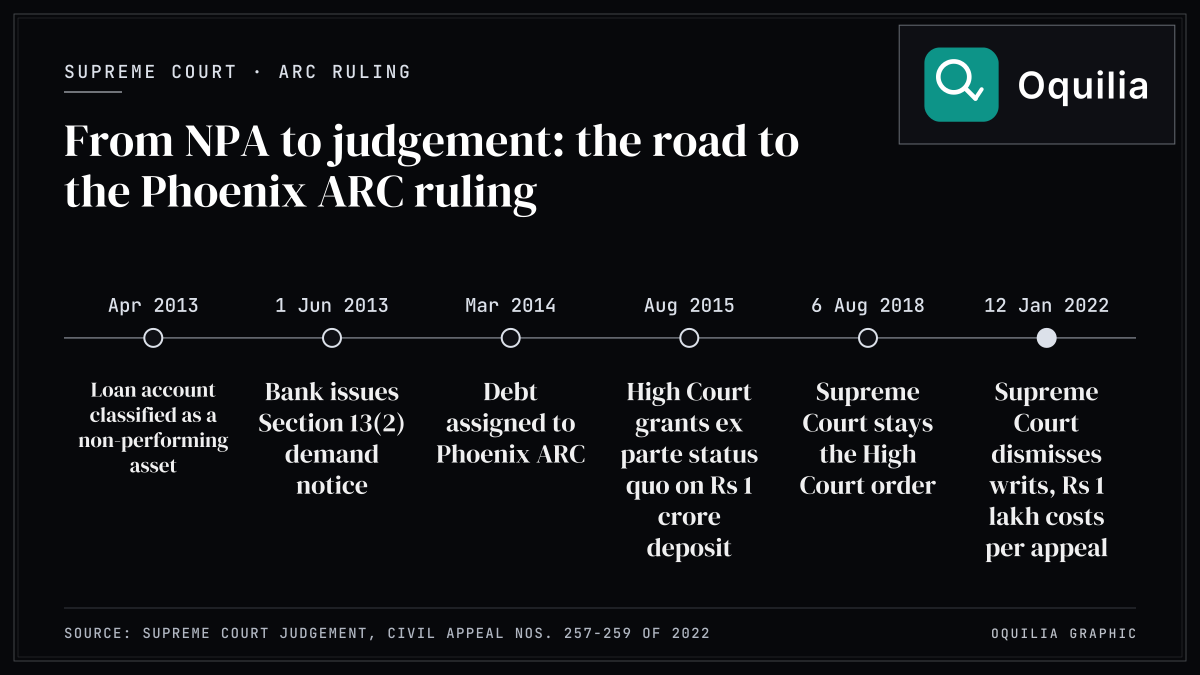
The facts of Phoenix ARC track the typical lifecycle of a SARFAESI enforcement. Here is the sequence as it applied to the education societies in the case, mapped to the statute.
- Borrowing and security (before 2013). The societies borrowed about Rs 105.6 crore and Rs 20 crore from Saraswat Co-operative Bank, secured partly by an equitable mortgage. A mortgage of this kind is the collateral that makes the loan a secured loan and opens the SARFAESI route.
- NPA classification (April 2013). The account was classified as an NPA in April 2013. Classification is the legal trigger for a Section 13(2) notice.
- Section 13(2) demand notice (01.06.2013). The bank issued the 60-day notice. At this stage a borrower may file a representation under Section 13(3A), and the creditor must reply with reasons within 15 days.
- Assignment to an ARC (March 2014). The bank assigned the debt to Phoenix ARC. From this point, the ARC was the secured creditor.
- Restructuring attempt (27.02.2015). The ARC issued a Letter of Acceptance, which in substance offered the borrowers a fresh arrangement. A fresh default followed.
- Possession warning (13.08.2015). The ARC wrote that it would take possession after 15 days. The borrowers argued this letter was a defective Section 13(4) notice that violated Rules 8(1) and 8(2) of the Security Interest (Enforcement) Rules, 2002.
- Writ petitions (2015). Instead of approaching the DRT under Section 17 within 45 days, the borrowers filed W.P. Nos. 35564-35566 of 2015 in the Karnataka High Court.
- Ex parte status quo (26.08.2015). The High Court granted an ex parte status quo on a deposit of Rs 1 crore, then extended it on 28.02.2017 and 27.03.2018 on further Rs 1 crore deposits each, without ever deciding the ARC's application to vacate it.
- Supreme Court stay (06.08.2018). The Supreme Court stayed the High Court's order, and on 12.01.2022 allowed the ARC's appeals.
| Event | Date | Statutory hook |
|---|---|---|
| NPA classification | April 2013 | Precondition for 13(2) |
| Demand notice | 01.06.2013 | Section 13(2), 60 days |
| Assignment to Phoenix ARC | March 2014 | ARC becomes secured creditor |
| Letter of Acceptance | 27.02.2015 | Contractual restructuring |
| Possession letter | 13.08.2015 | Alleged 13(4) notice; Rules 8(1), 8(2) |
| First High Court status quo | 26.08.2015 | Article 226 writ, Rs 1 crore deposit |
| Extensions | 28.02.2017 and 27.03.2018 | Rs 1 crore deposit each |
| Supreme Court stay | 06.08.2018 | Interim relief to ARC |
| Final judgement | 12.01.2022 | Writs dismissed |
The arithmetic is worth noting. Across three orders, the borrowers deposited a total of Rs 3 crore against dues of about Rs 117 crore, roughly 2.6% of the claim, and kept the creditor away from the security for nearly three years, from August 2015 to August 2018. That imbalance is precisely what the Supreme Court objected to in paragraph 13.2.
If you are working out what a settlement or prepayment might cost before the dispute reaches this stage, the Oquilia loan foreclosure calculator shows the interest saved by closing a loan early, and the loan against property calculator helps you model what a mortgaged asset can realistically support.
Borrower Defences Available
Phoenix ARC does not leave a borrower defenceless. It moves the fight to the right forum. The defences below are the ones the statutory scheme supports, and each is tied to a specific provision or to the facts of the 2022 case.
1. Object to the 13(2) notice under Section 13(3A). Within the 60-day window, file a written representation pointing out errors in the amount, the NPA classification or the security described. The creditor must reply with reasons within 15 days. A reasoned reply, or the absence of one, becomes evidence before the DRT later.
2. Challenge Section 13(4) measures before the DRT under Section 17 within 45 days. This is the route the Supreme Court said the Vishwa Bharati societies should have taken. Even if the 13.08.2015 letter was, as they claimed, a Section 13(4) notice, paragraphs 7.3 and 10 of the judgement hold that Section 17 gave them an effective remedy. Grounds typically argued at the DRT include procedural defects under Rules 8(1) and 8(2) of the Security Interest (Enforcement) Rules, 2002, which are the very rules the borrowers invoked in this case.
3. Seek interim relief from the DRT, not the High Court. The DRT can grant a stay on measures under Section 13(4). Per the Section 17 brief, a deposit is not mandatory at this stage, but the Tribunal may direct one. Expect a deposit condition if you want possession or sale halted.
4. Appeal to the DRAT under Section 18 within 30 days. If the DRT rules against you, the appeal lies to the DRAT within 30 days. Budget for the pre-deposit: 50% of the debt due (the lower of the creditor's claim and the DRT's figure), reducible to not less than 25% for reasons recorded in writing. On a debt of Rs 117 crore, that is Rs 58.5 crore at 50% or Rs 29.25 crore at the 25% floor.
5. Contest Section 14 possession applications. Where the creditor goes to the Chief Metropolitan Magistrate or District Magistrate under Section 14, the magistrate is under a 30-day disposal mandate after the 2016 amendment. Any grievance about the resulting possession is again a Section 13(4) measure that goes to the DRT under Section 17.
6. Negotiate before the deadline, not after. The 27.02.2015 Letter of Acceptance shows that ARCs do negotiate. The borrowers' fresh default after that letter cost them the advantage. If a restructuring is on the table, model the repayment on the home loan EMI calculator or the debt consolidation calculator before signing.
| Defence | Forum | Time limit | Deposit |
|---|---|---|---|
| Representation to 13(2) notice | Secured creditor | 60-day notice window; reply in 15 days | None |
| Challenge to 13(4) measures | DRT (Section 17) | 45 days | Not mandatory; DRT may direct |
| Appeal against DRT order | DRAT (Section 18) | 30 days | 50% of debt, reducible to 25% |
| Writ petition against ARC | High Court (Article 226) | Not maintainable per Phoenix ARC (2022) | Not applicable |
What does not work after 12 January 2022 is filing a writ petition against an ARC on the theory that it is a "State" or performs a public duty. The borrowers in the case relied on Praga Tools and Ramesh Ahluwalia to argue that a writ can lie against a private body discharging a public function; the Court held both inapplicable. It also distinguished J. Rajiv Subramaniyan, the case borrowers usually cite for High Court intervention in SARFAESI matters.
Recent Tribunal/HC Position
The core holdings of Phoenix ARC Pvt Ltd v. Vishwa Bharati Vidya Mandir (12 January 2022) fall into three parts, each with a paragraph reference in the judgement.
(a) The alternative-remedy bar (paragraphs 7.3, 10 and 13.2). Following Satyawati Tondon, the Court held that the Karnataka High Court ought not to have entertained the writs at all, because Section 17 of SARFAESI provides an effective remedy, even assuming the 13.08.2015 letter was a Section 13(4) notice. In paragraph 13.2, the Court went further and called the filing of the writs "an abuse of process of the Court".
(b) An ARC is not amenable to writ jurisdiction (paragraphs 11 and 12). This is the holding that sets the 2022 judgement apart. The Court characterised an ARC as a private financial institution acting as a secured creditor under a commercial contract, not performing a public function. Where a borrower is aggrieved by ARC action under SARFAESI, "no writ petition would lie and/or is maintainable and/or entertainable". The point is distinct from the alternative-remedy rule: even a borrower who argues that the DRT remedy is inadequate faces a second barrier, because the respondent itself is outside Article 226 for this purpose.
(c) A warning on ex parte orders (paragraph 13.2). The Court said the High Court "granted an ex-parte ad-interim order mechanically and without assigning any reasons", and that High Courts must be "extremely careful and circumspect" in recovery matters. The record supports the criticism: the first status quo on 26.08.2015 was extended twice, on 28.02.2017 and 27.03.2018, while the ARC's vacating application stayed undecided.
Outcome (paragraph 14). The appeals were allowed, the writ petitions were dismissed, all interim orders were vacated, and the borrowers were ordered to pay costs of Rs 1 lakh in each appeal. With three civil appeals (Nos. 257-259 of 2022), that is Rs 3 lakh in total.
| Holding | Paragraph | Practical effect |
|---|---|---|
| Section 17 is an effective alternative remedy | 7.3, 10 | Go to the DRT within 45 days |
| Writ against an ARC under SARFAESI not maintainable | 11-12 | High Court is the wrong forum |
| Filing writs was an abuse of process | 13.2 | Risk of adverse costs |
| Ex parte orders granted mechanically | 13.2 | Interim relief will be scrutinised |
| Appeals allowed, costs imposed | 14 | Rs 1 lakh per appeal on borrowers |
For borrowers, the combined effect is that the High Court door is effectively closed in two ways when an ARC is the creditor. For lenders and ARCs, the ruling means a stay obtained on a token deposit, here Rs 1 crore at a time against roughly Rs 117 crore in dues, is vulnerable on appeal. Readers should note that the Oquilia Research Desk is a research team, not a law firm, and does not appear before any court; for a live dispute, consult an advocate who practises before the DRT.
FAQ
Can I file a writ petition in the High Court against an asset reconstruction company?
Under Phoenix ARC v. Vishwa Bharati Vidya Mandir (12 January 2022, paragraphs 11-12), a writ petition does not lie against an ARC for action taken under SARFAESI, because an ARC is a private financial institution acting under a commercial contract and is not performing a public function.
Where should I challenge an ARC's possession notice instead?
Before the Debts Recovery Tribunal under Section 17 of SARFAESI, within 45 days of the Section 13(4) measure. The Supreme Court held in paragraphs 7.3 and 10 that this is an effective remedy even where the notice itself is alleged to be defective.
Do I have to deposit money to approach the DRT under Section 17?
The statutory brief states that a deposit is not mandatory under Section 17, but the DRT may direct one, particularly as a condition for a stay. The mandatory pre-deposit applies at the Section 18 appeal stage: 50% of the debt due, reducible to not less than 25%.
How long do I have to appeal a DRT order?
Thirty days for an appeal under Section 18 of SARFAESI against a Section 17 order. For an appeal from a DRT order in a recovery application under the RDDB Act, 1993, Section 20 allows 45 days, with the pre-deposit governed by Section 21.
What happens if I object to the Section 13(2) notice?
Under Section 13(3A), you may file a representation within the 60-day notice period, and the secured creditor must reply with reasons within 15 days. The reply, or its absence, is useful evidence if the matter later reaches the DRT.
Can an ARC use SARFAESI if it bought my loan from a bank?
Yes. In Phoenix ARC, Saraswat Co-operative Bank assigned the debt in March 2014, and the ARC then proceeded as secured creditor on a default that began with NPA classification in April 2013 and a Section 13(2) notice dated 01.06.2013.
What costs did the borrowers face in this case?
Paragraph 14 of the judgement imposed costs of Rs 1 lakh in each of the three appeals, Rs 3 lakh in total, on top of the Rs 3 crore they had deposited across three High Court interim orders between 2015 and 2018.
Sources & Citations
- Phoenix ARC Private Limited v. Vishwa Bharati Vidya Mandir & Ors. — Indian Kanoon
- SARFAESI Act, 2002 and RDDB Act, 1993 — India Code