

The SMS Your Lender Must Send Before a Missed EMI Hits Your Credit Report: RBI's Default and DPD Alert Rule
RBI rules require banks to send an SMS or email alert when reporting a default or days past due to credit bureaus. How the reporting cycle works and how to dispute a wrong entry.
Key points
- The Reserve Bank of India requires lenders to send an SMS or email alert when they report a default or days past due to a credit information company.
- Banks report on the 9th, 16th and 23rd of each month and at month-end, and a correction request must be resolved within 30 days under Section 21(3) of CICRA 2005.
- Borrowers should keep contact details current, treat any alert as the last window to pay or dispute, and claim Rs 100 a day if a correction runs late.
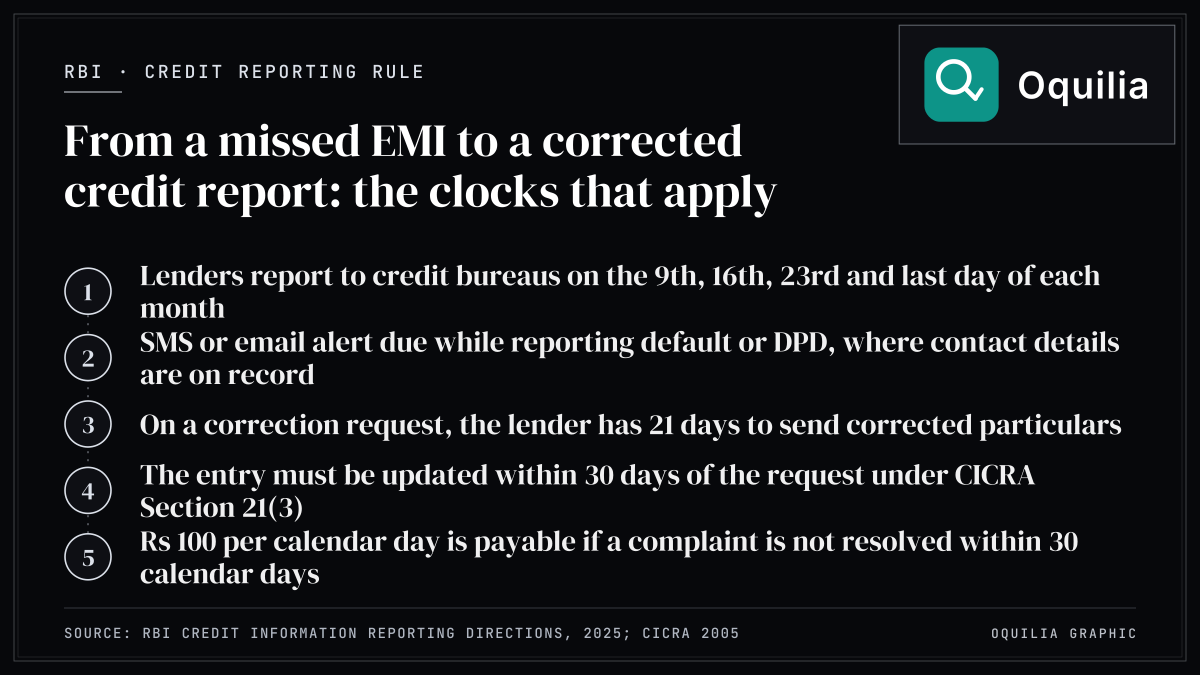
A missed EMI no longer travels silently from your lender's books to your credit report. Since the Reserve Bank of India's circular DoR.FIN.REC.49/20.16.003/2023-24 of 26 October 2023, a lender must send you an SMS or email alert at the point it reports a default or days past due (DPD) on an existing loan to a credit information company (CIC). That rule now sits in paragraph 34(1) of the Reserve Bank of India (Commercial Banks - Credit Information Reporting) Directions, 2025, issued on 28 November 2025 and updated as on 1 July 2026.
This playbook explains what the rule says, how the reporting cycle works, what a borrower can do once an alert lands, and how two High Courts dealt with borrowers whose credit reports stayed wrong after the dues were cleared. It is general information drawn from the RBI text and court orders, not legal advice on any individual case.
The Statutory Position
The alert rule is a direction, not a section of a statute, but it rests on one. The 2025 Directions are issued under Section 11 of the Credit Information Companies (Regulation) Act, 2005 (CICRA), which lets the RBI give directions to credit institutions and CICs in the public interest. The correction right that the alert is meant to protect comes from Section 21(3) of the same Act.
| Provision | What it says | Deadline or number |
|---|---|---|
| CICRA 2005, Section 11 | RBI's power to issue directions to credit institutions and CICs | Basis of the 2025 Directions |
| 2025 Directions, para 34(1)(i) | Lender sends SMS/email alert while reporting default or DPD to CICs | At the time of submission, wherever mobile/email is on record |
| 2025 Directions, para 34(1)(iii) | Lender runs awareness campaigns to collect mobile numbers and email IDs | Ongoing duty |
| 2025 Directions, para 34(2) | Dedicated nodal official at the lender for CIC grievances | Changes notified to CICs within 5 calendar days |
| 2025 Directions, para 34(3) | Lender must give reasons when it rejects a data-correction request | Using the CICs' standard list of reasons |
| 2025 Directions, para 34(4) | Root cause analysis of credit-report grievances | At least half-yearly; top management review at least annually |
| CICRA 2005, Section 21(3) | Borrower may ask the CIC, specified user or lender to update information | Update within 30 days of the request |
| CIC Rules 2006, Rule 20(3)(c) | Lender forwards corrected particulars | Within 21 days of being told of the inaccuracy |
Paragraph 34(1)(i) reads: "A CI shall send alerts through SMS / email to customers while submitting information to CICs regarding default / days past due (DPD) in existing credit facilities, wherever the mobile number/email ID details are available." To make this workable, paragraph 34(1)(ii) records that the Uniform Credit Reporting Format used by lenders to send data to CICs was modified, as set out in Annex V of the Directions.
Two limits are written into that one sentence. First, the trigger is "while submitting information", so the alert is tied to the reporting event, not to the missed payment date itself. Second, the duty applies "wherever the mobile number/email ID details are available", which means a borrower whose contact details are stale may receive nothing. The version quoted here applies, under paragraph 3, to commercial banks other than small finance banks, payment banks and local area banks; borrowers of other lenders should check the Directions that apply to their lender type.
The October 2023 circular also covers the CIC side: CICs send SMS or email alerts when a borrower's Credit Information Report (CIR) is accessed by a specified user and the enquiry reflects in the CIR. Taken together, a borrower can now be told both when a lender reports a default and when someone pulls the report.
The CICRA route connects to enforcement law as well. Under Section 13(2) of the SARFAESI Act, 2002, a secured creditor issues a 60-day notice once an account is classified as a non-performing asset, and under Section 13(3A) the borrower may make a representation that the creditor must answer with reasons within 15 days. A DPD alert is often the earliest written signal that an account is drifting towards that stage. Our SARFAESI glossary entry explains the later steps.
Procedure Step by Step
The alert only makes sense once you see the reporting calendar it is attached to. Paragraph 10 of the 2025 Directions fixes four reference dates every month.
| Reference date | What the lender submits | Submission deadline |
|---|---|---|
| 9th of the month | Incremental accounts only | Within 4 calendar days |
| 16th of the month | Incremental accounts only | Within 4 calendar days |
| 23rd of the month | Incremental accounts only | Within 4 calendar days |
| Last day of the month | Full file of all active accounts and accounts closed since last reference date | By the 5th of the next month |
Under paragraph 10(2)(iii)(d), "incremental accounts" include accounts where interest or an instalment of principal is overdue, and the Explanation adds that accounts "with change only in days past due" from the last reference date must also be reported. In practice, an overdue EMI can reach the CICs within days, and each such submission is the moment the paragraph 34 alert is due.
A practical sequence for a borrower who has missed, or fears missing, an EMI:
- Check the contact details on every loan. Paragraph 34(1)(i) only works "wherever the mobile number/email ID details are available". Update your mobile number and email with each lender before the next reference date (the 9th, 16th, 23rd or month-end).
- Read the alert closely. Note the lender, the account, the date and whether it speaks of default or DPD. Keep a screenshot; it is evidence of when the lender reported.
- Reconcile against your own records. Compare the alert with your bank statement and the EMI schedule. Our personal loan EMI calculator and home loan EMI calculator help rebuild the expected instalment.
- If the dues are genuine, regularise fast. Because reports go out four times a month, paying before the next reference date limits how many cycles show an overdue status.
- If the report is wrong, raise a correction request in writing. Section 21(3) of CICRA gives the lender or CIC 30 days to update after your request; Rule 20(3)(c) of the 2006 Rules gives the lender 21 days to send corrected particulars.
- Ask for reasons if the lender refuses. Paragraph 34(3) obliges the lender to state why a correction was rejected, using the CICs' standard list.
- Pull your CIR after any unexpected enquiry alert. If an enquiry appears that you did not authorise, dispute it with the CIC and the user named.
- Escalate if the 30-day window passes. Paragraph 35(1) entitles complainants to Rs 100 per calendar day when a complaint is not resolved within 30 calendar days, and paragraph 35(10) allows a complaint to the RBI Ombudsman under the Reserve Bank - Integrated Ombudsman Scheme if compensation is wrongly denied.
The compensation framework is a separate topic, but its arithmetic matters here. The RBI's own illustration in paragraph 35 describes a complaint filed with a CIC on 1 January 2022 and resolved on 3 February 2022, three days after the 30-day limit expired on 31 January 2022, producing compensation of Rs 300. Paragraph 35(9) requires that compensation to be credited within 5 working days of resolution.
Borrower Defences Available
A DPD alert is not a recovery notice, and it does not by itself start any proceeding. Its value is that it gives a dated, written trigger from which the borrower's statutory clocks can run. The table below sets out the main grounds a borrower can use.
| Situation | Defence or remedy | Source | Time limit |
|---|---|---|---|
| Alert reports DPD on an EMI that was actually paid | Request correction from lender or CIC | CICRA Section 21(3) | 30 days to update |
| Lender sat on the correction | Compensation for delay | 2025 Directions, para 35(1)-(2) | Rs 100 per day after 30 days; lender's share runs after 21 days |
| Lender rejected the correction | Demand written reasons | 2025 Directions, para 34(3) | With the rejection |
| Charges or debits were wrong and are contested | Insist on "disputed", not "settled" | 2025 Directions, para 12(4) | At the time of reporting |
| Compensation wrongly refused | RBI Ombudsman complaint | 2025 Directions, para 35(10) | After denial |
| No alert received at all | Check whether contact details were on record; raise with the lender's nodal official | 2025 Directions, para 34(1)-(2) | Nodal changes notified within 5 days |
Three points deserve emphasis.
The "settled" label is narrower than many lenders use it. Paragraph 12(4) says a lender shall use "settled" status only where, "due to financial inability to repay as per original terms and conditions", a principal or interest waiver or both is given. It adds that "Cases of wrong debits or contested charges shall not be reported as 'settled' but as 'disputed'." A borrower who pays under protest against a disputed charge has a written basis for refusing a "settled" tag. If a genuine compromise is on the table, paragraph 12(2) requires the lender to report the settlement and its reason, so price the long-term cost with our loan settlement cost calculator before signing.
A pending dispute freezes corrections both ways. The second proviso to Section 21(3) says no correction shall be made "if any dispute relating to such correction, deletion or addition is pending before any arbitrator or tribunal or court", and the lender's books then govern. A borrower in a Debts Recovery Tribunal case should expect the report to follow the bank's ledger until the dispute ends.
CICs correct only on the lender's certification. The first proviso to Section 21(3) allows a CIC to correct an entry only after the change "has been certified as corrected by the concerned credit institution". That is why the lender, not the bureau, is usually the right first target, and why paragraph 34(2) requires each lender to keep a named nodal official for CIC grievances.
On deposits and timelines, there is no pre-deposit for a correction request, unlike an appeal under Section 18 of the RDDB Act, 1993 from a DRT order. The binding clocks are the 21 days for the lender and 30 days overall, both counted from the date of the complaint, and the credit score glossary explains how the report and the score relate.
Recent Tribunal/HC Position
Courts have not ruled on the paragraph 34 alert itself, but two 2024 High Court orders show how Section 21(3) works when a borrower's report stays wrong after the money is paid.
Rashmita Mishra v. UCO Bank, Orissa High Court, W.P.(C) No. 33512 of 2023, order dated 3 July 2024. The borrower told the Court she had paid the entire dues "in the spirit of the judgment dated 29.09.2020" of the Debts Recovery Tribunal, Cuttack in O.A. No. 644 of 2016, and that her account had been regularised, yet her CIBIL score was shown as 668 and was blocking further credit. The bank said it had already sent an update. Dr Justice S.K. Panigrahi, after extracting Section 21(3), directed TransUnion CIBIL Limited to delete the negative credit history "as per the provision under Section 21(3)" within 15 working days of presentation of an authenticated copy of the order. The full order is on Indian Kanoon.
Subir Kumar Dutta v. Reserve Bank of India, Calcutta High Court, WPA No. 14541 of 2023, order dated 15 July 2024. The borrower sought correction of his CIBIL score, relying on a commercial credit information report from Union Bank. The bureau argued that it does not create the score on its own, that the score is built from reports sent by banks, and that those banks had not been made parties. Justice Shampa Sarkar held that the writ court could not order a correction only on the documents filed, noting that a CIC can correct information if the change is certified by the concerned credit institution. The Court directed the bureau to supply the information received from all the petitioner's creditors within one month. The order is on Indian Kanoon.
| Case | Court and date | Outcome | Lesson for borrowers |
|---|---|---|---|
| Rashmita Mishra v. UCO Bank | Orissa HC, 3 July 2024 | CIBIL told to delete negative history within 15 working days | Proof of full payment plus lender's update supports a Section 21(3) direction |
| Subir Kumar Dutta v. RBI | Calcutta HC, 15 July 2024 | No correction ordered; bureau to disclose lender data within 1 month | Join the reporting lenders; the bureau acts on their certification |
Read together, the two orders point the same way as paragraph 34: the lender's report is the root of the entry, so the dated alert, the lender's nodal official and the lender's certification are the levers that move a correction. Earlier coverage of related bank-borrower disputes is in our reports on the Rajasthan High Court's Bandhan Bank freeze ruling and the Madras High Court's stayed-auction ruling.
FAQ
When exactly must my lender send the default or DPD alert?
Under paragraph 34(1)(i) of the RBI's 2025 Credit Information Reporting Directions, the alert is sent "while submitting information to CICs" about default or days past due. Lenders submit on four reference dates each month (the 9th, 16th and 23rd, plus the month-end full file due by the 5th of the next month), so the alert is tied to those submissions.
What if I never received an alert?
The duty applies "wherever the mobile number/email ID details are available". First check whether your lender holds your current contact details. If it did and no alert came, raise it with the lender's nodal official for CIC grievances under paragraph 34(2), and keep the complaint in writing.
Does the alert rule apply to all lenders?
The 2025 Directions quoted here apply to commercial banks other than small finance banks, payment banks and local area banks, under paragraph 3. The underlying requirement was first issued in the RBI circular of 26 October 2023 to credit institutions; check the Directions applicable to your own lender type.
How long does a lender have to fix a wrong entry?
Section 21(3) of CICRA 2005 gives 30 days from the request. Within that, Rule 20(3)(c) of the CIC Rules 2006 gives the lender 21 days to send corrected particulars, leaving the CIC the remaining 9 days, as explained in paragraph 35(1) of the 2025 Directions.
Am I owed money if the correction is late?
Yes, under paragraph 35(1) a complainant is entitled to Rs 100 per calendar day once a complaint is not resolved within 30 calendar days of filing. The amount is to be credited within 5 working days of resolution, and wrongful denial can be taken to the RBI Ombudsman.
Can my lender mark a disputed charge as "settled"?
No. Paragraph 12(4) of the 2025 Directions says wrong debits or contested charges "shall not be reported as 'settled' but as 'disputed'". "Settled" is reserved for cases where a principal or interest waiver was given because of the borrower's financial inability to repay.
Will a court order the bureau to correct my report directly?
It depends on the record. In Rashmita Mishra v. UCO Bank (Orissa High Court, 3 July 2024) the Court directed deletion of negative history within 15 working days after full payment. In Subir Kumar Dutta v. RBI (Calcutta High Court, 15 July 2024) the Court declined because the reporting banks were not parties, and ordered disclosure of their data within one month instead.
Source: Reserve Bank of India (Commercial Banks - Credit Information Reporting) Directions, 2025, updated as on 1 July 2026.
Sources & Citations
- Reserve Bank of India (Commercial Banks - Credit Information Reporting) Directions, 2025 (updated as on July 01, 2026) — Reserve Bank of India
- Rashmita Mishra vs UCO Bank, Orissa High Court, 3 July 2024 — Indian Kanoon
- Subir Kumar Dutta vs The Reserve Bank of India, Calcutta High Court, 15 July 2024 — Indian Kanoon