

Notification 141/2026: no TDS on dividends between IFSC aircraft-leasing units, via Form 1(N)
CBDT Notification 141/2026 removes TDS under section 393(1) on dividends between IFSC aircraft-leasing units from 1 April 2026, if the payee first gives the payer a Form 1(N).
Key points
- CBDT Notification 141/2026, issued on 4 November 2026, bars TDS under section 393(1) of the Income-tax Act, 2025 on dividends between IFSC aircraft-leasing units.
- The relief is deemed in force from 1 April 2026 and applies only to payments made after the payer receives the payee's Form No. 1(N) for that tax year.
- Payers must still report every such dividend in the TDS statement under section 397(3)(b) and rule 219, and payees must file a fresh Form 1(N) each tax year.
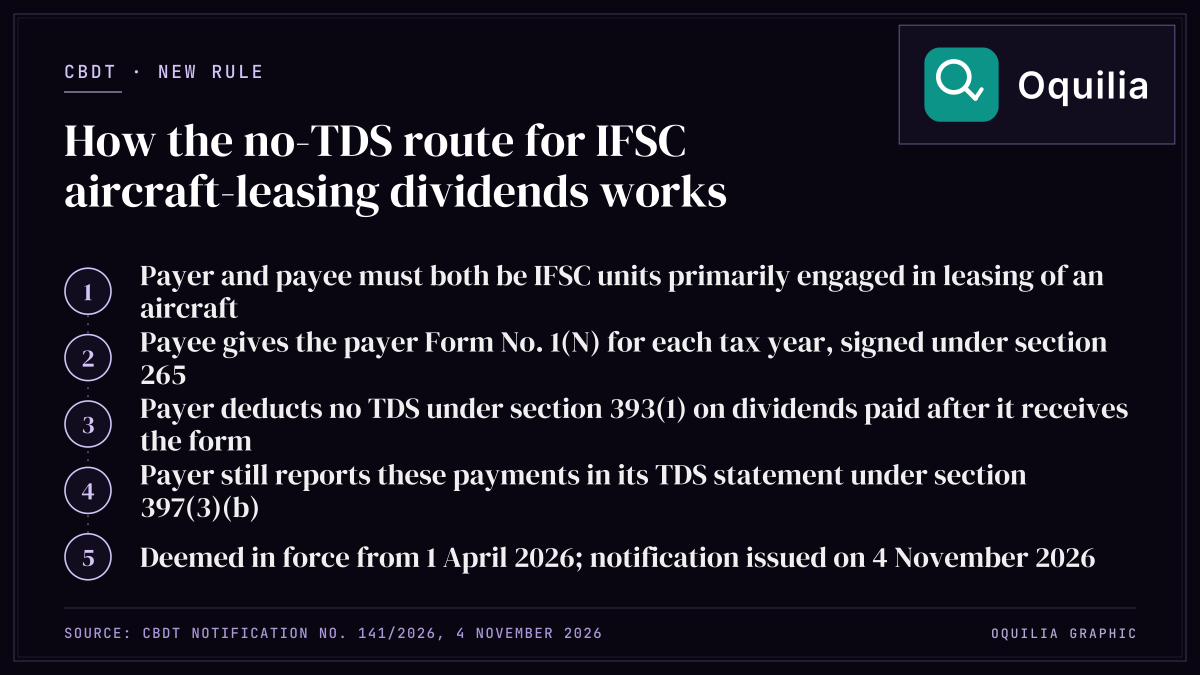
The Central Board of Direct Taxes (CBDT) has switched off tax deduction at source on one narrow but high-value stream of income: dividends that one aircraft-leasing unit in an International Financial Services Centre (IFSC) pays to another. Notification No. 141/2026, published as S.O. 6016(E) on 4 November 2026, is deemed to have come into force on 1 April 2026. The relief works only through a new statement-cum-declaration, Form No. 1(N), which the receiving unit must hand to the paying unit for each tax year.
This explainer walks through what the notification says, how the paperwork works, a worked cash-flow example and the mistakes that could put a leasing group back into a TDS default.
What the Section Says
The notification is issued under section 400(1) of the Income-tax Act, 2025 (30 of 2025), read with Schedule VI [Table: S.No. 11]. It specifies that no tax shall be deducted under section 393(1) [Table: S.No. 7] of the 2025 Act from dividend income, provided both sides of the payment meet the conditions below.
| Element | What Notification 141/2026 requires |
|---|---|
| Payer | Any unit of an IFSC primarily engaged in the business of leasing of an aircraft |
| Payee | A company that is a Unit of an IFSC primarily engaged in the business of leasing of an aircraft |
| Income covered | Income in the nature of dividend |
| TDS provision switched off | Section 393(1) [Table: S.No. 7], Income-tax Act, 2025 |
| Exemption it links to | Schedule VI [Table: S.No. 11], Income-tax Act, 2025 |
| Document | Form No. 1(N), statement-cum-declaration, one per tax year |
| Effective date | Deemed in force from 1 April 2026 |
| Issued | 4 November 2026, F. No. 275/17/2026-IT(B) |
The notification sets out duties for each party in paragraph 1. Under paragraph 1(1), the payee must furnish Form No. 1(N) to the payer, giving the tax year in which the dividend eligible for exemption under Schedule VI [Table: S.No. 11] is payable, and must furnish and verify it in the manner the Form specifies for that tax year.
Under paragraph 1(2), the payer must not deduct tax on any dividend paid or credited to the payee after the date it receives a copy of Form No. 1(N). The payer must also report all such payments, on which no tax was deducted because of this notification, in its statement of deduction of tax under section 397(3)(b) of the 2025 Act, read with rule 219 of the Income-tax Rules, 2026.
Paragraph 2 hands the plumbing to the Principal Director General of Income-tax (Systems) or the Director General of Income-tax (Systems), who will lay down procedures, formats and standards for secure capture and transmission of data, and for archival and retrieval.
The Explanation fixes three definitions:
- "Aircraft" takes the meaning in Note 3 of Schedule VI to the Income-tax Act, 2025.
- "International Financial Services Centre" takes the meaning in clause (q) of section 2 of the Special Economic Zones Act, 2005 (28 of 2005), available on India Code.
- "Unit" takes the meaning in clause (zc) of section 2 of the same 2005 Act.
The explanatory memorandum certifies that no person is adversely affected by giving the notification retrospective effect from 1 April 2026. That matters: the relief reaches back roughly 7 months before the 4 November 2026 issue date, but only in the taxpayer's favour.
What Form No. 1(N) asks for
Form No. 1(N) is short. Part A has 7 fields, followed by a declaration and a verification.
| Part A field | Detail required |
|---|---|
| 1. Name | Full name of the payee (Note 1) |
| 2. PAN | Permanent Account Number of the payee |
| 3. Name of the unit located in IFSC | Full name (Note 1) |
| 4. Address of the unit located in IFSC | 8 components under Note 2: country/region, flat/door/building, road/street/block/sector, PIN/ZIP, post office, area/locality, district, state |
| 5. Contact number | Country code and number |
| 6. Email ID | Contact email |
| 7. Tax year | In YYYY-YY format |
The declarant then states 2 things: that the unit is engaged in the business of leasing of aircraft and its dividend income is eligible for exemption under Schedule VI [Table: S.No. 11], and that the unit continues to be a unit working in an IFSC and continues in aircraft leasing during the tax year in which the declaration is submitted. The form must be signed by a person competent to sign the return of income under section 265 of the Income-tax Act, 2025. Note 3 says some fields will be pre-filled "to the extent possible", which suggests an online filing route once the Systems directorate publishes its procedure.
Worked Example
The arithmetic below is illustrative. It uses the 10% rate that applied to resident dividends under section 194 of the Income-tax Act, 1961, purely to show the cash-flow effect; deductors should confirm the rate in the section 393(1) table of the 2025 Act before relying on any figure. You can run your own numbers in the TDS calculator.
Assume AeroLease IFSC A (payer) declares a dividend of Rs 40 crore to its parent, AeroLease IFSC B (payee), another IFSC aircraft-leasing unit. There are 3 possible timelines in tax year 2026-27.
| Scenario | Form 1(N) received | Dividend paid | TDS deducted (illustrative 10%) | Cash reaching payee on payment date |
|---|---|---|---|---|
| A: Form first | 10 June 2026 | 15 July 2026 | Rs 0 | Rs 40 crore |
| B: No Form | Never | 15 July 2026 | Rs 4 crore | Rs 36 crore |
| C: Form late | 20 August 2026 | Rs 20 crore on 15 July, Rs 20 crore on 15 September 2026 | Rs 2 crore on the July tranche only | Rs 18 crore in July, Rs 20 crore in September |
Scenario A is the intended route: because the declaration reached the payer before payment, the full Rs 40 crore moves with no withholding, and the payer still discloses the payment in its quarterly TDS statement under section 397(3)(b).
Scenario B shows the cost of skipping the form. Rs 4 crore sits with the government until the payee claims it back through its return of income for tax year 2026-27, which means the money could be locked up for well over 12 months once return filing and processing are counted.
Scenario C is the trap. Paragraph 1(2)(a) switches off deduction only for payments made or credited after the date the payer receives the form. The Rs 20 crore tranche paid on 15 July 2026, before the 20 August 2026 receipt date, falls outside the protection on the text of the notification, so the payer should have deducted on it. Only the September tranche is covered.
What about dividends paid between 1 April 2026 and 4 November 2026, before the notification even existed? The deemed commencement date of 1 April 2026 opens the window, but the operative condition still turns on the date of receipt of Form No. 1(N). Groups in this position should take advice on how the retrospective effect and the receipt-date condition interact, and keep the declaration date on file. Any amount already deducted and deposited will appear in the payee's Form 26AS and is claimed in the return.
Common Mistakes
1. Treating the notification as a blanket IFSC exemption. The relief applies only when the payer is an IFSC unit "primarily engaged in the business of leasing of an aircraft" and the payee is a company that is such a unit. A dividend from an IFSC aircraft lessor to a mainland Indian parent, a fund-management unit or an individual shareholder is outside Notification 141/2026, and section 393(1) applies as usual.
2. Paying before the form arrives. As Scenario C shows, paragraph 1(2)(a) ties relief to payments "after the date of receipt of copy" of Form No. 1(N). Board resolutions that declare and pay on the same day should collect the declaration in advance.
3. Reusing last year's declaration. The form is tied to a single tax year in YYYY-YY format, and the declarant certifies the unit "continues" to qualify during that year. A Form 1(N) for 2026-27 does not cover 2027-28.
4. Leaving the payments out of the TDS statement. Nil deduction does not mean nil reporting. Paragraph 1(2)(b) requires the payer to furnish particulars of all such payments in the statement under section 397(3)(b) read with rule 219 of the Income-tax Rules, 2026. Omitting them is a reporting gap that invites a mismatch notice on the e-filing portal.
5. Wrong signatory. The form must be signed by a person competent to sign the return of income under section 265 of the Income-tax Act, 2025. A treasury manager without that authority signing on behalf of the payee company can invalidate the declaration.
6. Ignoring the exemption side. Form 1(N) only removes withholding. The payee's claim that the dividend is exempt still rests on Schedule VI [Table: S.No. 11] and must hold up in its own return; see our tax exemption primer and the income tax calculator for the broader picture.
| Checklist item | Who | When |
|---|---|---|
| Confirm both units are IFSC aircraft-leasing units | Payer and payee | Before declaring dividend |
| Sign Form No. 1(N) for the tax year | Payee, via section 265 signatory | Before the payment date |
| Record date of receipt of Form 1(N) | Payer | On receipt |
| Pay with nil TDS | Payer | Only after receipt |
| Report payment in TDS statement under section 397(3)(b) and rule 219 | Payer | Quarterly statement for that period |
| Claim exemption under Schedule VI [S.No. 11] | Payee | Return for the tax year |
For a related deductor-side process, see our explainer on Form 121 nil-tax declarations and the 26-character UIN.
FAQ
What does CBDT Notification 141/2026 do?
Issued on 4 November 2026 under section 400(1) of the Income-tax Act, 2025, it provides that no tax is deducted under section 393(1) [Table: S.No. 7] on dividends paid by an IFSC aircraft-leasing unit to a company that is also an IFSC aircraft-leasing unit, once the payee furnishes Form No. 1(N).
From when does the relief apply?
The notification is deemed to have come into force on 1 April 2026, the start of tax year 2026-27. The explanatory memorandum certifies that the retrospective effect adversely affects no one.
Who files Form No. 1(N), and to whom?
The payee, the receiving IFSC aircraft-leasing company, furnishes it to the payer. It is signed by a person competent to sign the return under section 265 of the Income-tax Act, 2025.
Is Form 1(N) filed once or every year?
It is filed for each tax year. Field 7 asks for the tax year in YYYY-YY format, and the declaration certifies continued IFSC and aircraft-leasing status during that year.
Does the payer still have to report the dividend?
Yes. The payer must include all such payments, on which no tax was deducted because of the notification, in its TDS statement under section 397(3)(b) read with rule 219 of the Income-tax Rules, 2026.
What if the dividend is paid before the payer receives the form?
Paragraph 1(2)(a) bars deduction only on payments made or credited after the date of receipt of Form No. 1(N). On the notification's text, a payment made earlier is not covered, and any tax deducted on it is claimed back by the payee in its return.
How are "aircraft", "IFSC" and "Unit" defined?
"Aircraft" follows Note 3 of Schedule VI to the Income-tax Act, 2025. "IFSC" follows section 2(q) and "Unit" follows section 2(zc) of the Special Economic Zones Act, 2005.
Sources & Citations
- Notification No. 141/2026 (S.O. 6016(E)) dated 4 November 2026 — Income Tax Department
- Special Economic Zones Act, 2005 — India Code
- Income Tax e-filing portal — Income Tax Department