

Foreign Assets of Small Taxpayers Disclosure Scheme 2026: how assets are valued and the 20% variance safe zone
FAST-DS 2026 values every foreign asset as on 31 March 2026 and protects declarations if the tax department's value differs by up to 20%. Rule-by-rule guide with worked examples.
Key points
- CBDT notified the Foreign Assets of Small Taxpayers - Disclosure Scheme Rules, 2026 on 14 August 2026, with declarations due by 31 December 2026.
- Assets are valued at the higher of cost and market value on 31 March 2026, with a Rs 1 crore ceiling under Sl. No. 1 and Rs 5 crore under Sl. No. 2.
- A declaration is not void merely because an asset's value, other than a bank account, differs from the officer's figure by up to 20% of the declared value.
The Central Board of Direct Taxes notified the Foreign Assets of Small Taxpayers - Disclosure Scheme Rules, 2026 (FAST-DS) on 14 August 2026 through G.S.R. 732(E), published in Gazette of India Extraordinary No. 668. The rules, made under section 143 of the Finance Act, 2026, came into force on 16 August 2026 and give residents who left foreign assets or income out of their returns until 31 December 2026 to come clean. Every asset is valued as on a single date, 31 March 2026, and Rule 5(2) offers a 20% cushion if the tax department later values an asset differently.
This guide covers the FAST-DS 2026 valuation rules asset by asset, using the government's own illustrations. All figures come from the 2026 rules on the Income Tax Department's portal.
What the Section Says
Chapter IV of the Finance Act, 2026 sets up the scheme, and the 2026 rules fill in the mechanics. Rule 2(1)(e) fixes the valuation date as 31 March 2026, Rule 2(4) fixes the last date as 31 December 2026, and Rule 2(3) names the Principal Director General of Income-tax (Systems) or the Director General of Income-tax (Systems) as the income-tax authority that receives declarations.
Two doors, two ceilings
Section 133 of the Act has a Table with two serial numbers, and Rule 5(1) caps each one. The ceilings are aggregate figures across everything declared under that serial number, not per-asset limits.
| Table in section 133 | What it covers | Aggregate ceiling (Rule 5(1)) | Amount payable (Rule 4 illustrations) |
|---|---|---|---|
| Sl. No. 1 | Undisclosed asset located outside India and undisclosed foreign income | Rs 1 crore | Tax at 30% plus penalty equal to 100% of the tax, i.e. 60% of value |
| Sl. No. 2 | Foreign asset bought from income earned while non-resident, or from income already taxed in India, but left out of the return schedule | Rs 5 crore | Fee of Rs 1 lakh |
Form 1, Part D computes the Sl. No. 1 liability "@ 60%" of the combined value and asks for "Nil or Rs 1 lakh" as the Sl. No. 2 fee.
How each asset is valued (Rule 3)
Rule 3(1) gives a separate method for each asset class. The common thread is "higher of cost and market value on 31 March 2026", with indexed cost of acquisition under section 48 of the Income-tax Act, 1961 deemed to be fair market value (FMV) when no valuation report is obtained.
| Asset class | Rule | Fair market value | If no valuation done |
|---|---|---|---|
| Bullion, jewellery, precious stones | 3(1)(a) | Higher of cost and open-market price on 31 March 2026, per a valuer recognised by a foreign government or its agency | Indexed cost |
| Archaeological collections, paintings, sculptures, artworks | 3(1)(b) | Higher of cost and open-market price, same valuer requirement | Indexed cost |
| Quoted shares and securities | 3(1)(c)(i) | Higher of cost and average of lowest and highest price on 31 March 2026 (or last traded date before it) | Not applicable |
| Unquoted equity shares | 3(1)(c)(ii) | Higher of cost and book-value formula (A + B - L) x (PV / PE) | Indexed cost |
| Immovable property | 3(1)(d) | Higher of cost and open-market price, valuer recognised in the country where the property sits | Indexed cost |
| Bank account | 3(1)(e) | Sum of all deposits since opening, ignoring re-deposits of withdrawals | Not applicable |
| Interest in firm, AOP or LLP | 3(1)(f) | Share of net assets (A + B - L) allocated by capital, then by deed or profit ratio | Not applicable |
| Any other asset | 3(1)(g) | Higher of cost or amount invested and arm's-length open-market price | Indexed cost |
Explanation 1 to Rule 3 treats a share as quoted only if its exchange traded over USD 1 billion of shares in each of the 3 calendar years before the valuation date and the class traded on at least 60 business days in the prior year.
The 20% safe zone
Rule 5(2) is the protection most declarants will lean on. If the FMV of any asset other than a bank account declared in Form 1 differs from the value the Assessing Officer or another income-tax authority arrives at, the declaration is not treated as void for misrepresentation, suppression of facts or false particulars "only on account of such variance", as long as the variance does not exceed 20% of the FMV declared.
Worked Example
Take a resident who, as on 31 March 2026, holds an undisclosed foreign bank account valued at Rs 60 lakh and earned Rs 20 lakh of undisclosed foreign income in earlier years. These are the figures of Illustration 1 under Rule 4.
| Step | Calculation | Amount |
|---|---|---|
| Aggregate value under Sl. No. 1 | Rs 60 lakh + Rs 20 lakh | Rs 80 lakh (within Rs 1 crore) |
| Tax on asset | 30% of Rs 60 lakh | Rs 18 lakh |
| Tax on income | 30% of Rs 20 lakh | Rs 6 lakh |
| Penalty | 100% of Rs 24 lakh | Rs 24 lakh |
| Total payable | Rs 24 lakh + Rs 24 lakh | Rs 48 lakh |
The Rule 7 illustration then shows the payment clock on Rs 48 lakh. If the Form 2 order is passed on 22 September 2026, the month ends on 30 September 2026 and payment without interest is due by 30 November 2026. A payment on 17 December 2026 is 1 month late and carries interest of Rs 48,000 (1%), for a total of Rs 48,48,000. A 2-month delay carries Rs 96,000 (2%). The additional period runs only up to 31 January 2027, 4 months from the end of the order month; paying on 5 February 2027 forfeits the scheme entirely.
Reinvested money is not counted twice
Rule 3(3) stops double counting when one asset funds another. In the rules' Illustration 1, a foreign house (H1) bought in 2014 for Rs 20 lakh was sold in 2017 for Rs 25 lakh, the proceeds went into a bank account (BA), and Rs 30 lakh was withdrawn in 2018 to buy a second house (H2) worth Rs 50 lakh on 31 March 2026. With BA valued at Rs 70 lakh, the FMVs are: H1 nil (Rs 25 lakh less Rs 25 lakh invested), BA Rs 40 lakh (Rs 70 lakh less Rs 30 lakh) and H2 Rs 50 lakh.
In Illustration 2, Rs 70 lakh of undisclosed foreign income earned in 2022 funded a Rs 60 lakh property in 2023, now worth Rs 80 lakh. The income counts at Rs 10 lakh (Rs 70 lakh less Rs 60 lakh) and the property at Rs 80 lakh, a total of Rs 90 lakh, which still fits under the Rs 1 crore ceiling.
Applying the 20% buffer
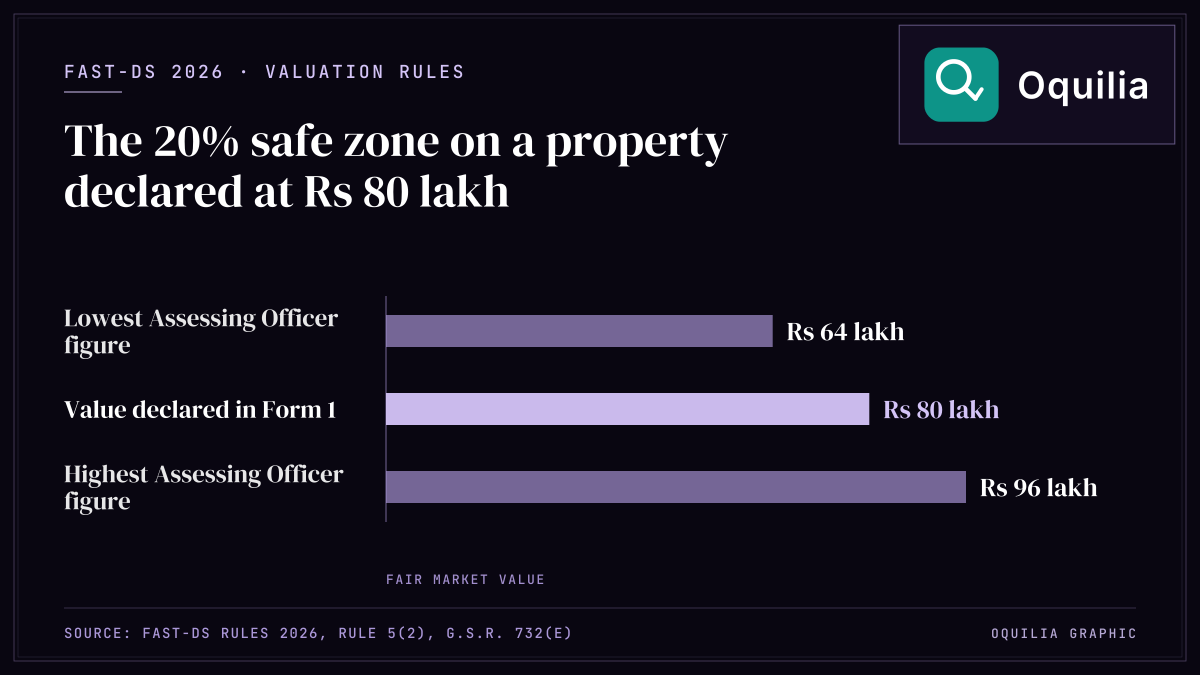
Suppose that same Rs 80 lakh property was declared at Rs 80 lakh on the strength of a recognised valuer's report. 20% of Rs 80 lakh is Rs 16 lakh, so an Assessing Officer's figure anywhere from Rs 64 lakh to Rs 96 lakh does not, by itself, void the declaration. A figure of Rs 1 crore is a Rs 20 lakh variance, 25% of the declared value, and the Rule 5(2) shield no longer applies.
Common Mistakes
1. Treating the ceilings as per-asset limits. Rule 4 Illustration 3 is blunt: foreign mutual fund units worth Rs 2.5 crore and New York-listed shares worth Rs 4 crore total Rs 6.5 crore, above the Rs 5 crore Sl. No. 2 ceiling, so the person "is not eligible to declare under this scheme" at all. The Rule 5 tables repeat the point: Rs 90 lakh of property plus Rs 30 lakh of income is Rs 1.20 crore and ineligible, while Rs 55 lakh plus Rs 25 lakh is Rs 80 lakh and eligible.
2. Netting withdrawals out of a bank account. Rule 3(1)(e) values an account at the sum of deposits since opening, not the closing balance. In the rules' example, deposits of USD 1,000 (2010), USD 500 (2011), USD 500 (2012), USD 500 (2013), USD 2,500 (2019) and USD 1,000 (2021) are reduced only for re-deposits of earlier withdrawals, giving a value of USD 4,900 converted at the 31 March 2026 rate. If the account was already declared under Chapter VI of the Black Money Act, 2015, only deposits after that declaration count, USD 3,100 in the example.
3. Getting a domestic valuer's report for a foreign asset. Rules 3(1)(a), (b), (c)(iii) and (d) all require a valuer recognised by the government of the country or territory outside India, or one of its agencies. A report that misses this test risks the FMV defaulting to indexed cost, which our capital gains calculator can help you estimate.
4. Using the wrong conversion date. Rule 3(4) converts values at the RBI reference rate on 31 March 2026, not the filing date; under Rule 3(5), other currencies go through US dollars first at the local central bank's rate on that date.
5. Ignoring residential status in the year of acquisition. Form 1 asks for residential status (resident, non-resident or RNOR) in the year each asset was acquired, and passport details where non-residence is claimed. Sl. No. 2 relief rests on that answer, so check your residential status for each year before choosing a door.
6. Paying after the additional period. As the Rule 7 illustration shows, the window closes 4 months after the end of the order month; paying later means the benefit of the scheme is not available.
FAQ
What is the valuation date under FAST-DS 2026?
Rule 2(1)(e) fixes it as 31 March 2026. Every asset is valued, and every foreign currency converted, as on that date, even though declarations can be filed up to 31 December 2026.
Does the 20% variance protection cover foreign bank accounts?
No. Rule 5(2) applies to "any asset (other than a bank account)". Bank accounts are valued by adding deposits under Rule 3(1)(e), so there is no estimate to vary.
What if I do not get a valuation report?
For jewellery, artworks, unquoted shares, immovable property and other assets, the provisos to Rule 3(1) deem indexed cost of acquisition, as defined in section 48 of the Income-tax Act, 1961, to be the FMV. Note 5 to Form 1 says the same.
How much do I pay under each serial number?
Under Sl. No. 1, the Rule 4 illustration charges tax at 30% plus a penalty equal to 100% of that tax, so Rs 80 lakh of assets and income costs Rs 48 lakh. Under Sl. No. 2, the fee is Rs 1 lakh; the rules' example is a Rs 3 crore foreign plot bought in 2015 while non-resident.
Which forms are involved?
Four: Form 1 is the declaration (Rule 5), Form 2 is the authority's order (Rule 6), Form 3 is the intimation of payment (Rule 7) and Form 4 is the order certifying validity, due within 1 month from the end of the month in which Form 3 is submitted (Rule 8).
Does FAST-DS change how I compute regular tax this year?
No. The scheme only covers past undisclosed foreign assets and income. For FY 2026-27 liability, use our income tax calculator, and for overseas remittances read our explainer on the Liberalised Remittance Scheme and FEMA.
This article explains notified rules and is not tax advice. Consult a chartered accountant before filing Form 1.
Sources & Citations
- Notification G.S.R. 732(E): Foreign Assets of Small Taxpayers - Disclosure Scheme Rules, 2026 — Income Tax Department (CBDT)
- Reference Rate Archive — Reserve Bank of India