

Buying property from an NRI? From 1 Oct 2026 individual buyers can report TDS in Form 141 Schedule E
CBDT's Fifth Amendment Rules let resident individuals and HUFs buying property from a non-resident report section 393(2) TDS in new Schedule E of Form 141 from 1 October 2026.
Key points
- CBDT notified the Income-tax (Fifth Amendment) Rules, 2026 on 22 September 2026, adding Schedule E to Form No. 141.
- From 1 October 2026, resident individuals and HUFs deducting TDS under section 393(2) on property bought from a non-resident use Schedule E.
- Each joint buyer files a separate form, and the seller's foreign address, email and contact number are mandatory even if a PAN is available.
From 1 October 2026, a resident individual or Hindu undivided family (HUF) that buys a flat, house or plot from a non-resident can report the tax deducted on the price in Form No. 141, the challan-cum-statement, using a new Schedule E. The change comes from the Income-tax (Fifth Amendment) Rules, 2026, notified by the Central Board of Direct Taxes (CBDT) as G.S.R. 830(E) on 22 September 2026 (Notification No. 121/2026).
Until now, Form No. 141 covered deductions under section 393(1) of the Income-tax Act, 2025, including the 1% deduction a buyer makes when the seller is a resident. The amendment adds section 393(2), Table Sl. No. 17, the provision for consideration paid to a non-resident for the transfer of immovable property.
What the Section Says
Section 393 of the Income-tax Act, 2025 sets out tax deduction at source (TDS) in tables. Section 393(1) covers payments to residents; section 393(2) covers sums paid to non-residents and took over the ground of section 195 of the Income-tax Act, 1961. Table Sl. No. 17 of section 393(2) is the entry for consideration on the transfer of immovable property. The Fifth Amendment Rules, made under section 533 read with sections 395(4)(a) and 397(3)(a) and (b), make four changes to the Income-tax Rules, 2026.
| Provision amended | What the notification does | In force |
|---|---|---|
| Rule 215(1), Table, Sl. No. 3 | Adds "deduction under section 393(2) [Table: Sl. No. 17]" where a resident individual or HUF deducts tax on consideration for transfer of any immovable property | 1 October 2026 |
| Rule 218(3) | Opening words now read "section 393(1) and (2)"; new clause (e) for property consideration paid or credited by a resident individual or HUF | 1 October 2026 |
| Rule 219(5) | New clause (e) for section 393(2) [Table Sl. No. 17] deductions by a resident individual or HUF | 1 October 2026 |
| Form No. 141 and Form No. 132 | New option "Transfer of any immovable property by a non-resident to a resident individual or Hindu undivided family"; new Schedule E in Form No. 141 | 1 October 2026 |
Rule 218(3) is the rule under which tax deducted by an individual buyer on a resident seller's property is paid with Form No. 141 within 30 days from the end of the month of deduction, as recorded in Oquilia's TDS calculator rules. The amendment brings section 393(2) property deductions by individuals and HUFs into the same rule. The notification does not amend section 397(1), which governs the tax deduction account number (TAN); a buyer should confirm the TAN position for a non-resident seller on the e-filing portal before paying, rather than assume the resident-seller exemption carries across.
Form No. 132, the TDS certificate, gets the same new transaction option, so the seller receives a certificate that matches the Form No. 141 filing. Schedule E itself asks for 7 groups of particulars:
| Schedule E item | What the buyer must enter |
|---|---|
| 1(i)-(ii) | Address of the property and its type: land (other than agricultural land), building or part of a building, or both |
| 1(iii) | PAN, name and share (%) of every buyer; shares must total 100% |
| 1(iv) | For every seller: PAN if available, name, status code, contact number, email, address abroad, tax residency certificate (TRC) number, tax identification number (TIN) and share (%) |
| 2-5 | Date of agreement, date of registration (if available), total stamp duty value, total sale consideration |
| 6 | Lump sum or instalments; for a subsequent or last instalment, the previous acknowledgement number |
| 7(iii)-(iv) | Whether the seller opts out of the section 202(1) regime, and whether the gain is long-term (section 197(1)) or short-term (excluding section 196) |
| 7(v) | Amount paid, amount liable to deduction, rate, any certificate number under section 395(1) or 395(2), tax deducted and date of deduction |
Note 10 to the Schedule says the tax deducted "shall include surcharge, if applicable, and cess". Note 11 says that where there is more than one deductor, "each deductor has to file separate form". Note 6(a) makes the seller's contact number, email and foreign address mandatory whether or not the non-resident has a PAN.
Worked Example
Two spouses, both resident, buy a flat from a non-resident seller on an agreement dated 5 November 2026. The total sale consideration is Rs 1,20,00,000 and the stamp duty value is Rs 1,10,00,000. Spouse A pays 60% and Spouse B pays 40%. The price is paid in 2 instalments: Rs 30,00,000 on 10 November 2026 and Rs 90,00,000 on registration on 15 December 2026. The seller tells the buyers the gain is long-term.
Step 1: the rate. Long-term capital gain on property is taxed at 12.5% without indexation for property bought on or after 23 July 2024, per the Budget 2024 rates in Oquilia's rate configuration. Health and education cess is 4% of tax plus surcharge. Before any surcharge, the effective rate is 12.5% x 1.04 = 13.0%.
Step 2: the amount. The example assumes the seller has not obtained a certificate under section 395(1) and the buyers have not sought one under section 395(2), and that the whole payment is the amount on which tax is to be deducted. Schedule E has a separate row for each certificate number; where one exists, the amount and rate in that certificate go into item 7(v) instead.
Step 3: each buyer's deduction. Each spouse deducts only on their own share and files their own Form No. 141.
| Instalment | Payment | Spouse A (60%) paid | Spouse A TDS at 13.0% | Spouse B (40%) paid | Spouse B TDS at 13.0% |
|---|---|---|---|---|---|
| First, 10 Nov 2026 | Rs 30,00,000 | Rs 18,00,000 | Rs 2,34,000 | Rs 12,00,000 | Rs 1,56,000 |
| Last, 15 Dec 2026 | Rs 90,00,000 | Rs 54,00,000 | Rs 7,02,000 | Rs 36,00,000 | Rs 4,68,000 |
| Total | Rs 1,20,00,000 | Rs 72,00,000 | Rs 9,36,000 | Rs 48,00,000 | Rs 6,24,000 |
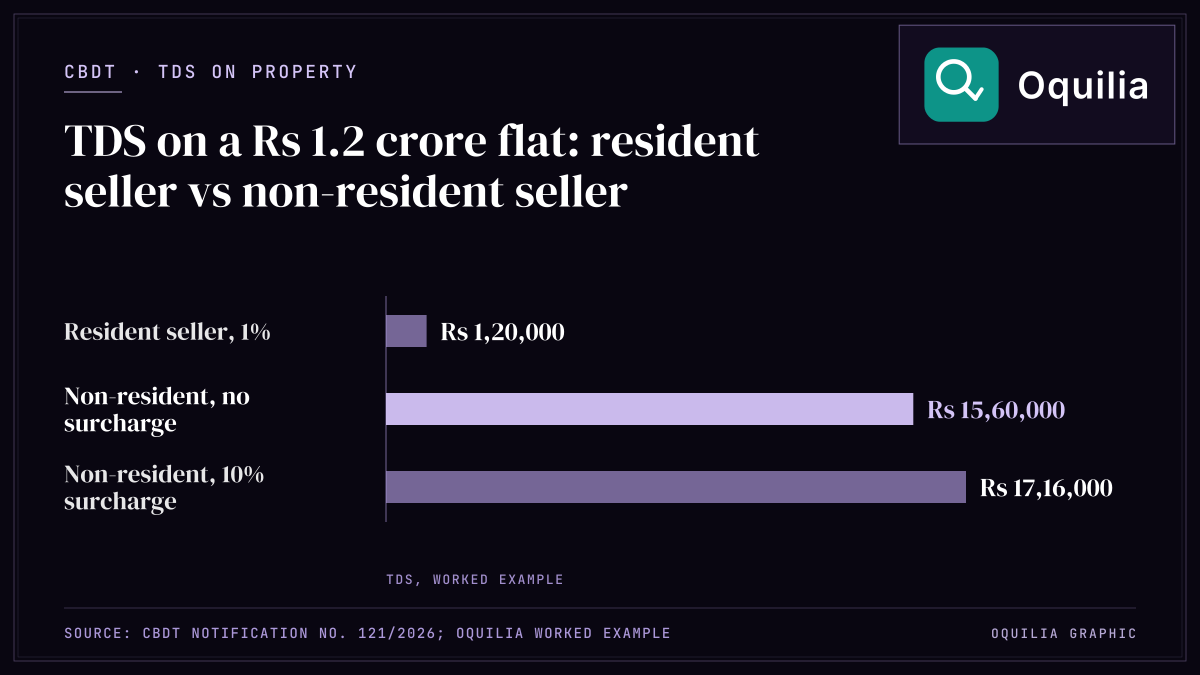
Together the buyers deduct Rs 15,60,000, which is 13.0% of Rs 1,20,00,000. If a 10% surcharge applied, the effective rate would be 12.5% x 1.10 x 1.04 = 14.3%, and the total would rise to Rs 17,16,000. Whether surcharge applies depends on the facts; Note 10 only requires that it be included where it does.
Step 4: the comparison. The gap from a resident-seller purchase is large.
| Seller | Provision | Rate | TDS on this Rs 1.2 crore flat |
|---|---|---|---|
| Resident | Section 393(1), Table Sl. No. 3(i) | 1% of price or stamp duty value, whichever is higher, at Rs 50 lakh or more | Rs 1,20,000 |
| Non-resident, no certificate, no surcharge | Section 393(2), Table Sl. No. 17 | 12.5% plus 4% cess | Rs 15,60,000 |
| Non-resident, no certificate, 10% surcharge | Section 393(2), Table Sl. No. 17 | 12.5% plus surcharge plus cess | Rs 17,16,000 |
Step 5: the filings. On the first instalment, each spouse selects "First instalment" in item 6(a). On 15 December 2026, each selects "Last instalment", quotes the acknowledgement number from the November filing in item 6(b), and enters Rs 72,00,000 or Rs 48,00,000 as the total paid in item 6(c). The seller can estimate the actual gain with Oquilia's capital gains calculator.
Common Mistakes
1. Deducting 1% because the buyer is an individual. The 1% rate in section 393(1), Table Sl. No. 3(i) applies only where the seller is a resident. Check the seller's residential status for the tax year before paying; on a Rs 1.2 crore flat, a wrong 1% deduction leaves Rs 14,40,000 short against the 13.0% example above.
2. Filing one form for joint buyers. Note 11 to Schedule E requires each deductor to file a separate form. Item 1(iii) still lists every buyer, with shares totalling 100%.
3. Leaving out the seller's foreign contact details. Note 6(a) makes the contact number, email and address abroad mandatory "whether PAN of the non-resident is available or not".
4. No PAN and no TRC or TIN. Where the non-resident has no PAN, Note 6(b) requires the TRC number and TIN under rule 217 "for ensuring that tax is not deducted at higher rate". Without a valid PAN, section 397(2)(b)(i) otherwise sets a floor of 20% or the applicable rate, whichever is higher. Oquilia's glossary explains the TRC.
5. Excluding surcharge and cess. Note 10 says the tax deducted includes surcharge, if applicable, and cess. Deducting a flat 12.5% on Rs 72,00,000 gives Rs 9,00,000, which is Rs 36,000 short of the Rs 9,36,000 that includes 4% cess.
6. Losing the acknowledgement number. For a subsequent or last instalment, item 6(b) asks for the previous acknowledgement number, and item 6(c) asks for the total paid including the current instalment.
7. Using Schedule E for agricultural land. Item 1(ii) offers only land other than agricultural land, a building or part of one, or both. Agricultural land is outside the Schedule's options.
8. Ignoring the certificate route. Item 7(v) has rows for a certificate under section 395(1), obtained by the seller, and under section 395(2), obtained by the buyer. Where the expected gain is far below the price, a certificate issued before payment can set a lower amount or rate; Note 3(c), as amended, now refers to a certificate issued by the Assessing Officer "or under section 395(6)".
FAQ
From what date can individual buyers use Schedule E?
The Fifth Amendment Rules came into force on 1 October 2026. A deduction under section 393(2), Table Sl. No. 17 made on or after that date by a resident individual or HUF is covered by the new Schedule E in Form No. 141.
Does Schedule E apply when a company buys from a non-resident?
No. The rule 215(1), rule 218(3) and rule 219(5) amendments, and the new option in Forms No. 132 and No. 141, each refer to a "resident individual or Hindu undivided family". Other buyers are not covered by these changes.
What rate does the buyer deduct?
The Schedule's item 7(v) asks for the "rate at which tax deducted at source" and points to Note 3. For a long-term gain on property, our worked example uses the 12.5% rate plus 4% cess, a 13.0% effective rate before surcharge. A certificate under section 395(1) or 395(2) can change the rate or amount.
The seller has no Indian PAN. What then?
Note 6(b) requires the seller's TRC number and TIN under rule 217 so that tax is not deducted at a higher rate. Without them, section 397(2)(b)(i) provides for 20% or the applicable rate, whichever is higher.
Does the seller get a TDS certificate?
Yes. Form No. 132, the TDS certificate, now carries the option "Transfer of immovable property by a non-resident to a resident individual or Hindu undivided family", matching Form No. 141.
Is tax treaty relief relevant?
Possibly. Under the 1961 Act's section 195, withholding followed the treaty rate or the Act's rate, whichever was lower. India keeps its right to tax gains on immovable property situated in India, so buyers should not treat such gains as tax-free. Our DTAA entry has the background.
Where can I check the TDS amount before paying?
Oquilia's TDS calculator lists the section 393 rates and thresholds checked on 12 November 2026. The e-filing TDS compliance FAQ on incometax.gov.in covers the portal steps.
Sources & Citations
- Notification No. 121/2026, G.S.R. 830(E): Income-tax (Fifth Amendment) Rules, 2026 — Income Tax Department (CBDT)
- TDS compliance FAQ — Income Tax Department e-filing portal