

Rule 189A: the new conditions for merging two registered charitable trusts without tax, and Form 112A
CBDT's new rule 189A sets 12 conditions for merging two registered charitable trusts with similar objects, a 5-year objects lock and a one-month deadline to file Form 112A.
Key points
- CBDT notified rule 189A and Form No. 112A on 30 October 2026, setting the conditions for one registered non-profit organisation to merge into another with similar objects.
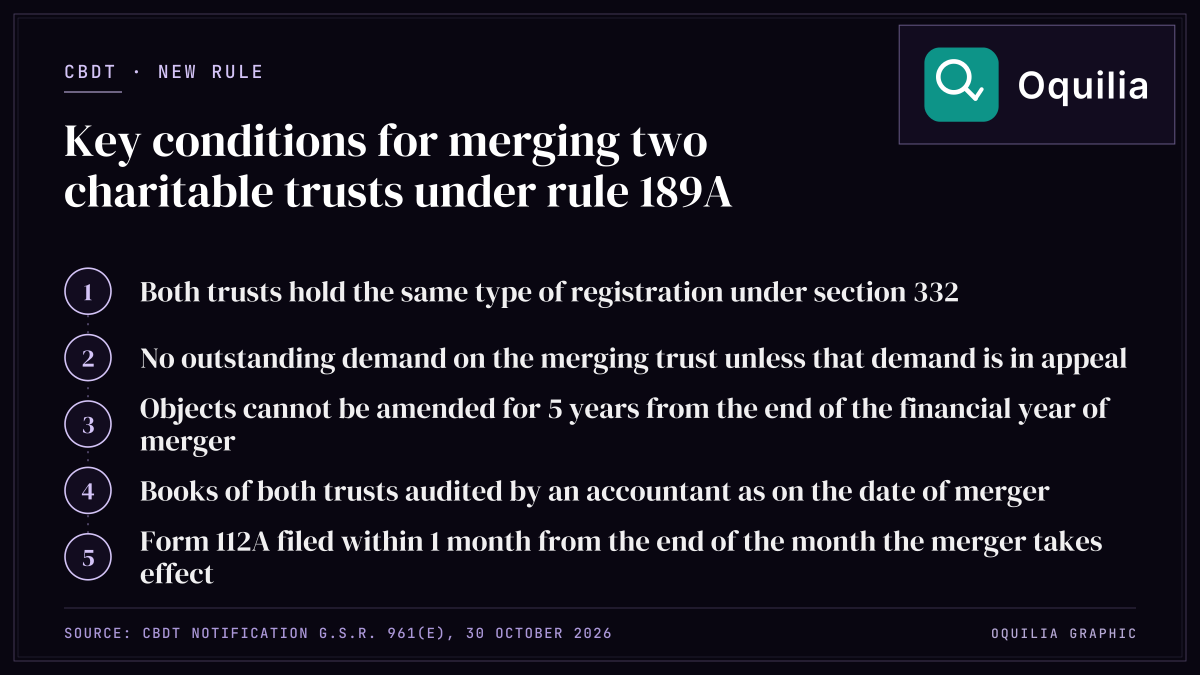
- The merged organisation must file Form 112A within one month from the end of the month the merger takes effect, and cannot amend its objects for five years.
- Trustees must clear any demand not in appeal, audit both sets of books as on the merger date and ensure no related person benefits before merging.
Two charitable trusts with the same mission now have a written rulebook for combining. On 30 October 2026 the Central Board of Direct Taxes (CBDT) notified the Income-tax (Eighth Amendment) Rules, 2026, as G.S.R. 961(E), which inserts a new rule 189A into the Income-tax Rules, 2026 and a new Form No. 112A in Appendix III. The rules came into force on the date of their publication in the Official Gazette, according to the notification published by the Income Tax Department.
The rule is made under section 533 read with sections 352(4) [Table: Sl. No. 8] and 354A of the Income-tax Act, 2025 (30 of 2025). It sets 12 conditions, lettered (a) to (l), that a merger between two registered non-profit organisations (NPOs) with "same or similar objects" must meet for the purposes of those two sections. This explainer covers each condition, a worked timeline and Form 112A, for donors and trustees; it is not advice on any particular merger.
What the Section Says
Rule 189A(1) lists the conditions. Rule 189A(3) defines the two parties: the merging NPO is the one that merges into another, and the merged NPO is the one it merges into. The rule separates NPOs registered under section 332 from those only provisionally registered under the same section.
The 12 conditions fall into five groups, summarised below from the notified text.
| Clause | What it requires | Who carries it |
|---|---|---|
| (a), (b) | A fully registered NPO cannot merge with a provisionally registered NPO, and the reverse is also barred | Both |
| (c) | No outstanding tax, interest, penalty, fine or other sum under any order of the Act, unless that demand is in appeal | Merging NPO |
| (d) | If an appeal is pending, the demand is paid once the appeal attains finality | Merged NPO |
| (e) | Objects cannot be amended for 5 years from the end of the financial year of merger | Merged NPO |
| (f) | All assets and liabilities pass across from the date of merger | Merged NPO |
| (g) | No direct or indirect benefit to any related person under section 337(1) [Table: Sl. No. 2] | Both |
| (h) | Six named obligations transfer (see below) | Merged NPO |
| (i) | Intimation in Form No. 112A within 1 month from the end of the month the merger takes effect | Merged NPO |
| (j), (k) | Pending and future assessments for years up to the merger date are made on the merged NPO | Merged NPO |
| (l) | Books of both NPOs audited by an accountant under section 515(3)(b) as on the date of merger | Both |
Clause (h) is the longest. It lists six obligations of the merging NPO that become obligations of the merged NPO: (i) application of income under section 341; (ii) application of accumulated income under section 342; (iii) tax under section 334 on the merging NPO's specified income; (iv) compliance with the conditions of section 340; (v) investment of funds only in the modes specified in section 350; and (vi) payment of additional income-tax under section 352 "whenever such liability arises".
Form No. 112A, inserted after Form No. 112, adds two undertakings that do not appear in rule 189A itself. First, depreciation cannot be claimed by the merged NPO on an asset whose cost of acquisition the merging NPO has already claimed as application. Second, contributions made by any person to the merging NPO are counted towards total contributions to the merged NPO for the purposes of section 355(h)(ii).
Rule 189A(2) says Form 112A must be furnished electronically, under a digital signature or an electronic verification code (EVC). Rule 189A(3)(i) defines EVC as a code generated to the data structure and standards specified by the Director General of Income-tax (Systems).
For readers new to the vocabulary, Oquilia's glossary entries on tax exemption and the assessment year explain the older terms the 2025 Act now replaces with "tax year".
Worked Example
The figures below are illustrative only. They are chosen to show how the clauses interact; they do not describe any real organisation.
Suppose two education trusts, both fully registered under section 332, decide to combine. Trust A (merging) runs 3 rural schools; Trust B (merged) runs 11. Trust A's trustees pass a resolution on 2 December 2026, and the merger takes effect on 15 December 2026, which falls in tax year 2026-27.
Step 1: check the registration pair. Both are fully registered, so clauses (a) and (b) are met. Had Trust A held only provisional registration, the merger could not qualify under rule 189A until both stood on the same footing.
Step 2: check outstanding demands. Trust A has two demands on the portal.
| Demand on Trust A | Amount | Status | Effect under rule 189A |
|---|---|---|---|
| Order for an earlier tax year | Rs 6,50,000 | In appeal | Allowed under clause (c); Trust B pays when appeal attains finality under clause (d) |
| Penalty order | Rs 1,20,000 | Not in appeal | Fails clause (c) until paid or appealed |
| Total | Rs 7,70,000 | Only the Rs 1,20,000 blocks the merger |
So of Rs 7,70,000 in demands, Rs 1,20,000 must be cleared before the merger can meet clause (c). The Rs 6,50,000 under appeal does not block it, but it becomes Trust B's liability if the appeal ends against Trust A.
Step 3: carry over assets and obligations. Trust A holds Rs 2.4 crore of assets, including a school building, and Rs 18 lakh of liabilities. Under clause (f) the full Rs 2.4 crore and the full Rs 18 lakh pass to Trust B from 15 December 2026. If Trust A had earlier claimed the building's cost as application, Trust B cannot claim depreciation on it, per the Form 112A undertaking.
Step 4: fix the dates. The timeline then runs as follows.
| Event | Date in this example | Source in rule 189A |
|---|---|---|
| Trustee resolution | 2 December 2026 | Form 112A declaration, Annexure A-3 |
| Merger takes effect | 15 December 2026 | Clause (f) |
| Audit cut-off for both trusts | 15 December 2026 | Clause (l) |
| Form 112A due | By 31 January 2027 | Clause (i): 1 month from end of December 2026 |
| End of financial year of merger | 31 March 2027 | Clause (e) |
| Objects lock ends | 31 March 2032 | Clause (e): 5 years after 31 March 2027 |
The audit cut-off is the merger date itself, 15 December 2026, not the year end. Annexure A-4 also asks for audited books for the financial year immediately preceding the tax year of merger, which in this example is FY 2025-26.
If your trust also pays salaries to teachers or staff, the payroll side does not change on merger; you can check withholding with Oquilia's TDS calculator, and individual donors or employees can run their own position through the income tax calculator or the old vs new regime comparison.
Common Mistakes
The rule is less than a month old, so there is no scrutiny record under it yet. The pitfalls below are the ones the notified text itself makes easy to fall into, based on its 12 clauses and the Form 112A undertakings.
1. Pairing a registered NPO with a provisionally registered one. Clauses (a) and (b) bar the combination in both directions. A trust that applied recently and holds provisional registration under section 332 should check its status on the e-filing portal before the trustees pass any resolution.
2. Treating every demand as "in appeal". Clause (c) excuses only a demand that is actually before an appellate authority. A demand where the appeal window is still open but nothing has been filed is, on a plain reading of the text, not in appeal. In the example above, that distinction is worth Rs 1,20,000.
3. Missing the one-month window. The deadline in clause (i) runs from the end of the month in which the merger takes effect, not from the merger date. A merger on 1 December 2026 and one on 31 December 2026 share the same 31 January 2027 deadline.
4. Amending objects too soon. Clause (e) freezes the merged NPO's objects for 5 years from the end of the financial year of merger, so a merger in December 2026 locks them until 31 March 2032. Adding a new activity by deed amendment inside that window would breach the condition.
5. Auditing at the year end only. Clause (l) requires both NPOs' books to be audited as on the date of merger by an accountant defined in section 515(3)(b). A routine audit on 31 March does not satisfy a cut-off of 15 December.
6. Double-claiming depreciation. The Form 112A undertaking bars the merged NPO from claiming depreciation where the merging NPO has already claimed the cost of acquisition as application. Fixed-asset registers should carry that history across.
7. Overlooking related persons. Clause (g) bars any direct or indirect benefit to a related person under section 337(1) [Table: Sl. No. 2] of either NPO. Merger terms that, for example, give a trustee's relative a paid post or a property on concessional terms should be reviewed against that provision.
8. Signing with the wrong method. Rule 189A(2) allows only a digital signature or an EVC. A physical letter to the Principal Commissioner does not meet the electronic filing requirement.
The full text of the Income-tax Act, 2025 is available on India Code for the 11 sections the rule cross-refers to, from section 332 to section 515.
FAQ
When did rule 189A come into force?
The Income-tax (Eighth Amendment) Rules, 2026 came into force on the date of publication in the Official Gazette, under rule 1(2). The notification, G.S.R. 961(E), is dated 30 October 2026 and carries Notification No. 139/2026.
Can a provisionally registered trust merge with a fully registered trust under rule 189A?
No. Clauses (a) and (b) of rule 189A(1) bar a merger between an NPO registered under section 332 and one provisionally registered under section 332, in either direction. Both must hold the same type of registration.
What is the deadline for filing Form No. 112A?
The merged NPO must file Form 112A with the jurisdictional Principal Commissioner or Commissioner within 1 month from the end of the month in which the merger takes effect. A merger effective on 15 December 2026 would need the form by 31 January 2027.
Does a pending tax appeal stop a merger?
No. Clause (c) blocks a merger only where the outstanding demand is not in appeal. If an appeal is pending, clause (d) makes the merged NPO liable to pay the demand once the appeal attains finality.
How long are the merged trust's objects frozen?
Under clause (e), the objects cannot be amended for 5 years from the end of the financial year in which the merger takes place. For a merger in FY 2026-27, that runs to 31 March 2032.
Which documents go with Form 112A?
Note 3 of the form lists 5 annexures: A-1 trust deeds of both NPOs, A-2 both registrations, A-3 the trustee or governing body resolution, A-4 audited books as on the merger date and for the preceding financial year, and A-5 the reasons for the merger.
Do donations to the old trust count for the merged trust?
Yes, for one purpose. The Form 112A undertaking says contributions made by any person to the merging NPO are counted in the total contribution to the merged NPO for the purposes of section 355(h)(ii).
Sources & Citations
- Notification No. 139/2026, G.S.R. 961(E): Income-tax (Eighth Amendment) Rules, 2026 — Income Tax Department (CBDT)
- Income-tax Act, 2025 (30 of 2025) — India Code