

Gifted Money to Your Spouse or Child? Section 99 of the Income-tax Act 2025 Adds the Income Back to Yours, With These Exceptions
Section 99 of the Income-tax Act 2025 clubs income from assets gifted to a spouse, son's wife or minor child with the giver's own. Worked example, Rs 29,120 cost and the exceptions.
Key points
- Section 99 of the Income-tax Act, 2025, the successor to section 64 of the 1961 Act, adds income from assets gifted to a spouse, son's wife or minor child back to the giver.
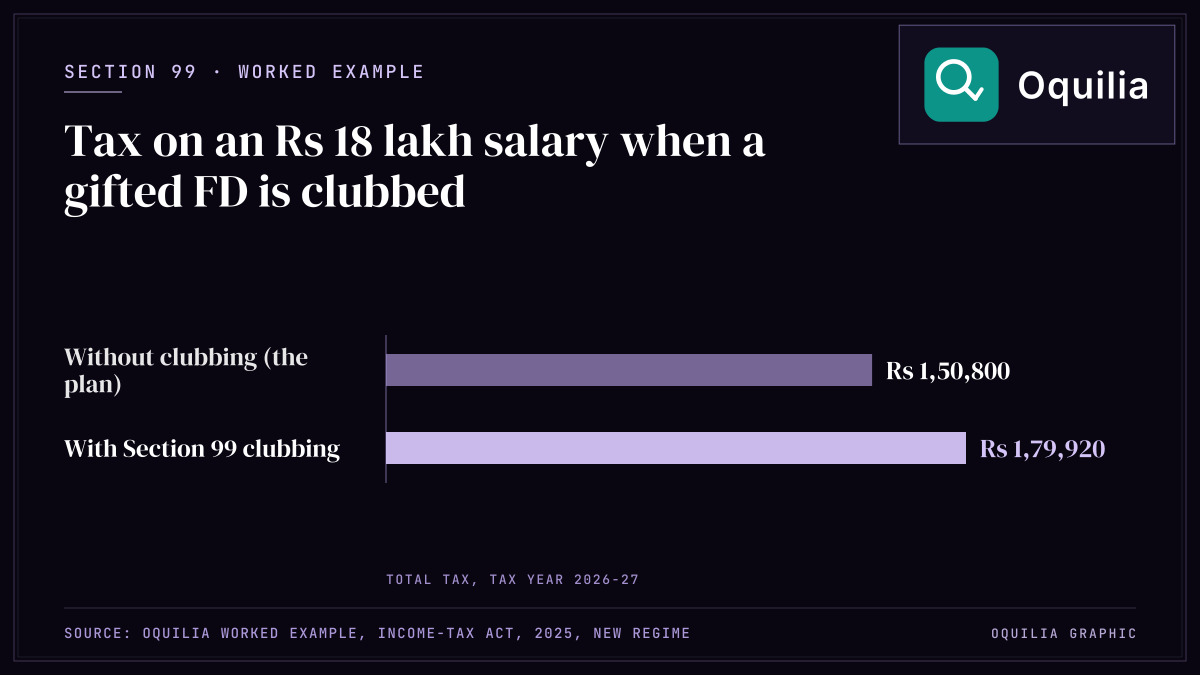
- On a Rs 18 lakh salary in tax year 2026-27, clubbing Rs 1,40,000 of FD interest from a gifted Rs 20 lakh raises the giver's tax by Rs 29,120.
- A minor's income from their own work or talent, a spouse's purely professional fees and genuine loans at adequate interest stay outside the clubbing rule.
Moving Rs 20 lakh into a spouse's name so the interest falls in a lower slab is one of the oldest tax ideas in Indian households, and Section 99 of the Income-tax Act, 2025 is the provision that undoes it. Section 99, titled "Income of individual to include income of spouse, minor child, etc.", is the successor to section 64 of the Income-tax Act, 1961, and it applies from tax year 2026-27, the first year governed by the 2025 Act.
The rule is simple to state: if you transfer an asset to your spouse, your son's wife or your minor child without adequate consideration, the income from that asset is added back to your own total income. This guide sets out what the section says, runs the numbers on a Rs 18 lakh salary, and lists the exceptions that are genuinely available.
What the Section Says
Section 99(1) has four limbs, each pulling a different stream of income back into the hands of the individual who made the transfer or holds the interest. The table below summarises them from the verified text of the section.
| Limb | Whose income | What is clubbed | Key exception |
|---|---|---|---|
| 99(1)(a)(i) | Spouse | Salary, commission, fees or other remuneration from a concern in which you have a substantial interest | Income solely attributable to the spouse's own technical or professional knowledge, experience and qualification |
| 99(1)(a)(ii) | Spouse | Income from assets you transferred directly or indirectly, otherwise than for adequate consideration | Transfer in connection with an agreement to live apart (subject to section 25(a)) |
| 99(1)(b) | Son's wife | Income from assets transferred on or after 1 June 1973 without adequate consideration | Transfer for adequate consideration |
| 99(1)(c) | Minor child | All income of the minor child | Income from the child's own work, from the child's skill, talent, specialised knowledge or experience, or where the child has a disability of the nature specified in section 154 |
| 99(1)(d) | Any person or AOP | Income from assets you transferred without adequate consideration, to the extent it is for the immediate or deferred benefit of your spouse or son's wife | Transfer for adequate consideration |
Two further sub-sections close the obvious workarounds. Section 99(2) deals with gifted money that the spouse or son's wife puts into a business or a partnership firm as capital, and clubs only a proportionate share of the business income using a formula. Section 99(3) covers property that you convert into the property of your Hindu undivided family, whether by impressing it with HUF character, throwing it into the common stock or transferring it to the family without adequate consideration: the income from that property is deemed to be yours.
The business-capital formula in Section 99(2)
Section 99(2) clubs an amount A, calculated as A = B x (C/D). The three inputs are defined in the section as follows.
| Symbol | Meaning under Section 99(2) |
|---|---|
| B | Income or interest arising to the spouse or son's wife from the business or firm |
| C | Value of the transferred assets invested, as on the first day of the tax year |
| D | Total investment or capital in the business or firm, as on the same day |
The formula matters because it clubs only the share of business income that the gifted capital produced, not the whole income of a spouse who also brought in her or his own money. The "first day of the tax year" test, which for tax year 2026-27 is 1 April 2026, also means that money gifted mid-year is measured only from the following year's opening balance.
The full text of the 2025 Act is published on India Code, and the predecessor provision with its case law can be read on Indian Kanoon.
Worked Example
Take Rahul, a salaried employee earning Rs 18,00,000 a year in tax year 2026-27 under the default new regime. His wife Meera has no income of her own. Rahul gifts her Rs 20,00,000 and she places it in a bank fixed deposit that, for this illustration, earns Rs 1,40,000 of interest in the year (an assumed 7% rate, used only to keep the arithmetic round).
The couple's hope is that Rs 1,40,000 in Meera's hands falls well inside the Rs 4,00,000 nil slab of the new regime and so attracts no tax. Section 99(1)(a)(ii) defeats that hope because the deposit came from an asset transferred without adequate consideration. The figures below use the new-regime slabs under section 202(1), the Rs 75,000 standard deduction and the 4% health and education cess, which are unchanged for tax year 2026-27.
| Line item | Without clubbing (the couple's plan) | With Section 99 clubbing |
|---|---|---|
| Rahul's gross salary | Rs 18,00,000 | Rs 18,00,000 |
| Less standard deduction | Rs 75,000 | Rs 75,000 |
| FD interest added under Section 99 | Nil | Rs 1,40,000 |
| Rahul's taxable income | Rs 17,25,000 | Rs 18,65,000 |
| Tax at 0% on first Rs 4,00,000 | Nil | Nil |
| 5% on Rs 4,00,000 to Rs 8,00,000 | Rs 20,000 | Rs 20,000 |
| 10% on Rs 8,00,000 to Rs 12,00,000 | Rs 40,000 | Rs 40,000 |
| 15% on Rs 12,00,000 to Rs 16,00,000 | Rs 60,000 | Rs 60,000 |
| 20% on income above Rs 16,00,000 | Rs 25,000 (on Rs 1,25,000) | Rs 53,000 (on Rs 2,65,000) |
| Tax before cess | Rs 1,45,000 | Rs 1,73,000 |
| 4% cess | Rs 5,800 | Rs 6,920 |
| Total tax on Rahul | Rs 1,50,800 | Rs 1,79,920 |
The difference is Rs 29,120 a year, which is the full Rs 1,40,000 of interest taxed at Rahul's 20% marginal slab plus 4% cess, an effective 20.8%. The tax rebate does not help either: the Rs 60,000 rebate under section 156 is available only up to Rs 12,00,000 of income in the new regime, and Rahul is above that line with or without the interest. You can test your own figures on the income tax calculator.
The same money, invested in Meera's business
Now suppose Meera instead puts the Rs 20,00,000 into a boutique she runs, alongside Rs 30,00,000 of her own savings, so that total capital on 1 April 2026 is Rs 50,00,000. The business earns Rs 6,00,000 in the year. Under Section 99(2), A = Rs 6,00,000 x (Rs 20,00,000 / Rs 50,00,000) = Rs 2,40,000.
Only Rs 2,40,000 is added to Rahul's income; the remaining Rs 3,60,000 stays taxable in Meera's hands. C and D are both read on 1 April, so keep records of each spouse's capital on that date.
The loan route
The exceptions in Section 99(1)(a)(ii), (b) and (d) all turn on the phrase "otherwise than for adequate consideration". If Rahul lends the Rs 20,00,000 to Meera on documented terms with interest at a commercially adequate rate, rather than gifting it, the transfer is for consideration and the FD interest is hers. Rahul then pays tax on the interest he receives from her, so the saving is only the gap between the FD return and the loan rate, and the arrangement must be genuine, with a written agreement and interest actually paid through a bank account.
Common Mistakes
The six errors below are the ones that turn a "tax-saving" gift into an addition under Section 99 or its predecessor, section 64 of the 1961 Act.
- Gifting cash for a spouse's fixed deposit. As the worked example shows, Rs 1,40,000 of interest on a gifted Rs 20,00,000 is clubbed in full under Section 99(1)(a)(ii), costing Rs 29,120 at the 20% slab.
- Routing the gift through a relative. The section covers assets transferred "directly or indirectly", and Section 99(1)(d) reaches transfers to any person or association of persons to the extent they benefit the spouse or son's wife. Gifting Rs 10,00,000 to a brother who then gifts it on to your wife does not break the chain.
- Forgetting the son's wife. Section 99(1)(b) applies to assets transferred to a daughter-in-law on or after 1 June 1973 without adequate consideration, so a father-in-law who funds a daughter-in-law's mutual fund portfolio has the income clubbed with his own.
- Opening investments in a minor's name. Under Section 99(1)(c) all income of a minor child is clubbed unless one of the three exceptions applies. Interest on a Rs 5,00,000 deposit in a 10-year-old's name is not the child's own earning and is added back to the parent.
- Clubbing income that should not be clubbed. The reverse error also costs money: prize money, performance fees or other income from a minor's own skill, talent or work is excluded under Section 99(1)(c), as is the income of a minor child with a disability of the nature specified in section 154, and a spouse's fees earned purely from her or his own professional qualification are excluded under Section 99(1)(a)(i).
- Throwing self-acquired property into the HUF. Section 99(3) deems the income from property converted into HUF property, without adequate consideration, to remain the individual's income, so moving a let-out flat earning Rs 3,00,000 a year into the HUF does not shift the rent.
Clubbed income must also be shown in your own ITR under the correct head, and it forms part of your gross total income for every threshold that depends on it, including the Rs 12,00,000 rebate limit. Whether a gift is itself taxable in the recipient's hands is a separate question; the gift tax calculator works through it, and the old vs new regime comparison shows which regime suits the enlarged income.
FAQ
Does Section 99 replace section 64 of the Income-tax Act, 1961?
Yes. Section 99 of the Income-tax Act, 2025 is the successor to section 64 of the 1961 Act and governs tax year 2026-27 onwards. Income of FY 2025-26 is still dealt with under the 1961 Act, according to the CBDT's transition guidance.
If I gift money to my wife and she invests it, is all her income clubbed with mine?
No. Only income arising from the asset transferred without adequate consideration is clubbed under Section 99(1)(a)(ii). If she invests the gift in a business alongside her own capital, Section 99(2) clubs only B x (C/D), which in the example above was Rs 2,40,000 out of Rs 6,00,000.
Is my minor child's income from acting or sports clubbed with mine?
No. Section 99(1)(c) excludes a minor child's income from work done by the child and from activities involving the child's skill, talent, specialised knowledge or experience. Income from investments you funded, such as Rs 35,000 of interest on a deposit in the child's name, is clubbed.
Is my spouse's salary from my company clubbed with my income?
Only if you have a substantial interest in the company and the salary is not solely attributable to your spouse's own technical or professional knowledge, experience and qualification. A qualified chartered accountant paid a market salary for accounting work falls within the exception in Section 99(1)(a)(i).
Does clubbing apply to gifts made to my son's wife?
Yes. Section 99(1)(b) clubs income from assets transferred to a son's wife on or after 1 June 1973 without adequate consideration, and Section 99(1)(d) extends the rule to indirect transfers for her benefit.
Can I avoid clubbing by lending instead of gifting?
A genuine loan at adequate interest is a transfer for consideration, so the clubbing provisions in Section 99(1)(a)(ii), (b) and (d) do not bite. You must then report the interest you receive, at your own slab rate of up to 30% in the new regime.
This article explains the law as published and is not tax advice. Read the full text of Section 99 on incometax.gov.in or India Code before restructuring family investments.
Sources & Citations
- Income of individual to include income of spouse, minor child, etc. — Indian Kanoon
- Income-tax Act, 2025 — India Code
- Income Tax Department e-filing portal — Income Tax Department