

Married in Goa? How Section 10 of the Income-tax Act 2025 Splits a Couple's Rent, Business and Capital-Gains Income 50:50
Spouses governed by Goa's communião dos bens must split rent, interest, business income and capital gains 50:50 under Section 10 of the Income-tax Act 2025; salary stays with the earner.
Key points
- Section 10 of the Income-tax Act 2025, successor to Section 5A of the 1961 Act, governs spouses under Goa's communião dos bens regime.
- Every head of income except salaries is divided equally, so Rs 6 lakh of community rent becomes Rs 3 lakh in each spouse's return.
- Each spouse files separately with their own slabs and rebate, and should reconcile TDS in Form 26AS and AIS with the 50:50 split.
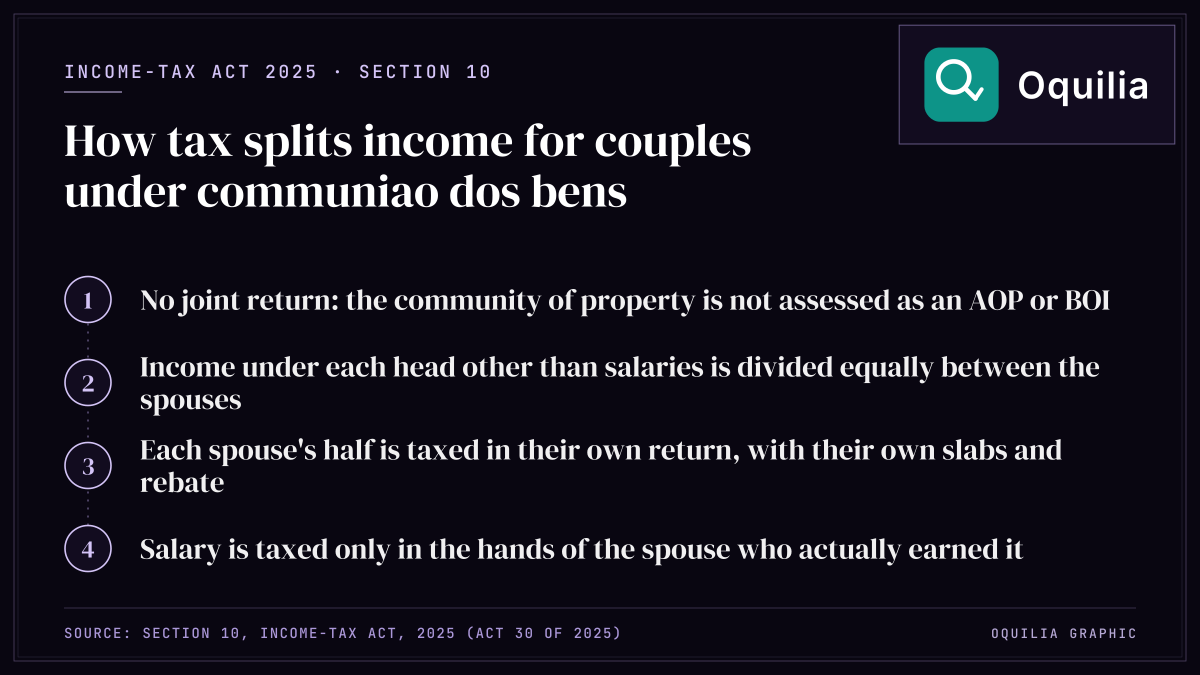
A married couple in Goa can earn exactly the same rupees as a couple in Pune and still file two very different sets of returns. The reason is Section 10 of the Income-tax Act, 2025 (Act 30 of 2025), titled "Apportionment of income between spouses governed by Portuguese Civil Code". It carries forward Section 5A of the Income-tax Act, 1961, and it applies to husbands and wives governed by the community of property system, known as communião dos bens, under the Portuguese Civil Code of 1860.
The rule is mechanical: for such a couple, every head of income except "Salaries" is split 50:50 between the spouses, and each half is taxed in the separate return of each spouse. This guide walks through the text, a worked example with real slab arithmetic, and the mistakes that trip couples up when they file.
What the Section Says
The full text of Section 10 is available on Indian Kanoon. Stripped of drafting language, it does four things for a husband and wife governed by communião dos bens in force in the State of Goa and in the Union territories of Dadra and Nagar Haveli and Daman and Diu.
| Clause | What it says | Practical effect |
|---|---|---|
| (a) | Income under any head is not assessed together as income of the "community of property", whether as an association of persons (AOP) or a body of individuals (BOI) | The community is not a separate taxpayer; there is no joint return |
| (b) | Income under each head other than "Salaries" is divided equally between husband and wife | Rent, interest, business profit and capital gains are split 50:50 |
| (c) | Each spouse's half is included separately in that spouse's total income, and the rest of the Act applies | Each spouse gets their own slabs, basic exemption and rebate |
| (d) | Salary income is taxed only in the hands of the spouse who actually earned it | A salary of Rs 9 lakh stays 100% in the earner's return |
Three points in that table matter more than they first appear.
First, the split is by head of income. The 1961 Act and the 2025 Act both group income into five heads: salaries, income from house property, profits and gains of business or profession, capital gains, and income from other sources. Four of those five heads are halved; only salaries escape.
Second, the section is written as a rule of assessment, not an option. Clause (b) says the income "shall" be divided equally. A couple governed by the community regime cannot choose to put 100% of the rent in the lower-earning spouse's return or 100% of the capital gains in the return of the spouse with losses to set off.
Third, the trigger is the matrimonial property regime, not the address. A couple who merely live in Goa, or own a flat in Panaji, but are not governed by communião dos bens fall outside Section 10. The words "governed by" in the section heading do the work, and the territorial reference covers Goa, Dadra and Nagar Haveli and Daman and Diu only.
1961 Act versus 2025 Act
| Item | Income-tax Act, 1961 | Income-tax Act, 2025 |
|---|---|---|
| Provision | Section 5A | Section 10 |
| Covers | FY 2025-26 and earlier (AY 2026-27 returns) | Tax year 2026-27 onwards |
| Heads split 50:50 | All except "Salaries" | All except "Salaries" |
| Salary | Taxed in earner's hands | Taxed in earner's hands |
| Joint assessment as AOP/BOI | Barred | Barred |
The substance did not change when Parliament replaced the 1961 Act: the 2025 Act renumbered the rule from 5A to 10 and kept the 50:50 split.
Worked Example
The figures below are hypothetical and built only to show the arithmetic. They use the FY 2025-26 new-regime slabs (0% up to Rs 4 lakh, 5% from Rs 4 lakh to Rs 8 lakh, 10% from Rs 8 lakh to Rs 12 lakh, 15% from Rs 12 lakh to Rs 16 lakh), the Rs 75,000 new-regime standard deduction for salaried taxpayers, the Section 87A rebate of up to Rs 60,000 for total income up to Rs 12 lakh, and 4% health and education cess. You can reproduce every line with the new-regime income tax calculator.
The couple. Maria and Joaquim are married and governed by communião dos bens. From community property they earn Rs 6 lakh a year in rent on a flat (no municipal tax paid) and Rs 2 lakh in fixed deposit interest. Maria also draws a salary of Rs 9 lakh. Joaquim has no salary.
Step 1: split each head
| Income | Total | Maria's share | Joaquim's share |
|---|---|---|---|
| Salary (Maria's own) | Rs 9,00,000 | Rs 9,00,000 | Nil |
| Rent from community flat | Rs 6,00,000 | Rs 3,00,000 | Rs 3,00,000 |
| FD interest (community) | Rs 2,00,000 | Rs 1,00,000 | Rs 1,00,000 |
Salary does not move. Rent and interest are halved before any deduction is applied.
Step 2: compute each spouse's total income
Each spouse claims the 30% standard deduction on their own half of the rent under the house-property computation (you can check this with the house property income calculator), so Rs 3,00,000 of rent becomes Rs 2,10,000 of taxable house-property income each.
| Line | Maria | Joaquim |
|---|---|---|
| Salary | Rs 9,00,000 | Nil |
| Less standard deduction | (Rs 75,000) | Nil |
| Income from house property (Rs 3,00,000 less 30%) | Rs 2,10,000 | Rs 2,10,000 |
| Income from other sources (FD interest) | Rs 1,00,000 | Rs 1,00,000 |
| Total income | Rs 11,35,000 | Rs 3,10,000 |
| Tax on slabs | Rs 53,500 | Nil (below Rs 4 lakh) |
| Section 87A rebate | (Rs 53,500) | Not needed |
| Tax payable | Nil | Nil |
Maria's slab tax is Rs 20,000 (5% of Rs 4 lakh) plus Rs 33,500 (10% of Rs 3,35,000), or Rs 53,500. Because her total income of Rs 11,35,000 is below Rs 12 lakh, the 87A rebate wipes it out. Joaquim's Rs 3,10,000 sits inside the Rs 4 lakh nil slab.
Step 3: what goes wrong if the split is ignored
Suppose the couple wrongly reports all the rent and interest in Maria's return because the flat and FD are registered in her name. Her total income becomes Rs 8,25,000 + Rs 4,20,000 + Rs 2,00,000 = Rs 14,45,000.
| Item | Correct (50:50 split) | Incorrect (all in Maria's return) |
|---|---|---|
| Maria's total income | Rs 11,35,000 | Rs 14,45,000 |
| Slab tax | Rs 53,500 | Rs 96,750 |
| 87A rebate | Rs 53,500 | Nil (above Rs 12 lakh) |
| Cess at 4% | Nil | Rs 3,870 |
| Household tax | Nil | Rs 1,00,620 |
That Rs 1,00,620 is not a saving the couple chose to forgo; it is the result of filing on the wrong basis. Equally, the Income Tax Department can recompute in the other direction where a couple has shifted more than half of a head into the lower-income return.
Capital gains: two exemptions, not one
The same logic applies to capital gains. If the couple sells listed equity from community holdings and books Rs 2,50,000 of long-term capital gains, each spouse reports Rs 1,25,000.
| Item | Split under Section 10 | One return (incorrect) |
|---|---|---|
| LTCG reported | Rs 1,25,000 each | Rs 2,50,000 |
| Exemption under the LTCG rule | Rs 1,25,000 each | Rs 1,25,000 |
| Taxable LTCG | Nil | Rs 1,25,000 |
| Tax at 12.5% | Nil | Rs 15,625 plus cess |
Each spouse's Rs 1,25,000 equity LTCG exemption is personal, so a correct 50:50 split uses two of them.
Common Mistakes
These are the errors most likely to surface when a return is processed or picked up for scrutiny.
- Splitting salary. Clause (d) is explicit: salary is taxed only in the hands of the spouse who earned it. A Rs 9 lakh salary cannot be reported as Rs 4.5 lakh in each return, whatever the property regime.
- Assuming everyone in Goa is covered. Section 10 applies only to spouses governed by communião dos bens. A couple living in Goa but not governed by that regime are taxed like any other couple, with income assessed to the person who owns the asset or earns the income.
- Filing one return for the "community". Clause (a) bars assessing the community as an AOP or BOI. There is no joint return in Indian income tax; each spouse files their own ITR for the relevant assessment year.
- Forgetting the non-earning spouse. In the example, Joaquim's Rs 3,10,000 is below the Rs 4 lakh new-regime nil slab. If his half of rent, interest and gains pushed him past the basic exemption limit (Rs 4 lakh in the new regime, Rs 2.5 lakh in the old regime under FY 2025-26 slabs), he would need to file a return of his own.
- Mismatched TDS credit. Banks and tenants deduct TDS against one PAN, usually the account holder's or the landlord named on the lease. When income is split 50:50, the TDS credit should line up with it. As a practical check, both spouses should compare the income and TDS shown in Form 26AS and the Annual Information Statement (AIS) on the income tax e-filing portal against their returns before filing; our TDS calculator helps size the deduction.
- Picking and choosing heads. The 50:50 rule runs across all four non-salary heads at once. A couple cannot split rent but keep a large capital gain in one return; clause (b) applies "under each head".
- Mixing regimes without checking. Each spouse picks the old or new regime for their own return. Run each spouse through the old versus new regime calculator separately rather than assuming the same choice suits both.
FAQ
Which couples does Section 10 of the Income-tax Act 2025 apply to?
It applies to a husband and wife governed by the community of property system (communião dos bens) under the Portuguese Civil Code of 1860, in force in Goa and in the Union territories of Dadra and Nagar Haveli and Daman and Diu. Residence alone does not trigger it.
Is salary split between husband and wife?
No. Under clause (d), salary is taxed only in the hands of the spouse who actually earned it. In the worked example, Maria's Rs 9 lakh salary stays entirely in her return.
Which incomes are split 50:50?
Every head other than "Salaries": income from house property, profits and gains of business or profession, capital gains and income from other sources such as interest. Rs 6 lakh of community rent becomes Rs 3 lakh in each return.
Can the couple file a single joint return?
No. Clause (a) says income is not assessed together as income of the community, whether as an AOP or a BOI. Each spouse files a separate return including their own half.
Does each spouse get their own basic exemption and rebate?
Yes. Clause (c) says each half is included in that spouse's total income and the rest of the Act applies. Each spouse therefore has their own slabs, their own Section 87A rebate (up to Rs 60,000 in the new regime for income up to Rs 12 lakh) and their own Rs 1,25,000 equity LTCG exemption.
Was this rule new in the 2025 Act?
No. It carries forward Section 5A of the Income-tax Act, 1961. Returns for FY 2025-26 (AY 2026-27) cite Section 5A; from tax year 2026-27 the reference is Section 10 of the 2025 Act.
What should we check before filing?
Confirm that you are governed by communião dos bens, list every non-salary receipt from community assets, halve each head, and reconcile both spouses' Form 26AS and AIS entries on incometax.gov.in so that TDS credit follows the 50:50 split.
This article explains the law as written and uses hypothetical figures. It is not tax advice; confirm your matrimonial property regime and figures with a qualified professional before filing.