

MP consumer commission cuts truck repossession award against Tata Motors to Rs 50,000
The Madhya Pradesh State Consumer Commission held that Tata Motors' finance arm lawfully repossessed a borrower's truck, but must pay Rs 50,000 because it did not prove a proper sale.
Key points
- The Madhya Pradesh State Consumer Disputes Redressal Commission ruled on 30 October 2026 in a truck loan dispute with Tata Motors.
- The commission cut the compensation to the borrower to Rs 50,000 from Rs 1,50,000 and let the lender recover unpaid dues.
- The commission held that a lender may repossess a vehicle on default, but must show the vehicle was sold by a proper procedure.
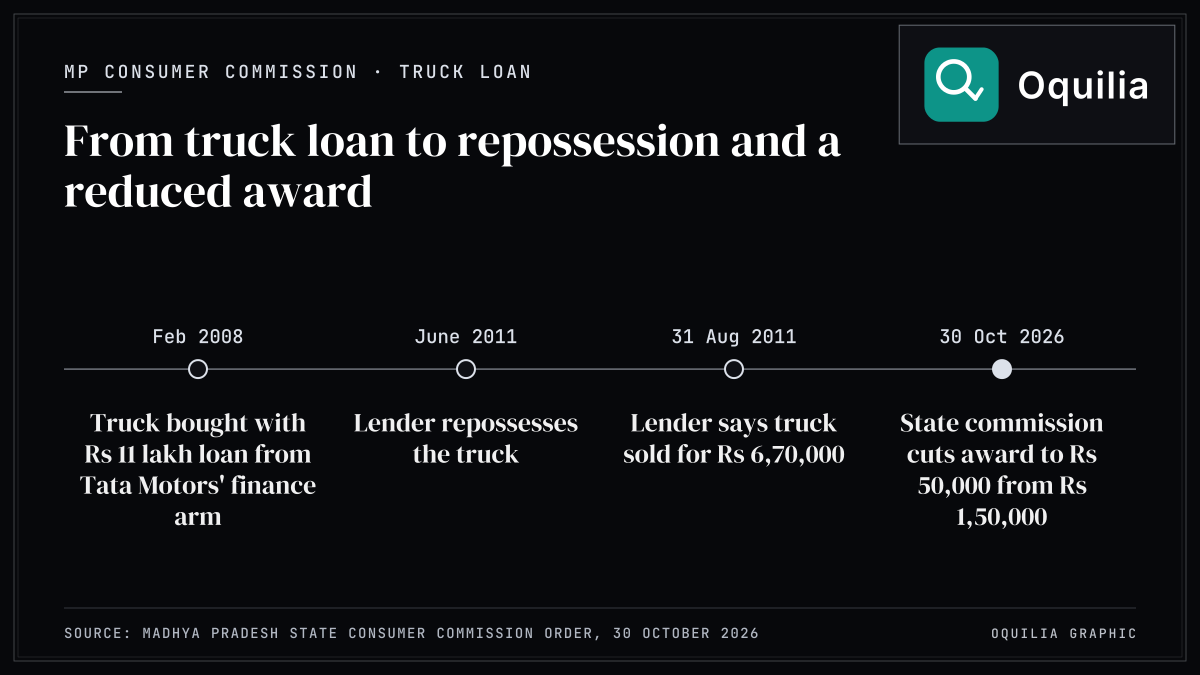
The Madhya Pradesh State Consumer Disputes Redressal Commission on 30 October 2026 held that the finance division of Tata Motors had the right to repossess a borrower's truck after he fell behind on instalments, but must compensate him because it did not prove that the truck was sold by a proper procedure. The commission cut the compensation to Rs 50,000 from Rs 1,50,000 awarded by the Bhopal district commission.
What Happened
According to the order, the borrower bought a 10-wheeler truck in February 2008 with a loan of Rs 11 lakh from Tata Motors' finance division, repayable in 56 instalments of Rs 27,300. He said he had paid Rs 8,46,929 by June 2011, when the lender repossessed the truck. The lender said it sold the truck for Rs 6,70,000 on 31 August 2011 and that Rs 2,18,016.56 was still due.
The commission held that the borrower was a consumer, as he bought the truck to earn a living through self-employment and the lender gave no evidence of a commercial business. It held that under the hypothecation agreement, the loan contract that pledges the vehicle to the lender, the lender could repossess the truck on default, citing the Supreme Court. Records showed the police were told before repossession and notices were sent. But the commission found the lender gave no evidence of how the sale was done, such as a public notice or tenders, so it was liable to pay compensation.
The commission also set aside the district commission's direction that the lender must not recover any dues, saying the loan agreement gives the lender that right. The district commission's direction on costs stands.
What It Means
For vehicle borrowers, the order says a lender may take back a financed vehicle when instalments are not paid, but must be able to show that it sold the vehicle by a proper process, or it may have to pay compensation. A borrower in default can still be asked to pay the balance of the loan. The commission's order may be appealed. A borrower with a grievance against a lender can file a complaint through the National Consumer Helpline (1915) or e-Daakhil.
Source: Consumer commission order
Sources & Citations
- Consumer commission order — Consumer commission