

Madras High Court orders DBS Bank to pay deceased woman's deposits to widowed daughter-in-law
The Madras High Court held that a widowed daughter-in-law is the heir to her late mother-in-law's fixed deposits of Rs 18,95,527 and ordered DBS Bank to pay her with interest within 15 days.
Key points
- The Madurai Bench of the Madras High Court set aside a Karur district court order that had refused a succession certificate to a widow.
- The court directed DBS Bank to pay deposits of Rs 18,95,527 with accrued interest within 15 days of receiving the judgment.
- The court held that under Section 15(1)(b) of the Hindu Succession Act, heirs are decided on the date the woman dies, not her husband.
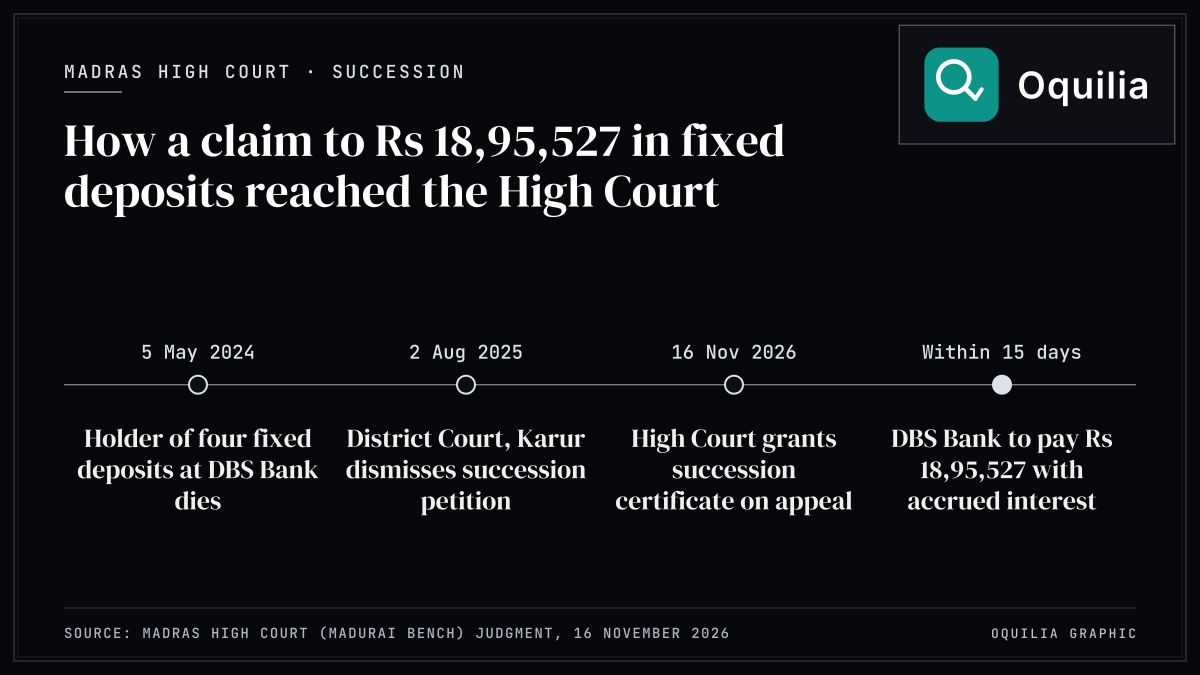
The Madurai Bench of the Madras High Court on 16 November 2026 ordered DBS Bank to pay a deceased woman's fixed deposits of Rs 18,95,527, with accrued interest, to her widowed daughter-in-law within 15 days. The court held that the daughter-in-law is the legal heir and set aside a district court order that had refused her a succession certificate.
What Happened
A woman who held four fixed deposits at DBS Bank's Chinnadharapuram branch in Karur district died on 5 May 2024. Her husband and her only son had both died before her, and the son had no children. When the son's widow asked for the money, the bank told her to obtain a succession certificate, a court document that lets an heir collect a dead person's debts and deposits.
The District Court, Karur, dismissed her petition on 2 August 2025. It said the legal heirs of the deceased woman's husband had not been made parties and doubted that a daughter-in-law could inherit.
The High Court disagreed. It held that under Section 15(1)(b) of the Hindu Succession Act, 1956, when a Hindu woman dies without a will and leaves no children or husband, her property goes to her husband's heirs, and those heirs are identified as on the date she dies. Relying on a Supreme Court ruling, the court held that the widow of a son who died earlier is such an heir. It noted that a newspaper notice and a local announcement had drawn no objection, and that the bank had no objection to the claim itself.
The court allowed the appeal, granted the succession petition and made no order on costs.
What It Means
The ruling shows that a widowed daughter-in-law can be the rightful heir to her mother-in-law's bank deposits where the mother-in-law leaves no husband, children or grandchildren. It also shows that a court should not refuse a succession certificate only because relatives who had already died were not made parties.
Families claiming a deceased relative's deposits usually need a succession certificate when there is no nominee. If a bank delays or refuses a valid claim, customers can complain to the RBI at https://cms.rbi.org.in.
Source: High Court judgment
Sources & Citations
- High Court judgment — Madras High Court