

Karnataka High Court upholds SBI demand, says signed borrower undertaking binds
The Karnataka High Court refused to quash a State Bank of India demand for Rs 38,14,024, holding that a borrower's admitted written undertaking cannot be set aside on a plea of financial distress.
Key points
- The Karnataka High Court on 19 November 2026 dismissed a borrower's petition against a State Bank of India demand.
- The bank had demanded Rs 38,14,024, which the borrower had agreed to pay in a signed undertaking dated 30 November 2021.
- The court held a borrower who admits signing must show cogent proof of coercion; financial distress alone is not enough.
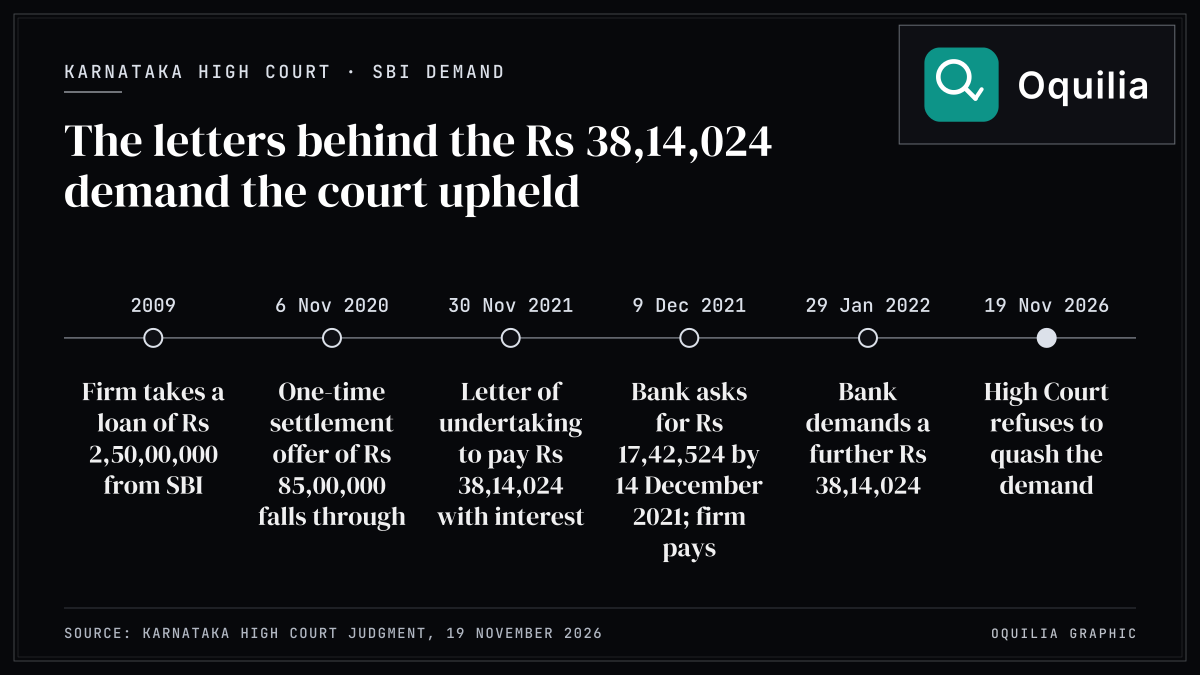
The Karnataka High Court on 19 November 2026 refused to quash a State Bank of India demand for Rs 38,14,024 from a Bengaluru borrower, holding that a written undertaking the borrower admitted signing could not be set aside on a bare claim of financial distress. The court dismissed the writ petition filed by Prakash Constructions, a proprietary concern, in Writ Petition No. 21736 of 2022.
What Happened
According to the judgment, the firm took a loan of Rs 2,50,00,000 from the bank in 2009. After the account turned bad, the bank started recovery under the SARFAESI Act, the law that lets banks seize and sell pledged property without going to court. A one-time settlement (OTS) offer of Rs 85,00,000 made on 6 November 2020 fell through, the court recorded, because the firm could not pay.
On 9 December 2021 the bank asked the firm to pay Rs 17,42,524 by 14 December 2021 while a request to waive Rs 20.82 lakh of penal interest was pending. The firm paid. On 29 January 2022 the bank demanded a further Rs 38,14,024 and said the mortgaged property would be released only after full payment. The firm argued this contradicted the December letter.
The bank relied on a letter of undertaking dated 30 November 2021 in which the firm agreed to pay Rs 38,14,024 with interest and charges. The firm said it signed under coercion to get its flats back. The court held that once signing is admitted, the borrower must show cogent material of coercion, and that a mere plea of financial distress does not make an undertaking unenforceable. Disputed facts about how such documents were signed, it said, cannot be examined in a writ petition.
What It Means
For borrowers negotiating with a bank, the ruling is a reminder that a signed acknowledgement of dues can bind them even if an earlier letter quoted a lower figure. Read any undertaking before signing, keep copies of every letter, and get the bank's decision on any waiver request in writing. A borrower with a complaint about a bank's service can approach the RBI's complaint portal at https://cms.rbi.org.in. The High Court's order can be appealed.
Source: High Court judgment
Sources & Citations
- High Court judgment — Karnataka High Court