

Karnataka High Court bars borrowers from reopening SARFAESI sale on grounds not raised earlier
The Karnataka High Court held that borrowers cannot challenge a bank's SARFAESI action on grounds they skipped earlier, dismissing a petition against Bank of Baroda over a 2010 auction.
Key points
- The Karnataka High Court on 18 November 2026 dismissed as not maintainable two borrowers' petition against Bank of Baroda.
- The court held that grounds available at the first challenge to a 2010 auction could not be raised more than a decade later.
- Borrowers contesting a bank's SARFAESI action must raise every available ground in their first challenge, the court's order indicates.
The Karnataka High Court on 18 November 2026 held that borrowers cannot reopen a bank's recovery action under the SARFAESI Act on grounds they could have raised, but did not, when they first challenged it. The court dismissed as not maintainable a writ petition by two borrowers against Bank of Baroda, which had taken possession of their property in 2008 and sold it at auction in 2010.
What Happened
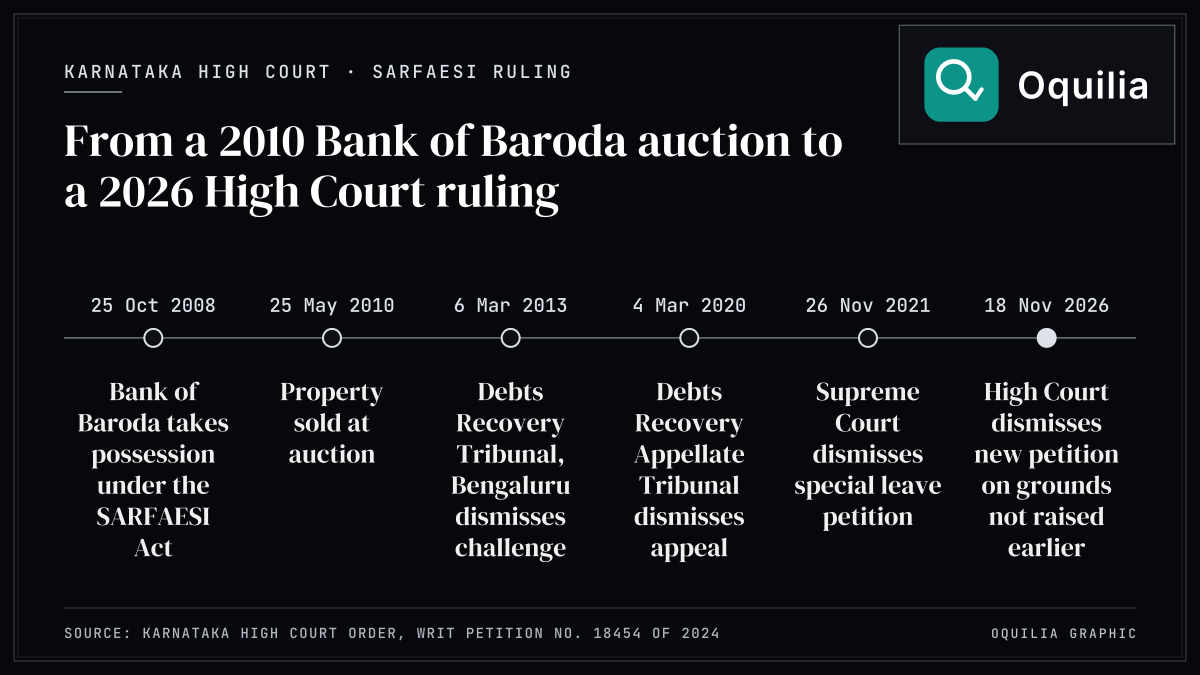
According to the order in Writ Petition No. 18454 of 2024 (neutral citation 2026:KHC:64114), Bank of Baroda's Infantry Road branch in Bengaluru took possession of the secured property on 25 October 2008 under the SARFAESI Act, the law that lets banks seize and sell a defaulting borrower's pledged property without a civil suit. After a first sale notice of 22 December 2008 did not lead to a sale, the bank held an auction on 25 May 2010, and the sale was confirmed on 11 June 2010.
The borrowers challenged the bank's action before the Debts Recovery Tribunal in Bengaluru, which dismissed their case on 6 March 2013. The Debts Recovery Appellate Tribunal in Chennai dismissed their appeal on 4 March 2020, the High Court dismissed a writ petition on 26 March 2021, and the Supreme Court dismissed their special leave petition on 26 November 2021, a review petition on 12 April 2022 and a curative petition on 10 October 2023.
In the new petition, the borrowers argued that the bank's very classification of their loan as a non-performing asset violated the Act and its rules. Their side told the court the grounds were available earlier but not raised. The court held that Order II Rule 2 of the Code of Civil Procedure, which bars splitting claims across cases, applies to writ petitions too. Grounds available at the earliest stage cannot be raised in separate proceedings more than a decade later, it held, and it did not go into their merits.
What It Means
For borrowers contesting a bank's action under the SARFAESI Act, the order means every available ground must be raised in the first challenge, before the Debts Recovery Tribunal. Once that challenge and the appeals have run their course, the court held, a fresh petition on grounds left out earlier will not be heard.
Source: High Court judgment
Sources & Citations
- High Court judgment — Karnataka High Court