

Gauhati High Court: civil courts cannot stop bank recovery under debt laws
The Gauhati High Court held on 6 November 2026 that civil courts cannot block a bank's recovery under debt laws, even over property a borrower never mortgaged.
Key points
- The Gauhati High Court dismissed a borrower's appeal against Punjab National Bank on 6 November 2026.
- The court held that a DRT Recovery Officer may sell a defaulter's other property too, with recovery of about Rs 1.61 crore pending.
- The court said secured assets should be sold first, and left the borrower free to seek fair treatment before the DRT, Guwahati.
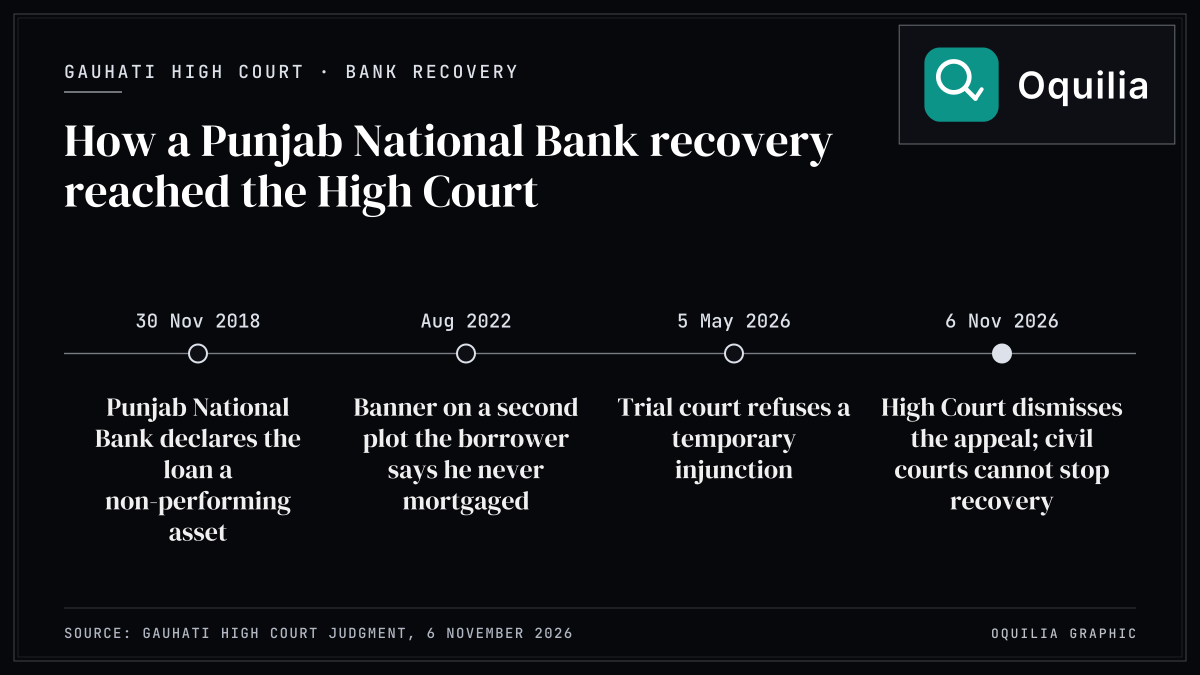
The Gauhati High Court on 6 November 2026 held that a civil court cannot grant an injunction to stop a bank's recovery action under the debt recovery law, even over a borrower's property that was never mortgaged to the bank. The court dismissed a borrower's appeal against Punjab National Bank, with recovery of about Rs 1.61 crore pending against him.
What Happened
According to the judgment, the borrower had mortgaged a plot in Cachar district, Assam, for a Punjab National Bank loan. The bank declared the loan a non-performing asset on 30 November 2018 and began recovery under the SARFAESI Act, the law that lets banks take over and sell secured property. In August 2022, the bank put a banner on a second plot, which the borrower said he had bought separately and never mortgaged.
The borrower filed a civil suit and asked for a temporary injunction to keep the bank off that plot. The trial court refused on 5 May 2026. The bank told the High Court that recovery proceedings for Rs 1,61,45,292.54, with interest at 10.50% a year, were pending before the Recovery Officer of the Debts Recovery Tribunal (DRT), Guwahati.
The court held that Section 25(aa) of the Recovery of Debts Due to Banks and Financial Institutions Act, 1993 lets the Recovery Officer take possession of and sell secured assets and also any other property of the debtor. It held that Section 34 of the SARFAESI Act bars civil courts from granting injunctions against such action. It said fairness demands that the Recovery Officer first try to recover dues by selling the secured assets, and turn to other property only if an amount still remains outstanding.
What It Means
For borrowers in default, the ruling means a civil court is not the place to stop recovery action by a bank under these laws, even for property that was not pledged. The court left the borrower free to approach the DRT, Guwahati, to seek fair use of the Recovery Officer's power over his property that was not mortgaged. Each side was left to bear its own costs. Bank customers with a grievance about a bank's service can complain to RBI at https://cms.rbi.org.in.
Source: High Court judgment
Sources & Citations
- High Court judgment — Gauhati High Court