

Delhi High Court rules DRT cannot accept borrower's late defence beyond 45 days
The Delhi High Court held that a borrower's written statement filed after the 45-day limit in the Recovery of Debts and Bankruptcy Act cannot be accepted, dismissing a plea in a Union Bank of India case.
Key points
- The Delhi High Court dismissed a borrower's plea against Union Bank of India and upheld orders refusing to accept a late written statement.
- The court held that under Section 19(5) of the RDB Act the maximum time to file a defence before a DRT is 45 days.
- Borrowers sued by banks before a Debts Recovery Tribunal must file their defence on time, as the delay cannot be excused.
The Delhi High Court on 18 November 2026 held that a borrower who fails to file a written defence within the period fixed by the Recovery of Debts and Bankruptcy Act cannot have the delay excused. A Division Bench dismissed a borrower's petition in a recovery case filed by Union Bank of India.
What Happened
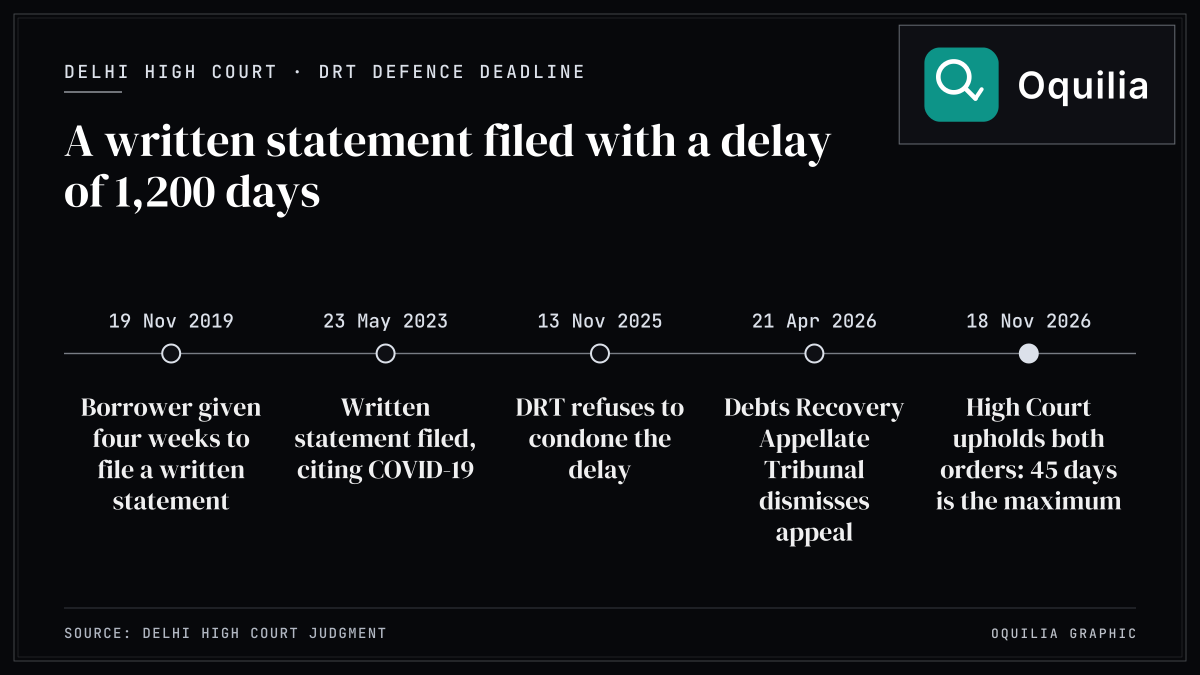
According to the judgment, Union Bank of India filed a recovery case before the Debts Recovery Tribunal (DRT), a special forum for bank recovery suits, against the borrower and others in 2018. The borrower was given four weeks on 19 November 2019 to file a written statement, his formal reply to the bank's claim. He filed it on 23 May 2023, citing COVID-19, and asked the tribunal to condone the delay.
The DRT refused on 13 November 2025, and the Debts Recovery Appellate Tribunal dismissed his appeal on 21 April 2026. The High Court upheld both orders. It held that Section 19(5) of the RDB Act gives a defendant 30 days from the service of summons, which the tribunal may extend by up to 15 days in exceptional cases, so the maximum is 45 days.
The court held that the RDB Act is a special law for bank recovery that overrides the general civil procedure, so the general power to condone delay cannot be used. It noted that the written statement was filed with a delay of 1,200 days and was late even after excluding the period from 15 March 2020 to 28 February 2022, which the Supreme Court had excluded from limitation during the pandemic. The court followed its own judgment of 23 September 2026 on the same point and disagreed with a contrary view of the Punjab and Haryana High Court.
What It Means
For borrowers and guarantors sued by a bank before a DRT, the ruling means the defence must be filed within 30 days of receiving the summons, or at most within 15 more days if the tribunal allows. A defence filed later can be refused, and the case may go ahead without it. Borrowers with a complaint about a bank's service can approach the RBI at https://cms.rbi.org.in.
Source: High Court judgment
Sources & Citations
- High Court judgment — Delhi High Court