

Andhra Pradesh High Court tells four lenders to use lawful recovery, not strong-arm tactics
The Andhra Pradesh High Court directed Axis Bank, SBI Cards, ICICI Bank and IndusInd Bank to follow lawful procedure to recover a borrower's dues.
Key points
- The Andhra Pradesh High Court on 29 October 2026 disposed of a borrower's petition alleging harassment by loan recovery agents.
- It directed Axis Bank, SBI Cards, ICICI Bank and IndusInd Bank to use procedure recognised by law, not strong-arm tactics, if dues are unpaid.
- The court held the petition not maintainable against ten other lenders, leaving the borrower free to approach the appropriate forum.
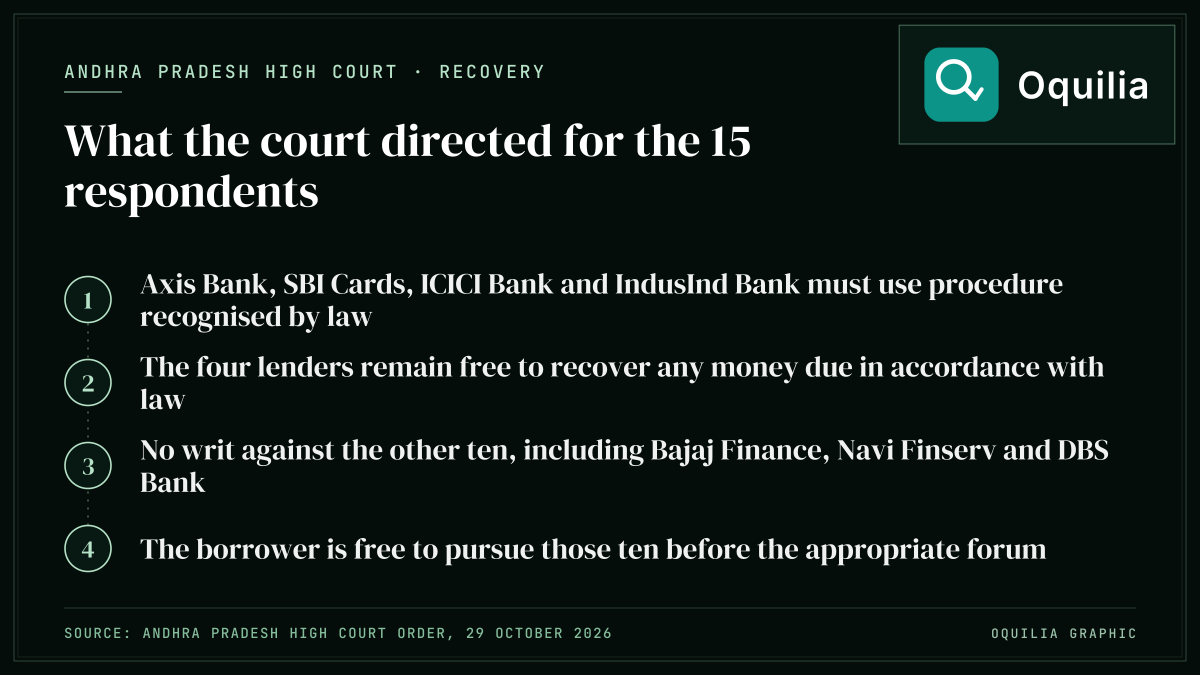
The Andhra Pradesh High Court has directed four lenders to recover a borrower's dues only through procedure recognised by law and not through strong-arm tactics. In an order of 29 October 2026, the court disposed of a writ petition filed by a borrower from Anantapur against 15 respondents, including the Reserve Bank of India and several banks and lending companies.
What Happened
The borrower alleged that the lenders harassed him and his family by sending loan recovery agents to his home, making continuous phone calls and humiliating him in front of neighbours, without following RBI's guidelines of 12 August 2022. He asked the court to declare the coercive recovery actions illegal and to direct the lenders to consider his request for time to regularise his accounts.
The court cited the Supreme Court's ruling that hiring recovery agents who act as musclemen is deprecated, and that a bank should follow the procedure recognised by law when a borrower defaults. As the lenders said they had never sent agents and intended to follow the law, the court saw no purpose in keeping the case pending.
It directed Axis Bank, SBI Cards, ICICI Bank and IndusInd Bank to resort to procedure recognised by law if the borrower has defaulted, and said they remain free to recover any money due in accordance with law. For the other ten respondents, including Bajaj Finance, Navi Finserv, Yes Bank and DBS Bank, the court relied on a Supreme Court ruling that a writ petition is not maintainable against a private non-banking financial company or private commercial entity. It left the borrower free to pursue remedies against them before the appropriate forum.
What It Means
The order does not cancel any dues; lenders may still recover what is owed, but only through lawful means. It also shows that a writ petition in a High Court may not lie against private lending companies, so borrowers may need another forum. A borrower facing abusive recovery calls or visits can complain to the lender and then to the RBI at https://cms.rbi.org.in. Threats or intimidation can be reported to the police, and online harassment through cybercrime.gov.in or helpline 1930.
Source: High Court judgment
Sources & Citations
- High Court judgment — Andhra Pradesh High Court