

West Bengal consumer commission orders builder Jio-Rio Construction to pay Rs 3 lakh
The West Bengal State Consumer Disputes Redressal Commission held developer Jio-Rio Construction deficient in service and ordered Rs 3 lakh compensation and Rs 20,000 costs to a landowner.
Key points
- The West Bengal State Consumer Disputes Redressal Commission held developer Jio-Rio Construction and its partners deficient in service.
- The commission ordered Rs 3 lakh compensation and Rs 20,000 litigation cost, payable within sixty days of its 23 November 2026 order.
- The commission refused building-related reliefs because no duly sanctioned building plan was shown; the order may be appealed.
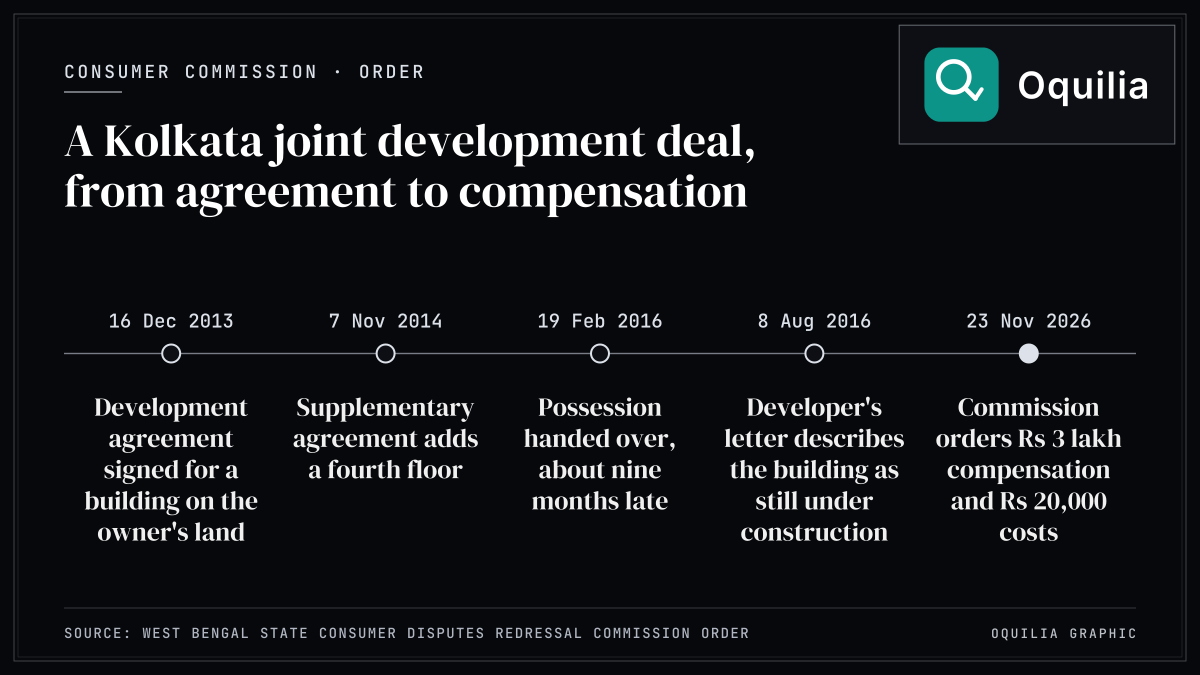
The West Bengal State Consumer Disputes Redressal Commission on 23 November 2026 ordered developer M/s Jio-Rio Construction and its two partners to pay Rs 3 lakh as compensation and Rs 20,000 as litigation cost to a landowner. The commission held that the developer was deficient in service in a joint development project in Kolkata. The amounts are to be paid within sixty days.
What Happened
According to the order, the landowner signed a development agreement with the developer on 16 December 2013 for a building on his land, and a supplementary agreement on 7 November 2014 adding a fourth floor. The principal agreement required the owner's share to be handed over complete, with a completion certificate from the municipality, within 21 months.
The commission noted that possession was handed over on 19 February 2016, about nine months late, and that no completion certificate was given within the stipulated period. It found an occupancy certificate produced by the developer "doubtful", since the developer's own letter of 8 August 2016 to the electricity distributor described the building as still under construction.
The land records showed the plot as 'Bagan', or orchard land. The commission held that it was the developer's duty to tell the owner about converting the land and to seek action, and that its failure to do so was deficiency in service, though the owner also bore some responsibility.
Because it was not shown that the building followed a duly sanctioned plan, the commission refused to order a completion certificate, electricity meters or finishing works. A claim of Rs 1.5 lakh in finishing expenses was rejected for want of evidence. It allowed the complaint in part.
What It Means
For landowners who enter joint development deals, the order shows that a commission can treat the developer as a service provider and hold it to the agreed timelines and paperwork, including the completion certificate. It also shows that reliefs tied to the building can be refused where the land was not converted and the plan sanction is not shown, so owners should check the land's status before construction. The order may be appealed. Consumers can seek help through the National Consumer Helpline (1915) or file complaints on e-Daakhil.
Source: Consumer commission order
Sources & Citations
- Consumer commission order — Consumer commission