

Uttarakhand High Court orders lender to return truck repossessed from borrower
The Uttarakhand High Court ordered a finance company to release a borrower's repossessed truck at once, and said RBI's rules on recovery practices must be strictly followed.
Key points
- The Uttarakhand High Court on 18 November 2026 allowed a transporter's petition and ordered the lender to release his repossessed truck.
- The borrower had taken a loan of Rs 6,05,000; the court said the lender can still recover its legitimate dues.
- The court directed strict compliance with RBI's guidelines on recovery practices, following its own April 2026 judgment.
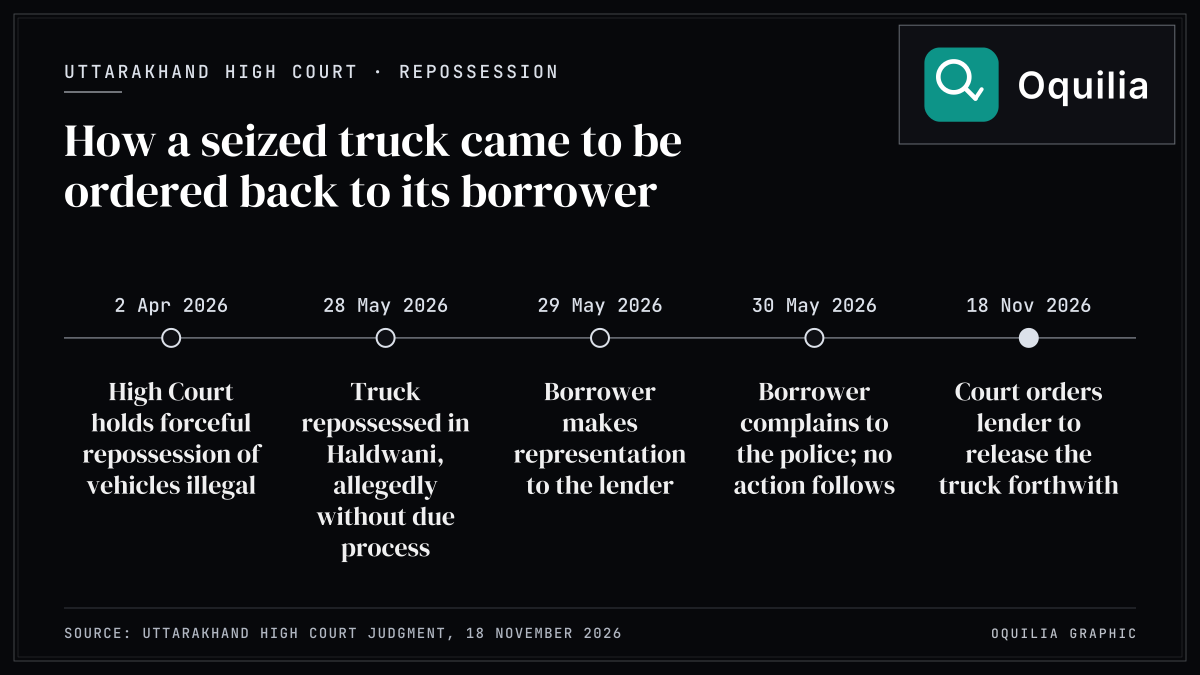
The Uttarakhand High Court on 18 November 2026 ordered a finance company to release forthwith a truck it had repossessed from a borrower who fell behind on his loan. The court allowed the borrower's petition in line with its own judgment of 2 April 2026, in which it had held the forceful repossession of vehicles through coercive means to be arbitrary and illegal.
What Happened
According to the order, the petitioner, a transporter, took a loan of Rs 6,05,000 to buy a truck, repayable in monthly instalments of Rs 22,275. As per a balance sheet dated 1 April 2026, Rs 2,87,576 remained outstanding. He told the court that, owing to financial hardship and ill health, he could not pay the instalments after March 2026.
On 28 May 2026 the vehicle was repossessed in Haldwani, allegedly without due process of law. The borrower's representation to the lender on 29 May 2026 and his complaints to the police on 30 May 2026 brought no action, so he approached the High Court. The Reserve Bank of India and the lender were respondents.
The borrower's counsel relied on the court's 2 April 2026 judgment, which, as the order records it, deprecated forceful repossession and held it violative of constitutional and regulatory safeguards. The lender's counsel supported this and agreed that the petition could be decided in the same terms.
The court directed the lender to release the truck to the borrower in roadworthy condition, subject to normal wear and tear. It said the order does not bar the finance company from recovering its legitimate dues, and that RBI's guidelines on recovery practices must be given strict and scrupulous compliance.
What It Means
For borrowers who have bought a vehicle on a loan, the order shows the court treating a forceful seizure through coercive means as no substitute for due process. It does not wipe out the loan: the dues remain recoverable through lawful means.
A borrower who faces coercive recovery by a bank or a finance company regulated by RBI can complain to the lender first and then to RBI's complaint portal at https://cms.rbi.org.in.
Source: High Court judgment
Sources & Citations
- High Court judgment — Uttarakhand High Court