

Supreme Court upholds NCLAT order setting aside Twinstar's Videocon resolution plan
The Supreme Court dismissed Twinstar Technologies' appeals, upholding the NCLAT judgment that set aside approval of its Rs 2,962.02 crore plan for Videocon Industries and sent it back to lenders.
Key points
- The Supreme Court on 16 November 2026 dismissed Twinstar Technologies' appeals in the Videocon group insolvency case.
- Twinstar's plan offered Rs 2,962.02 crore against admitted claims of Rs 64,838.63 crore, the judgment records.
- The process returns to the committee of creditors, and the court set limits on when the NCLAT may send back an approved plan.
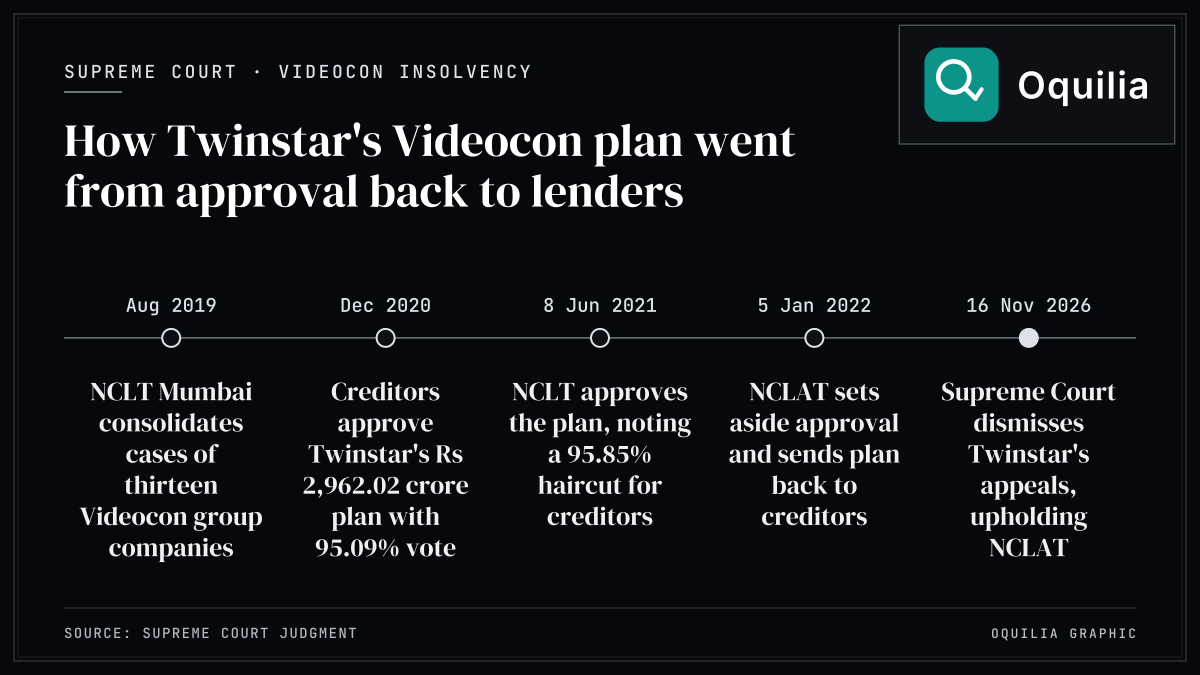
The Supreme Court on 16 November 2026 dismissed appeals by Twinstar Technologies Limited against an NCLAT judgment that had set aside approval of its resolution plan for Videocon Industries Limited and twelve group companies. The plan offered Rs 2,962.02 crore against admitted claims of Rs 64,838.63 crore, the judgment records.
What Happened
The judgment records that the State Bank of India and other creditors began insolvency cases against thirteen Videocon group companies, which the National Company Law Tribunal (NCLT), Mumbai, consolidated in August 2019. The committee of creditors (CoC), the lenders who vote on a rescue plan, approved Twinstar's plan with 95.09% of the voting share in December 2020. Bank of Maharashtra, IFCI Ltd, Small Industries Development Bank of India and one other creditor dissented.
The NCLT approved the plan on 8 June 2021, noting a haircut of 95.85% for creditors, and directed that dissenting financial creditors be paid their liquidation value in cash upfront. On appeals by the dissenting lenders, the National Company Law Appellate Tribunal (NCLAT) on 5 January 2022 set aside the approval and sent the matter back to the CoC. It held that paying dissenting creditors through non-convertible debentures redeemable over a long period did not meet Section 30(2)(b) of the Insolvency and Bankruptcy Code.
The Supreme Court found no merit in Twinstar's appeals. It also dismissed appeals by the former promoter and by a vendors' association concerning the group's foreign oil and gas assets, upholding the NCLAT's 14 May 2026 judgment, with liberty to the association to pursue other remedies. The court laid down guardrails for the NCLAT when sending an approved plan back: remand must rest on a finding of legal non-compliance, be used sparingly, and come with a strict direction to follow the Code's timelines.
What It Means
With the NCLAT judgment upheld, the insolvency process of the Videocon group companies returns to the committee of creditors, to be completed under the Code. Creditors whose claims were to be settled under the plan, including GAIL (India) Ltd, will have their claims dealt with by the resolution professional, the court said.
For lenders and homebuyers in other insolvency cases, the ruling sets out when an appellate tribunal may return an approved plan to creditors. Under the Code, the Supreme Court's judgment is final.
Source: Supreme Court order
Sources & Citations
- Supreme Court order — Supreme Court of India