

Supreme Court ends STC's insolvency case against Ganesh Benzoplast, restores NCLT order
The Supreme Court on 16 November 2026 held that State Trading Corporation was bound by Ganesh Benzoplast's rehabilitation scheme and was owed nothing beyond the Rs 2.19 crore already paid.
Key points
- The Supreme Court on 16 November 2026 set aside an NCLAT judgment that had revived STC's insolvency petition against Ganesh Benzoplast.
- The court restored the NCLT's 2020 order directing payment of Rs 2,18,88,421, which STC had accepted without prejudice.
- The court held that a rehabilitation scheme approved under the old sick-company law binds all unsecured creditors.
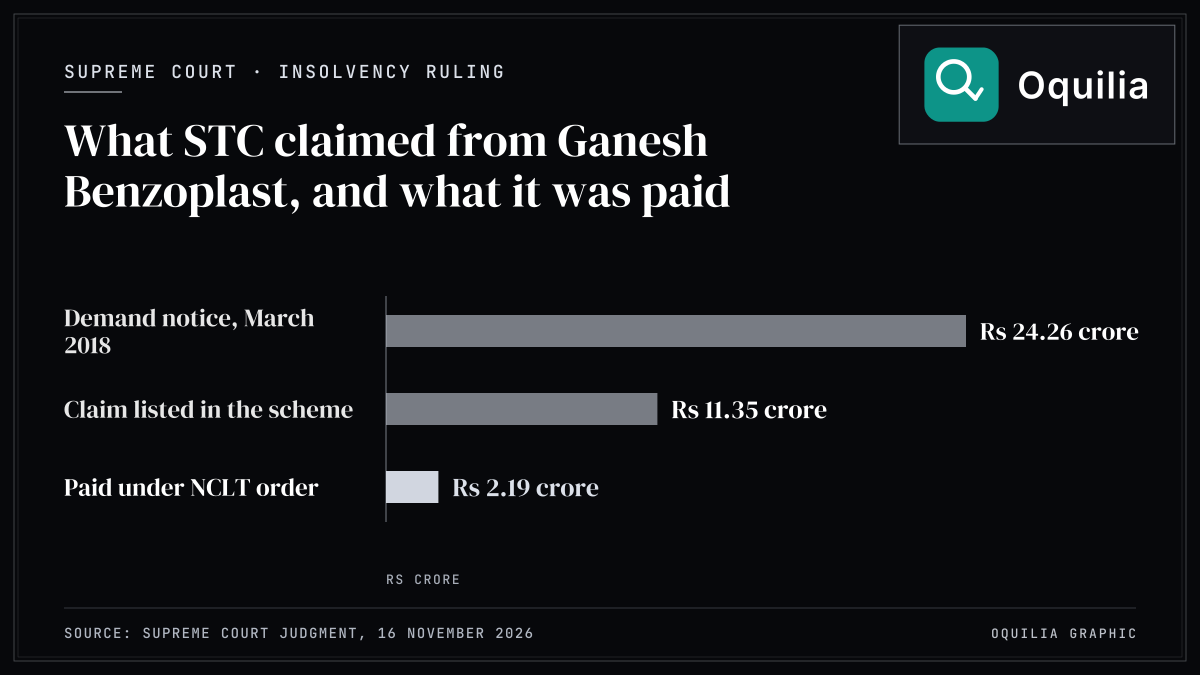
The Supreme Court on 16 November 2026 set aside a judgment of the National Company Law Appellate Tribunal (NCLAT) that had revived an insolvency petition by the State Trading Corporation of India (STC) against Ganesh Benzoplast Ltd. The court restored a 2020 order of the National Company Law Tribunal (NCLT), Mumbai, that had closed the case once the company paid STC Rs 2,18,88,421, which the judgment says was 25% of STC's principal dues.
What Happened
According to the judgment, Ganesh Benzoplast, a chemicals manufacturer and storage terminal operator, was declared a sick industrial unit by the Board for Industrial and Financial Reconstruction (BIFR) in 2010. Its rehabilitation scheme, approved by the Delhi High Court on 4 December 2015, said unsecured creditors would be paid 25% of their principal dues in five annual instalments. STC was listed in the scheme not as an unsecured creditor but as a contingent liability, with a claim of Rs 11.35 crore, and never challenged that.
In March 2018, STC sent a demand notice under the Insolvency and Bankruptcy Code, 2016 for Rs 24.26 crore and then filed an insolvency petition. The NCLT closed the petition in February 2020 by directing payment of 25% of the principal dues, quantified at Rs 2,18,88,421. STC accepted that amount without prejudice on 20 March 2020 but appealed, and the NCLAT restored the petition on 21 January 2026.
The Supreme Court held that, under its earlier rulings in Modi Rubber and Fertilizer Corporation of India, a rehabilitation scheme approved under the Sick Industrial Companies (Special Provisions) Act, 1985 binds all unsecured creditors, and the scheme's option to wait seven years and then claim full dues was not valid. STC, still only a contingent liability, could at best have claimed 25% of its principal dues, which it had already received. Nothing was left to decide, the court held.
What It Means
The insolvency case against Ganesh Benzoplast is over, and STC cannot press for its full claim. The ruling, marked reportable, tells creditors of a company revived under the old sick-company law that the approved scheme's scaled-down payment is the most they can recover, and that a creditor who did not challenge how the scheme treated its claim cannot reopen it later through the insolvency code.
Source: Supreme Court order
Sources & Citations
- Supreme Court order — Supreme Court of India