

Supreme Court grants bail to 3 ex-PHED officials in Jal Jeevan Mission case
The Supreme Court granted bail to three former Rajasthan PHED officials accused in the ACB's Rs 979.45 crore Jal Jeevan Mission tender case, citing a long trial ahead.
Key points
- The Supreme Court on 25 November 2026 granted bail to three former Rajasthan PHED officials accused in the ACB's Jal Jeevan Mission tender case.
- The ACB alleges forged IRCON certificates were used to win about 104 tenders worth Rs 979.45 crore between 2021 and 2023.
- Bail is not acquittal: charges are yet to be framed, the accused are presumed innocent, and the trial court has been asked to expedite the trial.
The Enforcement Action
The Supreme Court on 25 November 2026 granted regular bail to three former senior officials of Rajasthan's Public Health Engineering Department (PHED) who are accused in the Anti-Corruption Bureau's case over tenders awarded under the Jal Jeevan Mission. A bench of Justice Dipankar Datta and Justice Sheel Nagu allowed the appeals of Subodh Agarwal, Dinesh Goel and Mahendra Prakash Soni, and set aside the Rajasthan High Court orders that had refused them bail.
The appeals arose out of SLP (Crl.) Nos. 19042, 19335 and 19254 of 2026, and the common order carries the neutral citation 2026 INSC 1267. All three appeals stem from FIR No. 245/2024 dated 30 October 2024, registered at the Police Station, Anti-Corruption Bureau, Jaipur. The prosecution alleges that work orders for approximately 104 tenders, aggregating to Rs 979.45 crore, were obtained on the strength of forged credentials.
The court was clear about the limits of what it decided. It recorded that it had "not expressed any opinion on the merits of the allegations", and that its observations are confined to bail. The order is not a finding on guilt or innocence; charges have not yet been framed.
Before the court, counsel for the three officials argued that the investigation against them had run its course, that chargesheets had been filed, and that the evidence was largely documentary and already in the agency's custody. The State of Rajasthan opposed bail, citing the scale of the alleged economic offence and the alleged breach of public trust. The officials have not otherwise publicly responded to the allegations on the record reviewed for this report.
How the Scheme Worked
Everything in this section is the prosecution's case as the Supreme Court's orders summarise it. None of it has been tested at trial.
According to the court's 25 November order, the matter began as Preliminary Enquiry No. 06/2024 dated 18 January 2024, which "ultimately culminated" in the October 2024 FIR. The prosecution alleges that between 2021 and 2023, two private contracting firms - M/s Shri Ganpati Tubewell Company and M/s Shri Shyam Tubewell Company - procured forged work-experience certificates purportedly issued by IRCON International Limited, a central public sector enterprise. Using these certificates, the firms are alleged to have qualified for and secured the work orders on about 104 tenders.
The Jal Jeevan Mission is a joint Central and State programme intended to provide household tap connections for drinking water. An earlier Supreme Court order in the same FIR, dated 29 September 2026, describes the prosecution's case that the firms acted "in connivance with senior public servants and private intermediaries", causing wrongful loss to the State exchequer.
The role the prosecution attributes to the three appellants is set out in the latest order. Subodh Agarwal was then Additional Chief Secretary and Chairman of the PHED Finance Committee; Dinesh Goel was then Chief Engineer (Special Projects); and Mahendra Prakash Soni was then Superintending Engineer, PHED, and Additional Chief Engineer (Project), Ajmer. They are accused of abusing their positions on evaluation and finance committees to facilitate the award of the tenders, and of "turning a blind eye" to complaints about the irregularities. The September order records the prosecution's allegation that whistleblower complaints in February and March 2023 had flagged the use of forged IRCON certificates.
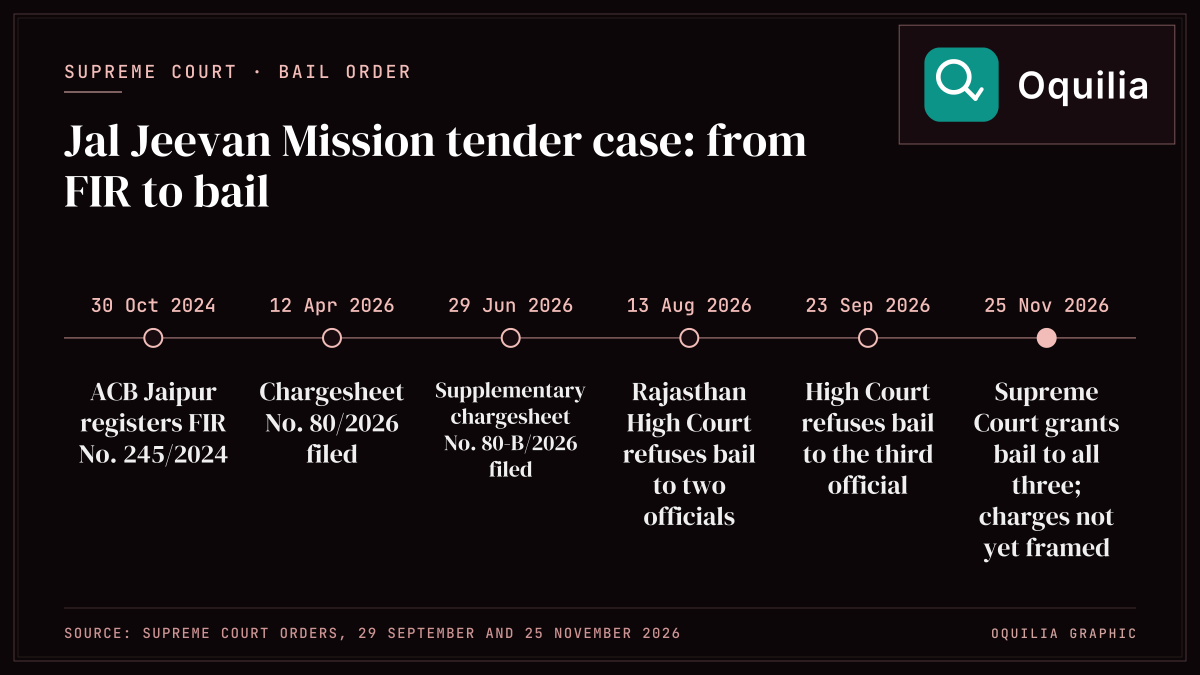
The procedural history runs as follows. The ACB filed Chargesheet No. 80/2026 dated 12 April 2026 and Supplementary Chargesheet No. 80-B/2026 dated 29 June 2026, according to the September order. The prosecution proposes to examine 124 witnesses and relies on documentary evidence running into thousands of pages. The Rajasthan High Court dismissed the bail applications of Agarwal and Soni on 13 August 2026 and that of Goel on 23 September 2026. Arguments in the Supreme Court concluded on 16 November 2026, when the bench reserved its order on two of the petitions, per the court's record of proceedings for that day.
The Law Invoked
The September 2026 Supreme Court order records that FIR No. 245/2024 was registered under Sections 7(c), 9, 10, 13(1)(a) read with Section 13(2), and Section 12 of the Prevention of Corruption Act, 1988 (as amended in 2018), along with Sections 409, 466, 467, 468, 471, 477-A and 120-B of the Indian Penal Code, 1860.
In plain terms, and as offences the FIR alleges rather than findings, the Prevention of Corruption Act provisions the order lists deal with bribery of and by public servants, with criminal misconduct by a public servant (Section 13, with Section 13(2) setting the punishment), and with abetment (Section 12). Per the order, the IPC sections the FIR invokes are the provisions on criminal breach of trust by a public servant (Section 409), forgery of various kinds and the use of forged documents as genuine (Sections 466, 467, 468 and 471), falsification of accounts (Section 477-A) and criminal conspiracy (Section 120-B). The latest order summarises these as "criminal conspiracy, forgery, and criminal breach of trust by public servants".
The September order also notes that the same FIR gave rise to a money-laundering case under ECIR No. JPZO/29/2023, in which the then PHED Minister was granted bail by the Supreme Court on 3 December 2025. It further records that sanction under Section 19 of the Prevention of Corruption Act, which is required before a court can take cognizance against a public servant, was granted on 6 September 2026 for six other co-accused public servants.
What Happens Next
The three officials will be released on bail subject to bail bonds and any conditions the trial court imposes. The Supreme Court directed them to participate diligently in the trial and appear on fixed dates, and said any unjustified default or breach of conditions would entitle the trial court to cancel bail.
The case now returns to the trial court, where charges are yet to be framed. The bench "encouraged" the trial court to frame charges at an early date and expedite the trial, and said any attempt by an accused to delay proceedings may be "dealt with a firm hand", including by cancelling bail without reference to the Supreme Court. The September order noted further reasons the trial has not begun: investigation against some accused is still pending and two accused are absconding.
Bail is not acquittal. A chargesheet contains allegations, not findings of guilt; the accused are presumed innocent until proven guilty, and due process continues. The trial court will weigh the evidence when the case comes to trial.
What It Means
The order applies a principle the same bench set out when it granted bail to co-accused in September: pre-trial incarceration "cannot masquerade as punitive detention". With the investigation against the appellants complete, the evidence largely documentary and a long trial ahead, the court held that further custody would serve no purpose. It also relied on parity, since several co-accused, including the then PHED Minister, had already been released by the Supreme Court or the High Court. For readers following large economic-offence cases, this is the pattern to expect: bail turns on the stage of the case and the risk of tampering, not on the size of the alleged loss.
For citizens, the alleged method in this case is a familiar risk in public procurement: eligibility built on borrowed or forged experience certificates. Procuring departments can reduce that risk by verifying completion certificates directly with the issuing body before a bid is technically qualified. Whistleblower complaints, which the prosecution says were raised in 2023, are only useful if they reach someone obliged to act on them.
Anyone tracking the matter can follow the trial-court stage through the court's own records. Supreme Court daily orders and judgments are published on the court's website and indexed by public legal databases, and Rajasthan High Court bail orders are available in the same way.
FAQ
Does this mean the people named are guilty?
No. A chargesheet contains allegations, not findings of guilt; the accused are presumed innocent until proven guilty, and due process continues. The Supreme Court's order is a bail order only, and the bench stated that it expressed no opinion on the merits of the allegations, the roles attributed to the appellants or the evidentiary value of the records. Charges have not yet been framed.
What exactly did the Supreme Court order?
It allowed the three criminal appeals, set aside the Rajasthan High Court's bail-rejection orders dated 13 August 2026 and 23 September 2026 as they relate to the appellants, and directed that Subodh Agarwal, Dinesh Goel and Mahendra Prakash Soni be released on bail in connection with FIR No. 245/2024, unless required in another case, on bail bonds and terms set by the trial court.
What is the case about?
The Rajasthan Anti-Corruption Bureau alleges that two private firms used forged work-experience certificates, purportedly issued by IRCON International Limited, to secure work orders for about 104 Jal Jeevan Mission tenders worth Rs 979.45 crore between 2021 and 2023, allegedly in connivance with public servants. The prosecution's case is yet to be tested at trial.
Can the bail be cancelled?
Yes. The Supreme Court said that if an appellant fails to appear without justifiable cause or breaches any bail condition, the trial court may cancel that appellant's bail. It also said attempts by any accused to delay the trial may lead to cancellation of bail without reference to the Supreme Court.
Where can I read the official orders?
The Supreme Court's record of proceedings dated 16 November 2026, and its 29 September 2026 order in the same FIR are linked below. The 25 November 2026 order is digitally signed and carries the neutral citation 2026 INSC 1267.
This report is based on the Supreme Court record of proceedings dated 16 November 2026, the Supreme Court's order dated 29 September 2026 in the same FIR, and the Supreme Court order dated 25 November 2026. It was surfaced via coverage in LiveLaw.
This report describes enforcement actions and allegations on the public record, attributed to the officials cited. An order, FIR or chargesheet is not a conviction; parties are presumed innocent until proven guilty.
Named in this report, or spotted an error? Corrections and responses: editor@oquilia.com. We correct errors promptly and record responses from named parties.
Sources & Citations
- Subodh Agarwal vs State of Rajasthan, Supreme Court record of proceedings, 16 November 2026 — Supreme Court of India
- Sanjay Badaya vs State of Rajasthan, 2026 INSC 1065, order dated 29 September 2026 — Supreme Court of India
- Subodh Agarwal vs State of Rajasthan, 2026 INSC 1267, order dated 25 November 2026 — Supreme Court of India (copy via LiveLaw)