

SEBI enforces Rs 2.58 crore recovery from former SecureKloud CFO
SEBI's recovery officer has barred former SecureKloud director R S Ramani from disposing of assets to recover Rs 2.58 crore in dues, alongside a July order finding insider trading.
Key points
- SEBI's Southern Regional Office has prohibited former SecureKloud director and CFO R S Ramani from disposing of any movable or immovable property.
- The order of 3 August 2026 enforces Recovery Certificate No. 8709 of 2025 for about Rs 2.58 crore, plus interest and costs, after bank remittances fell short.
- A separate SEBI order of 31 July 2026 found insider trading and imposed a two-year bar and Rs 10 lakh penalty; it can be appealed to the SAT.
The Enforcement Action
The Securities and Exchange Board of India (SEBI) is enforcing recovery of dues from R S Ramani, a former whole-time director and chief financial officer of Chennai-based SecureKloud Technologies Ltd, formerly known as 8K Miles Software Services Ltd. The recovery runs under Recovery Certificate No. 8709 of 2025, which records dues of Rs 2,58,01,000 (about Rs 2.58 crore) plus further interest, costs, expenses and charges, according to a prohibitory order issued by SEBI's Southern Regional Office.
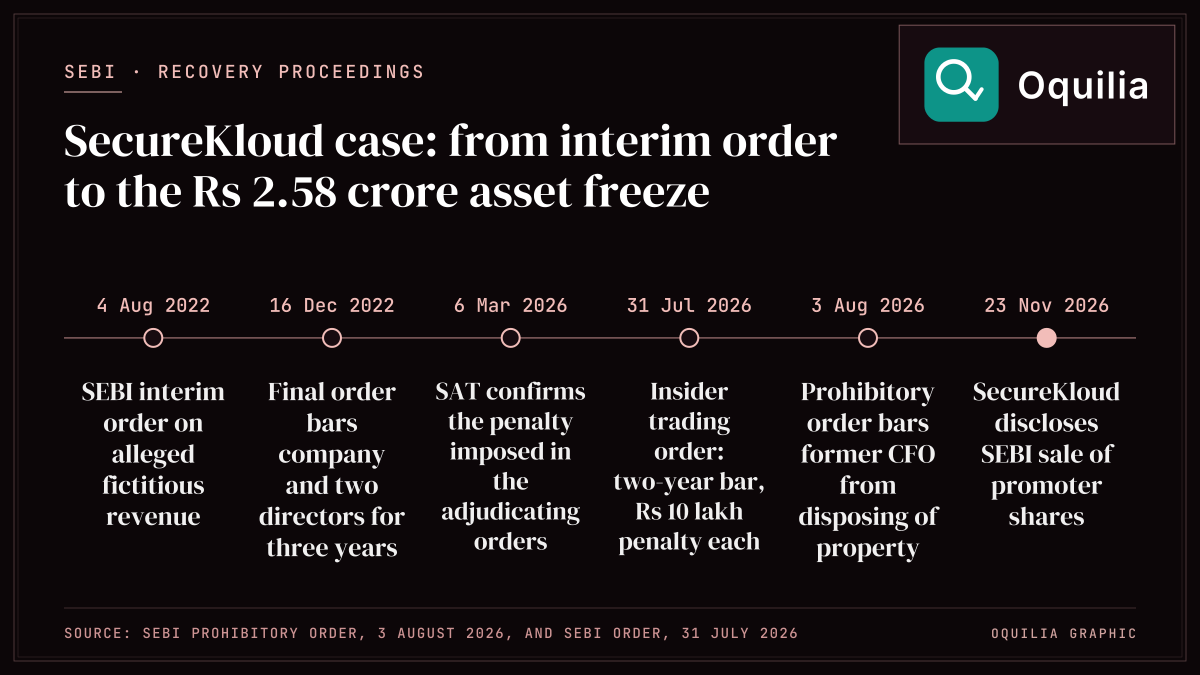
The latest step in the matter surfaced on 23 November 2026, when SecureKloud disclosed a SEBI sale of promoter shares for penalty recovery, as reported in coverage surfaced via Google News from scanx.trade. A sale of attached securities is how a SEBI recovery officer turns frozen holdings into money that can be applied against a certified debt.
Prohibitory Order No. RRD/SRO/1515/2026/1, dated 3 August 2026 and signed by the Recovery Officer at SEBI's Chennai office, bars Mr Ramani, described in the order as the "Defaulter", from disposing of, transferring, alienating or charging any of his movable or immovable property.
Separately, in an order dated 31 July 2026, a SEBI quasi-judicial authority found that Mr Ramani and the company's former chairman and managing director, Suresh Venkatachari, traded in SecureKloud shares while in possession of unpublished price sensitive information, barred both for two years and imposed a penalty of Rs 10 lakh on each. Mr Ramani contended before SEBI that his sales were driven by bona fide personal reasons, including a planned retirement; the order rejected that contention. He has not publicly responded to the recovery proceedings.
How the Scheme Worked
The underlying matter dates back to SEBI's interim order of 4 August 2022. As the July 2026 order summarises it, SEBI alleged that SecureKloud inflated its sales from FY 2016-17 to FY 2018-19 by booking fictitious revenue with three entities, Ensys Technologies Inc, Idol Solutions Inc and Intuit Micro Technologies LLC, which were "controlled /managed by the Promoters / Directors". According to the order, there were no actual sales to these entities and no actual payments received; the amounts shown as received were funded by the company itself.
The interim order culminated in a Final Order dated 16 December 2022 passed by a SEBI Whole Time Member. Per the July 2026 order, that Final Order held that consolidated revenue rose from Rs 271.93 crore in FY 2015-16 to Rs 850.39 crore in FY 2018-19, then fell to Rs 386.43 crore in FY 2019-20 once fictitious revenue stopped being booked. The balance sheet, it found, grew from Rs 44.76 crore in March 2013 to Rs 997.99 crore in March 2019, partly by capitalising fictitious software development expenditure, before Rs 755.17 crore was wiped off in a single year. The statutory auditor, Deloitte Haskins and Sells, resigned citing corporate governance issues and filed a fraud report dated 13 September 2019 with the Central Government.
The Final Order restrained SecureKloud, Mr Venkatachari and Mr Ramani from the securities market for three years. On appeal, the Securities Appellate Tribunal (SAT), by an order dated 6 March 2026, "confirmed the penalty imposed in the Adjudicating Orders" and found merit in SEBI's findings, though it set aside a direction to recover Rs 3.83 crore from Mr Venkatachari.
A separate insider-trading investigation followed. SEBI's July 2026 order records that Mr Ramani sold 16,82,506 shares between 15 May 2017 and 22 January 2018 for about Rs 110.48 crore, while the information about the misstated accounts remained unpublished until the auditor's report was disclosed on 3 November 2019. The show-cause notice had put the loss avoided at about Rs 103.19 crore. The order, however, held that the computation did not reasonably approximate the gain and declined to direct disgorgement, leaving SEBI free to issue a fresh notice.
On recovery, the prohibitory order sets out the chronology: a Notice of Demand dated 23 April 2025; attachment orders dated 10 March 2026 covering demat accounts, mutual fund folios, bank accounts and lockers; and an order dated 21 April 2026 directing banks to remit balances and mutual funds to redeem units. Because those remittances were "not sufficient", the Recovery Officer issued the 3 August prohibitory order.
The Law Invoked
The prohibitory order is issued under Rules 16 and 48 of the Second Schedule to the Income-tax Act, 1961, read with Section 28A of the SEBI Act, 1992. Section 28A lets SEBI recover unpaid penalties, disgorgement and other dues using the machinery the tax department uses against tax defaulters. Rule 16 restrains a defaulter from dealing with property once a notice is served, and Rule 48 provides for attachment of immovable property by an order prohibiting the defaulter from transferring or charging it.
The July 2026 order found violations of Section 12A(d) and 12A(e) of the SEBI Act, which prohibit insider trading and dealing on the basis of material non-public information, read with Regulation 4(1) of the SEBI (Prohibition of Insider Trading) Regulations, 2015, which bars an insider from trading while in possession of unpublished price sensitive information. The penalties were imposed under Section 15G, which provides for a penalty of not less than Rs 10 lakh for insider trading.
The directions were issued under Sections 11(1), 11(4), 11(4A), 11B(1) and 11B(2) of the SEBI Act, which empower SEBI to restrain persons from the market and levy penalties after an inquiry.
What Happens Next
Under the prohibitory order, Mr Ramani was directed to furnish details of all his movable and immovable property, with original title deeds, to SEBI's Southern Regional Office within two weeks. The order is also served on the Inspector General of Registration in Tamil Nadu and on district registrars and sub-registrars, who are directed not to register any transfer, mortgage or lease of his property. Recovery continues until the certified dues, with interest and costs, are realised.
The July 2026 order directs payment of the Rs 10 lakh penalties within 45 days of receipt. Under paragraph 103, the new two-year restraint begins only after the three-year restraint from the December 2022 Final Order expires. SEBI orders are appealable to the SAT under Section 15T of the SEBI Act, and SAT rulings can be taken to the Supreme Court on questions of law.
Whether a fresh disgorgement proceeding follows is open; the order expressly left SEBI "at liberty" to pursue one after further analysis.
What It Means
For shareholders of SecureKloud, the recovery proceedings do not touch their holdings; they are directed at the personal assets of a person SEBI has certified as a defaulter. The broader signal is that SEBI's recovery wing pursues certified dues for years after the original order, moving from bank remittances to attachment of securities and, where needed, freezing of real estate.
The matter is also a reminder of how accounting red flags surface. In this case, the signals SEBI later relied on included rapid revenue growth concentrated in a few related counterparties and the resignation of a statutory auditor citing governance concerns. Investors can track auditor resignations, which listed companies must disclose to stock exchanges, and read the reasons given.
Anyone can check whether SEBI has acted against a company or its promoters by searching the Enforcement section of sebi.gov.in, which publishes orders, recovery certificates, attachment notices and release orders by name.
FAQ
What did SEBI order in the recovery proceedings?
The Recovery Officer at SEBI's Southern Regional Office prohibited R S Ramani from disposing of, transferring or charging any movable or immovable property, and directed him to disclose all his assets with title deeds within two weeks. The order, dated 3 August 2026, enforces Recovery Certificate No. 8709 of 2025 for Rs 2,58,01,000 plus interest and costs.
What is the legal status of SEBI's findings?
SEBI's findings are regulatory, not criminal. The July 2026 order is a quasi-judicial finding by SEBI that can be appealed to the Securities Appellate Tribunal. No court has convicted anyone in this matter, and those named retain every remedy available to them under the SEBI Act.
Can the July 2026 order be appealed?
Yes. Section 15T of the SEBI Act allows any person aggrieved by a SEBI order to appeal to the SAT, generally within 45 days of receiving the order. The SAT may confirm, modify or set aside the order, and its rulings can be appealed to the Supreme Court.
Does this affect ordinary SecureKloud shareholders?
The recovery proceedings target the defaulter's own assets, not the company or its public shareholders, and nothing in the prohibitory order directs any action against the company. Shareholders should rely on the company's stock exchange filings for any further updates.
Where can I read the official orders?
Both the prohibitory order and the 31 July 2026 order are published in the Enforcement section of sebi.gov.in, under Recovery Proceedings and Orders respectively. The links appear in this report.
This report is based on the official SEBI prohibitory order dated 3 August 2026 and SEBI order dated 31 July 2026. It was surfaced via coverage in scanx.trade.
This report describes enforcement actions and allegations on the public record, attributed to the officials cited. An order, FIR or chargesheet is not a conviction; parties are presumed innocent until proven guilty.
Named in this report, or spotted an error? Corrections and responses: editor@oquilia.com. We correct errors promptly and record responses from named parties.