

SEBI eases KYC for investors: name change via PAN and Aadhaar, portable KYC records
SEBI has changed its KYC rules so investors can change their name with PAN and Aadhaar alone and reuse verified KYC records across brokers and mutual funds, from 24 December 2026.
Key points
- SEBI issued a circular on 25 November 2026 simplifying client on-boarding and KYC records held by KYC Registration Agencies.
- The changes take effect from 24 December 2026, and KRAs must issue a standard operating procedure within 30 days.
- Investors need fewer documents for a name change, and a verified KYC record can be reused when opening accounts elsewhere.
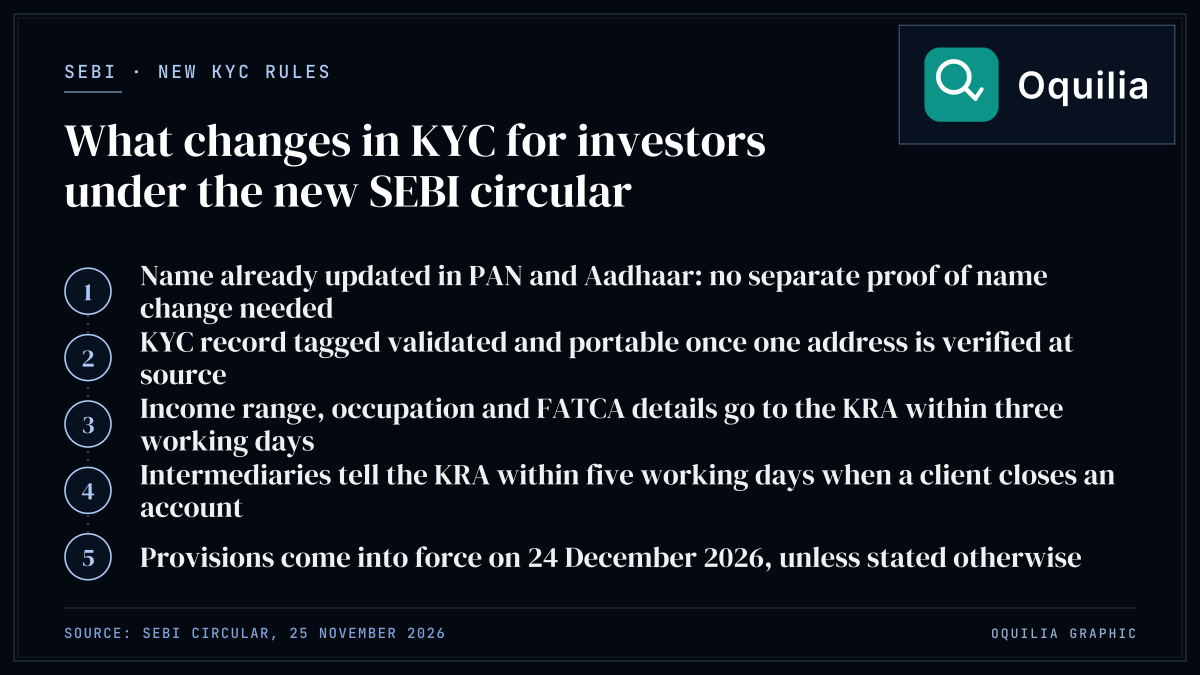
The Securities and Exchange Board of India (SEBI) has changed the know-your-client (KYC) rules that brokers, depository participants, mutual funds and other market intermediaries follow, to make opening accounts simpler. The circular is dated 25 November 2026 and its provisions come into force on 24 December 2026, unless stated otherwise. The changes follow a working group's review and a public consultation, SEBI said.
What Happened
KYC records in the securities market are held by KYC Registration Agencies (KRAs), which share them with intermediaries. Under the circular, some common details from the account opening form, such as income range, occupation, politically exposed person status and FATCA and CRS tax information, will now be uploaded to the KRA within three working days of KYC, along with the CKYC ID, the DIGIPIN address code and the expiry date of the identity document, where available.
An investor who has already updated their name in PAN and Aadhaar will no longer need to submit separate proof of a name change. Otherwise, a marriage certificate, a passport showing the husband's name or a gazette notification will do, with extra documents for Karnataka and Punjab.
A KYC record will be tagged "validated" and portable across intermediaries if either the current or the permanent address has been verified at source. Verifying a mobile number becomes optional where the KRA already shows it as verified and seeded with Aadhaar. Overseas address proof becomes optional for Overseas Citizen of India card holders and foreign nationals resident in India who give verified proof of an Indian address.
Intermediaries must tell the KRA within five working days when a client closes an account. Mutual funds must report folios with no holding or transaction for six months.
What It Means
For investors, opening an account with a new broker or fund house should need fewer repeat documents, since more verified details will travel with the KYC record. Intermediaries must update a client's record when the KRA or the central KYC registry sends a change, and give the client an option to confirm it. Several of the changes also apply to individual non-resident clients from FATF-compliant countries. Complaints against a registered intermediary can be filed on SEBI's SCORES portal at https://scores.sebi.gov.in.
Source: SEBI circular
Sources & Citations
- SEBI circular — Securities and Exchange Board of India