

RBI issues final rules for banks to put debit holds on suspected money mule accounts
RBI on 27 November 2026 issued final directions setting a uniform, time-bound procedure for banks to hold suspected money mule accounts, effective from 1 July 2027.
Key points
- RBI issued final amendment directions on suspected money mule accounts for six types of banks on 27 November 2026.
- The directions take effect from 1 July 2027, or earlier if a bank decides to implement the procedure sooner, RBI said.
- Banks will follow a common procedure for temporary debit holds, which RBI said is meant to protect genuine customers from inconvenience.
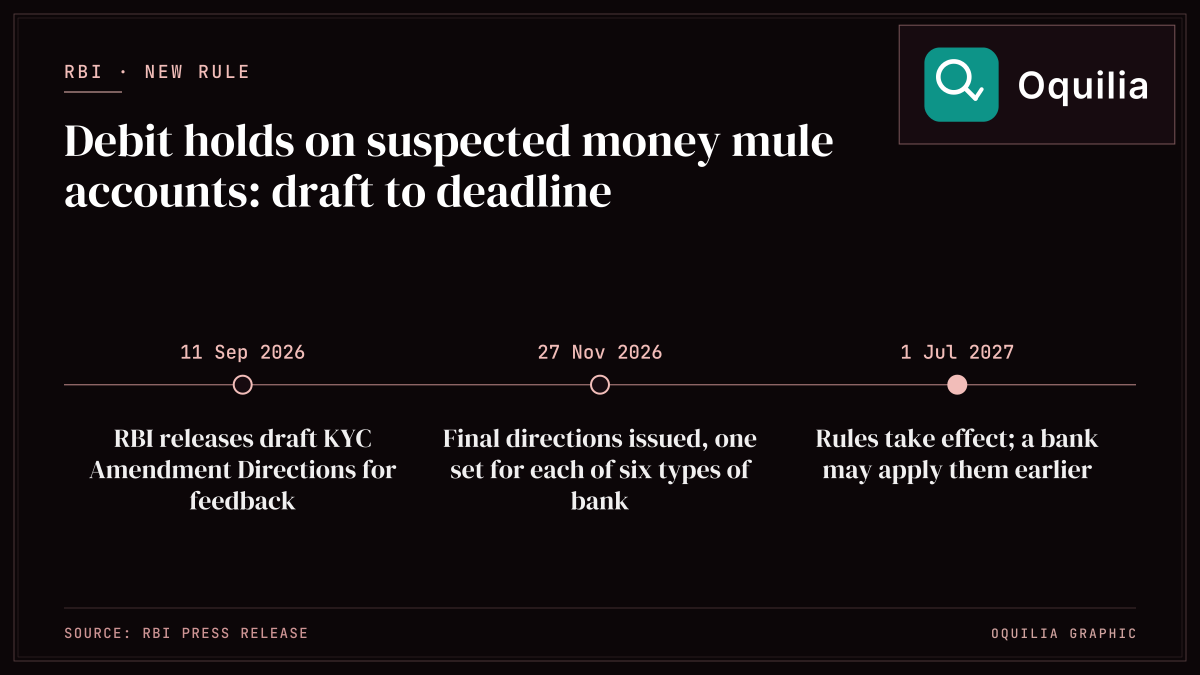
The Reserve Bank of India (RBI) on 27 November 2026 issued final rules on how banks may place temporary debit holds on accounts suspected of being used as money mule accounts in cyber-enabled financial frauds. The rules take effect from 1 July 2027, RBI said, though a bank may choose to apply them earlier. They cover commercial banks, small finance banks, payments banks, local area banks, regional rural banks and urban co-operative banks.
What Happened
RBI had released a draft of the Know Your Customer (KYC) Amendment Directions on 11 September 2026 and sought feedback from stakeholders. According to RBI, the draft proposed a Standard Operating Procedure (SOP): a uniform, time-bound procedure under which banks would, on their own, place temporary debit holds on amounts or accounts suspected to be linked to money mule activity and cyber-enabled financial frauds, and remove such holds in coordination with law enforcement agencies. RBI said the draft also aimed to protect genuine customers from inconvenience.
RBI said it has examined the feedback, incorporated the resulting changes in the final directions and published a statement on the feedback received. It issued six sets of amendment directions, one for each type of bank: commercial banks, small finance banks, payments banks, local area banks, regional rural banks and urban co-operative banks.
A money mule account is a bank account used to receive and pass on money obtained through fraud. A debit hold stops money from being withdrawn or moved out of an account, or out of a specific amount in it, while the hold is in place.
What It Means
For bank customers, the change means that from 1 July 2027 at the latest, every bank in these six groups will follow a common, time-bound procedure when it suspects that an account or an amount is linked to mule activity. RBI has said the procedure is meant to protect genuine customers from inconvenience, and that holds are to be removed in coordination with law enforcement agencies.
Some banks may start sooner, since RBI has allowed a bank to implement the procedure before that date.
Anyone who has lost money to a cyber fraud should report it at once at https://cybercrime.gov.in or on helpline 1930. A complaint against a bank can be filed with RBI at https://cms.rbi.org.in.
Source: RBI press release
This report describes enforcement actions and allegations on the public record, attributed to the officials cited. An order, FIR or chargesheet is not a conviction; parties are presumed innocent until proven guilty.
Named in this report, or spotted an error? Corrections and responses: editor@oquilia.com. We correct errors promptly and record responses from named parties.
Sources & Citations
- RBI press release — Reserve Bank of India