

Orissa High Court quashes unreasoned cognizance order against Goldenland Developers in ED case
The Orissa High Court on 18 November 2026 quashed a Bhubaneswar court's order taking cognizance of a money-laundering complaint by the ED against Goldenland Developers, holding it gave no reasons.
Key points
- The Orissa High Court quashed a Bhubaneswar Sessions Court order that took cognizance of an ED money-laundering complaint against Goldenland Developers.
- The High Court held on 18 November 2026 that the order of 6 October 2026 gave no reasons and sent the matter back to the trial court.
- The trial court must hear both sides and decide on cognizance afresh within one month; the High Court expressed no view on the merits.
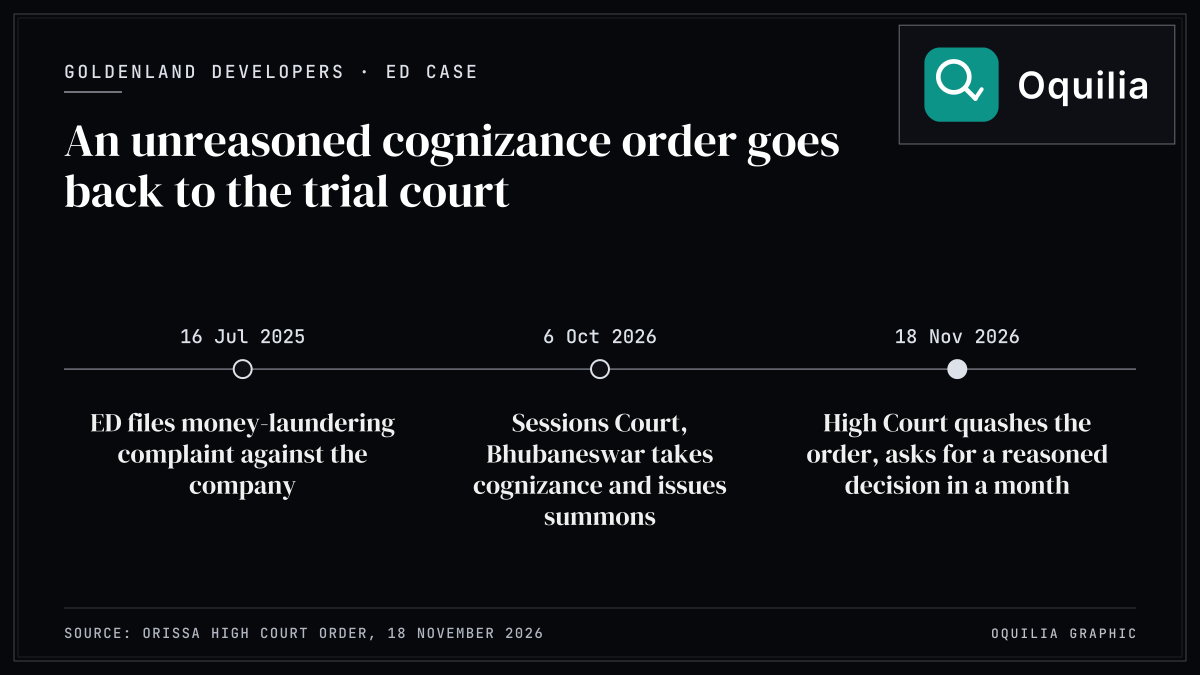
The Orissa High Court on 18 November 2026 quashed an order of a Sessions Court in Bhubaneswar that had taken cognizance of a money-laundering complaint filed by the Enforcement Directorate (ED) against New Delhi-based Goldenland Developers Ltd and others, holding that the order gave no reasons. Taking cognizance is the step at which a court decides there is enough material to proceed with a case and summon the accused.
What Happened
The company and the other petitioners challenged the Sessions Court's order of 6 October 2026 in PMLA Case No. 03 of 2025, which took cognizance of an offence under Section 4 of the Prevention of Money Laundering Act, 2002 and issued summons, according to the High Court's order. Their counsel argued that the order was unsustainable because it assigned no reasons. The ED filed a counter affidavit defending the order on its merits.
The High Court noted that the operative part of the trial court's order said only that, prima facie, materials were available to attract Section 4 of the Act. The High Court declined to go into the merits of the case. It held that since cognizance had been taken without reasons, the proper course was to send the matter back.
The High Court quashed the order of 6 October 2026 and remitted the case to the same Sessions Court to hear both parties and decide on cognizance afresh, with adequate reasons. As the ED's complaint was filed on 16 July 2025, it asked the trial court to hear the parties and pass orders within one month. It made clear that it had expressed no opinion on the merits.
The case against the company and the others rests on the ED's allegations. These are allegations, not findings of guilt; the accused are presumed innocent until proven guilty in court, and due process continues.
What It Means
The order does not end the ED's case: the trial court will decide again whether to proceed, this time with reasons, after hearing both sides. It reinforces that a court taking cognizance of a money-laundering complaint must record why it finds enough material to summon the accused, a safeguard that applies to every accused in such cases.
Source: High Court judgment
Sources & Citations
- High Court judgment — Orissa High Court