

Form 173A and New Rule 281A: How FPIs Claim the Schedule IV G-Sec Interest and Gains Exemption
CBDT Notification 137/2026 inserts Rule 281A and Form 173A: FPIs claiming the Schedule IV (Sl. Nos. 13D, 13E) exemption on G-sec interest and gains must now report every ISIN.
Key points
- The CBDT's Notification No. 137/2026 inserts Rule 281A and Form No. 173A into the Income-tax Rules, 2026.
- Claims under Schedule IV (Table: Sl. Nos. 13D and 13E) of the Income-tax Act, 2025 now need 9 fields per ISIN, in rupees, signed by the Principal officer.
- FPIs should map every government security they hold to its own Part B block; only the BIS may skip the TIN and SEBI registration fields.
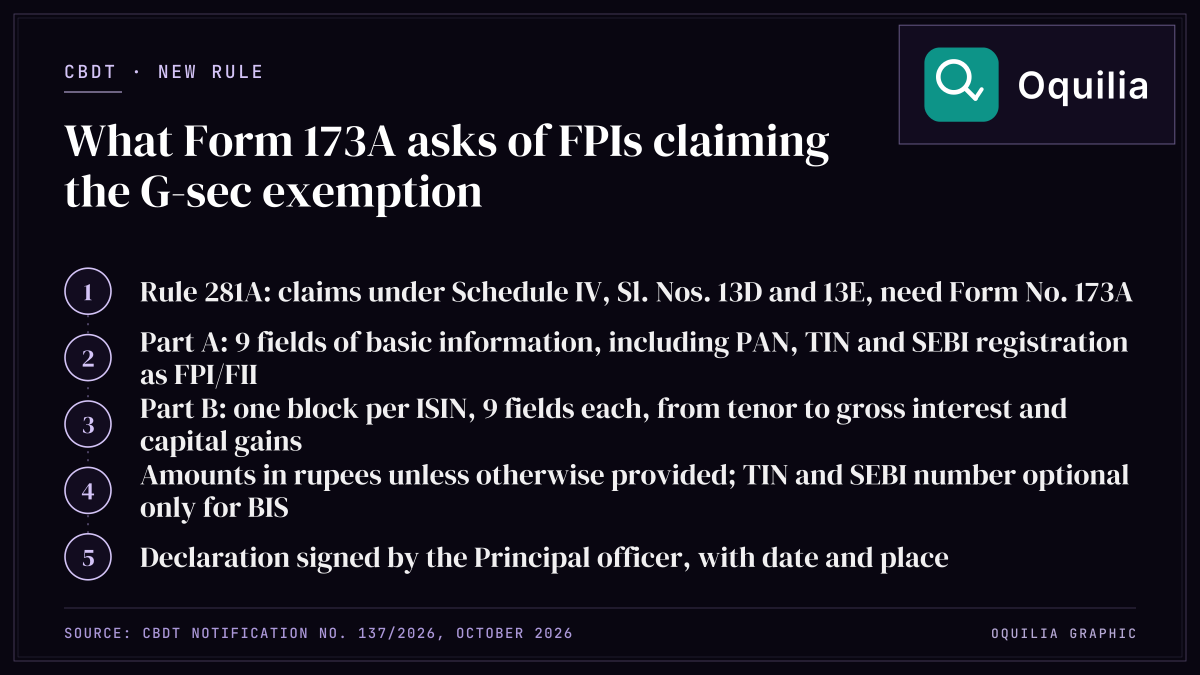
The Central Board of Direct Taxes (CBDT) has added a new disclosure step for foreign portfolio investors that want to keep their Indian government bond income out of tax. Notification No. 137/2026 (F. No. 370142/35/2026-TPL), issued in October 2026, makes the Income-tax (Seventh Amendment) Rules, 2026. It inserts Rule 281A into the Income-tax Rules, 2026 and creates Form No. 173A, which must be furnished to claim the exemption listed at Sl. Nos. 13D and 13E of the Table in Schedule IV of the Income-tax Act, 2025.
The notification on the Income Tax Department's portal runs to two pages. This guide covers what it says, a worked example, and the filing errors to avoid.
What the Section Says
The notification is made under section 533 of the Income-tax Act, 2025 (30 of 2025), read with Schedule IV of that Act. Section 533 is the rule-making power; Schedule IV carries the Table of exemptions, and Sl. Nos. 13D and 13E of that Table are the entries this form serves. The amending rules come into force on the date of their publication in the Official Gazette, so there is no grace period written into the text.
New Rule 281A sits immediately after Rule 281 and says, in substance, one thing: for the purposes of claiming exemption under Schedule IV (Table: Sl. Nos. 13D and 13E), the assessee shall furnish information in Form No. 173A. The rule does not say the exemption is new; it says the claim now has to be supported by a prescribed form.
The form's own title states what is being claimed: "Information to be furnished for claiming exemption on interest and capital gains from Government securities". Two income streams are covered, interest and capital gains, and both are reported security by security.
The parent rules matter for context. According to the note at the foot of Notification 137/2026, the Income-tax Rules, 2026 were published as G.S.R. 198(E) dated 20 March 2026, and this is their seventh amendment in 2026. The notification is signed by Under Secretary Kritika Jain for the CBDT.
Who the form is written for
Field (vi) of Part A asks for a "SEBI Registration Number as FPI/FII", which tells you the intended filer: a foreign portfolio investor (or a legacy foreign institutional investor) registered with the Securities and Exchange Board of India. Note 4 then carves out one named institution: for the Bank for International Settlements (BIS), the Tax Identification Number and SEBI registration fields are optional. Nothing in the two pages names any other category of claimant, so readers should check the text of Sl. Nos. 13D and 13E themselves on India Code before relying on the exemption.
Part A: basic information (9 fields)
| Field | What is asked | Note in the form |
|---|---|---|
| (i) | Name | Note 1: name in full |
| (ii) | Country of residence | - |
| (iii) | Address in the country of residence or headquarters | Note 2: 7 address components |
| (iv) | Permanent Account Number (PAN) | - |
| (v) | Tax Identification Number (TIN) in country of residence | Note 4: optional for BIS |
| (vi) | SEBI registration number as FPI/FII | Note 4: optional for BIS |
| (vii) | Tax year for which exemption is claimed | - |
| (viii) | Email ID | - |
| (ix) | Contact number with country code | - |
Note 2 lists the 7 address components expected: country or specified territory; flat, door or building; road, street, block or sector; PIN or ZIP code; town, area or locality; district; and state.
Part B: details per government security (9 fields per ISIN)
| Field | What is asked |
|---|---|
| (i) | International Securities Identification Number (ISIN) |
| (ii) | Type: Treasury Bills, Fixed Rate bonds, Floating Rate bonds, State Development Loans (SDLs), or Others (specify), select one |
| (iii) | Tenor |
| (iv) | Total value of securities as on 1 April |
| (v) | Value of securities purchased during the year |
| (vi) | Sale consideration of securities sold during the year |
| (vii) | Total value of securities as on 31 March |
| (viii) | Gross interest received or accrued during the tax year |
| (ix) | Capital gains earned during the tax year |
Block A of Part B covers one ISIN; the form then says "Repeat if required", so a portfolio of 40 ISINs means 40 blocks. Fields (iv) to (ix) all carry Note 3, under which amounts are to be filled in rupees unless otherwise provided. The form closes with a declaration that the information is true and in accordance with Schedule IV (Table: Sl. Nos. 13D and 13E), dated, with place, and signed by the Principal officer.
Worked Example
The figures below are illustrative only. They describe a hypothetical FPI, called Fund X here, holding 2 Indian government securities during one tax year (1 April to 31 March). The ISINs are placeholders, not real securities.
Fund X holds a 10-year fixed rate central government bond (Block A) and a 15-year State Development Loan (Block B). Its custodian's records give the following year-end numbers, already converted to rupees as Note 3 requires.
| Part B field | Block A: fixed rate bond | Block B: SDL |
|---|---|---|
| (i) ISIN | IN-PLACEHOLDER-A | IN-PLACEHOLDER-B |
| (ii) Type | b. Fixed Rate bonds | d. State Development Loans |
| (iii) Tenor | 10 years | 15 years |
| (iv) Value on 1 April | Rs 200 crore | Rs 80 crore |
| (v) Purchased during year | Rs 50 crore | Rs 0 |
| (vi) Sale consideration | Rs 30 crore | Rs 20 crore |
| (vii) Value on 31 March | Rs 222 crore | Rs 61 crore |
| (viii) Gross interest | Rs 14 crore | Rs 5.2 crore |
| (ix) Capital gains | Rs 0.6 crore | Rs 0.4 crore |
Across both blocks, Fund X reports gross interest of Rs 19.2 crore (Rs 14 crore plus Rs 5.2 crore) and capital gains of Rs 1 crore (Rs 0.6 crore plus Rs 0.4 crore). That is Rs 20.2 crore of income for which it is claiming exemption under Sl. Nos. 13D and 13E, and the form supports that claim line by line.
A quick reasonableness check helps before the Principal officer signs. For Block A, opening value of Rs 200 crore plus purchases of Rs 50 crore minus sale consideration of Rs 30 crore gives Rs 220 crore; the closing value of Rs 222 crore is Rs 2 crore higher, which here reflects a price movement during the year. For Block B, Rs 80 crore minus Rs 20 crore gives Rs 60 crore against a closing Rs 61 crore, a Rs 1 crore difference. Form 173A does not ask for this roll-forward, and its notes do not prescribe a valuation basis for fields (iv) and (vii), but a working paper kept for each of the 2 blocks means any query can be answered quickly.
Two further checks are worth making. First, on a consistent valuation basis, field (vii) for one year should reconcile to field (iv) for the next for each ISIN still held on 1 April; a gap between the two is easy for a reviewer to spot. Second, the interest in field (viii) is "received/accrued", so a coupon that accrued on 31 March but is paid in April belongs in the year it accrued, not the year it was paid.
Common Mistakes
Because the form took effect on Gazette publication in October 2026, there is no published body of assessment orders on it yet. The pitfalls below are drawn from the form's own wording and notes, and each one maps to a specific field.
| Mistake | Field affected | What the form requires |
|---|---|---|
| Reporting in US dollars or another currency | Part B (iv) to (ix) | Note 3: amounts in rupees unless otherwise provided |
| Grouping several ISINs in one block | Part B (i) | One block per ISIN, "Repeat if required" |
| Ticking 2 security types | Part B (ii) | "Select one" of 5 options |
| Abbreviated fund name | Part A (i) | Note 1: name in full |
| Address with missing PIN/ZIP or district | Part A (iii) | Note 2: 7 components |
| Netting interest against losses | Part B (viii) | Gross amount of interest |
| Leaving TIN or SEBI number blank | Part A (v), (vi) | Optional only for BIS under Note 4 |
| Using "financial year" wording from old forms | Part A (vii) | The form asks for the "Tax year" |
| Declaration signed by an authorised signatory not designated as Principal officer | Declaration | Signature of the Principal officer |
Treating the BIS carve-out as general
Note 4 relaxes fields (v) and (vi) for one entity only, the Bank for International Settlements. An FPI that leaves its SEBI registration number blank is filing an incomplete form; there is no wider exemption from those 2 fields in the text of Notification 137/2026.
Assuming the old-law references still apply
Every reference in the form points to Schedule IV of the Income-tax Act, 2025, not to section 10 of the 1961 Act. Compliance manuals written before the 2025 Act should be updated to cite Rule 281A and Form 173A, and to describe the exemption by its Schedule IV serial numbers 13D and 13E. Our glossary entry on tax exemption explains how exempt income differs from a deduction. For residents holding similar securities, the income tax calculator covers the regular slab computation.
FAQ
What is Form 173A?
Form No. 173A is the form inserted by Notification No. 137/2026 into the Income-tax Rules, 2026. It is titled "Information to be furnished for claiming exemption on interest and capital gains from Government securities" and is required by new Rule 281A for claims under Schedule IV (Table: Sl. Nos. 13D and 13E) of the Income-tax Act, 2025.
When did Rule 281A come into force?
Under rule 1(2) of the Income-tax (Seventh Amendment) Rules, 2026, the rules come into force on the date of their publication in the Official Gazette. The notification is dated October 2026.
Who signs Form 173A?
The declaration at the end of the form is signed by the Principal officer, with date and place. The signatory certifies that the information is true and in accordance with Schedule IV (Table: Sl. Nos. 13D and 13E) of the 2025 Act.
Which government securities go into Part B?
Part B offers 5 types: Treasury Bills, Fixed Rate bonds, Floating Rate bonds, State Development Loans (SDLs), and Others (to be specified). Each ISIN is reported in its own block with its tenor, opening and closing values, purchases, sale consideration, gross interest and capital gains.
Does the Bank for International Settlements have to give a SEBI number?
No. Note 4 to the form makes the TIN in the country of residence and the SEBI registration number as FPI/FII optional for the Bank for International Settlements. All other fields still apply.
In which currency are the amounts reported?
Note 3 says amounts are to be filled in rupees unless otherwise provided. A fund that keeps its books in another currency must convert before filling fields (iv) to (ix) of Part B.
Does Form 173A itself grant the exemption?
No. The exemption sits in Schedule IV of the Income-tax Act, 2025; Rule 281A and Form 173A only prescribe the information to be furnished when claiming it. Eligibility conditions should be read from Sl. Nos. 13D and 13E of the Schedule, available on India Code.
Sources & Citations
- Notification No. 137/2026: Income-tax (Seventh Amendment) Rules, 2026 — Income Tax Department (CBDT)
- India Code: Income-tax Act, 2025 — India Code
- Securities and Exchange Board of India — SEBI