

Registered valuers and authorised income-tax practitioners get until 31 March 2027 under the Income-tax Act, 2025: revised Forms 169 and 171
CBDT Notification 120/2026 moves the registration date for valuers and authorised income-tax practitioners to 31 March 2027 and revises Forms 169 and 171. Fees, asset classes and pitfalls.
Key points
- The CBDT, by Notification No. 120/2026 dated 17 September 2026, moved the date in rules 246(4) and 256(4) of the Income-tax Rules, 2026 to 31 March 2027.
- Revised Form No. 169 for valuers under section 514 costs Rs 10,000 per asset class, with nil fee for valuers already registered under the Wealth-tax Act, 1957.
- Valuers and authorised income-tax practitioners now have until 31 March 2027, and taxpayers relying on valuation reports should confirm their valuer's registration.
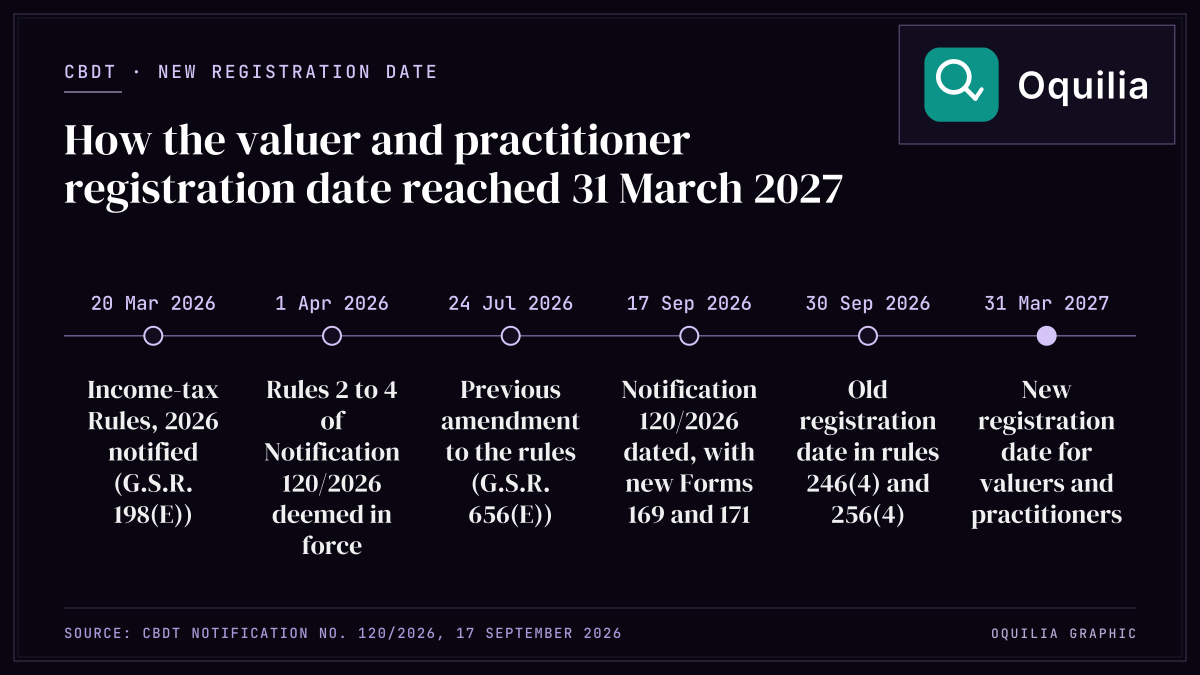
The Central Board of Direct Taxes (CBDT) has pushed a registration date for two groups of professionals back by six months. Notification No. 120/2026 (G.S.R. 822(E)), dated 17 September 2026, makes the Income-tax (Fourth Amendment) Rules, 2026, and replaces "30th September, 2026" with "31st March, 2027" in rule 246(4) and rule 256(4) of the Income-tax Rules, 2026. The e-filing portal describes this as extending the registration deadline for Registered Valuers and Authorised Income-tax Practitioners to 31 March 2027. The same notification substitutes a fresh Form No. 169 for valuers under section 514 and a fresh Form No. 171 for authorised income-tax practitioners under section 515 of the Income-tax Act, 2025 (30 of 2025).
Valuers matter to ordinary taxpayers more than the name suggests. Whenever a capital asset such as land, a building, unlisted shares or jewellery has to be valued for income-tax purposes, the figure frequently comes from a registered valuer, and that figure flows into a capital gains computation. If your valuer's registration lapses under the new Act, the report may be questioned. This explainer sets out what the 17 September 2026 notification changes, using only the Gazette text.
What the Section Says
The notification is made under section 533 of the Income-tax Act, 2025, read with sections 262, 273, 413, 514 and 515. It has 8 rules, and they come into force on two different dates, which is the first point practitioners tend to miss.
| Rule of the notification | What it changes | In force from |
|---|---|---|
| Rule 2 | Rule 160(3) and 160(4): reference "(i)" becomes "(a)" | 1 April 2026 (deemed) |
| Rule 3 | Rule 176(3)(a)(ii): "by affixing digital signature" becomes "by way of an electronic communication" | 1 April 2026 (deemed) |
| Rule 4 | Rule 225: clause (4)(c) and sub-rules (75) to (83) and (91) omitted; wording changes in (19), (56) and (87) | 1 April 2026 (deemed) |
| Rule 5 | Rule 246(4): "30th September, 2026" becomes "31st March, 2027" (valuers) | Date of Gazette publication |
| Rule 6 | Rule 256(4): "30th September, 2026" becomes "31st March, 2027" (practitioners) | Date of Gazette publication |
| Rule 7 | New Form No. 169 (rules 246 and 247) | Date of Gazette publication |
| Rule 8 | New Form No. 171 (rules 256 and 257) | Date of Gazette publication |
Section 514 (valuers). Under the revised Form No. 169, an applicant applies for registration as a valuer under section 514 to the Principal Chief Commissioner, Chief Commissioner, Principal Director General or Director General, as applicable. The form has 5 parts: Part A personal information (name in full, PAN, address, date of birth, mobile and e-mail), Part B class of asset, Part C qualifications under rule 247(2), Part D disqualifications under rule 247(4) or (5), and Part E verification and declaration.
Part C asks for uploads of educational qualifications, former employment, practice as a consulting engineer, real-estate valuer, surveyor or architect, and full details of experience as a valuer, including a list of assets valued or works executed during the last 3 years. Question 8(ii) asks whether the applicant is registered as a valuer under the Wealth-tax Act, 1957 (27 of 1957); if yes, a valid certificate must be uploaded.
Note 3 to Form No. 169 lists 11 classes of asset. Note 6 says a separate form is required for each class, and Note 7 sets the fee.
| Sl. No. | Class of asset in Form No. 169 |
|---|---|
| 1 | Immovable property (other than agricultural lands, plantations, forests, mines and quarries) |
| 2 | Agricultural lands, other than coffee, tea, rubber or cardamom plantation |
| 3 | Coffee, tea, rubber or cardamom plantation |
| 4 | Forest |
| 5 | Mines and quarries |
| 6 | Stocks, shares, debentures, securities, shares in partnership firms and business assets, including goodwill |
| 7 | Machinery and plant |
| 8 | Jewellery |
| 9 | Works of art |
| 10 | Life interest, reversions and interest in expectancy |
| 11 | Any other asset |
The fee under Note 7 is Rs 10,000 per form. No fee is payable by a valuer already registered under the Wealth-tax Act, 1957. Note 8 says some information in the form will be pre-filled "to the extent possible".
In Part E, the valuer declares 4 things: (a) to make an impartial and true valuation of any asset they are required to value; (b) to furnish the valuation report in the prescribed form; (c) to charge fees not exceeding the rate or rates prescribed by the Board; and (d) not to value any asset in which they have a direct or indirect interest.
Section 515 (authorised income-tax practitioners). The revised Form No. 171 is addressed to the Chief Commissioner or Commissioner of Income-tax and covers registration under section 515(3)(a)(v), (vi), (vii) or (viii). Part A asks for 9 items of personal data, including gender, PAN, permanent and present addresses, principal place of profession in India and, for a partner in a firm, the firm's name and PAN.
Part B (row 10 of Form No. 171) asks for prescribed educational qualifications with a true copy of the certificate (Annexure A-1), whether the applicant is already registered as an authorised income-tax practitioner under the Income-tax Act, 1961 (43 of 1961) with the certificate (Annexure A-2), any other eligibility details (Annexure A-3), and whether the applicant is disqualified under section 515(4), (5) or (7). An applicant who is disqualified must say whether the disqualification is permanent under section 515(4)(a), 515(5)(b) or 515(7); if not permanent, the form asks for the date until which it runs.
The applicant also certifies 2 facts: practice before income-tax authorities for not less than 1 year, and no earlier application under the 2025 Act to any other Chief Commissioner or Commissioner. The official notification is available on the Income Tax Department portal.
Worked Example
Take a practising engineer-valuer who wants to value 3 classes of asset under the new Act: immovable property (class 1), machinery and plant (class 7) and stocks, shares and business assets including goodwill (class 6). Note 6 means 3 separate Forms No. 169, and Note 7 means a fee of Rs 10,000 on each.
| Scenario | Forms needed | Fee per form | Total fee |
|---|---|---|---|
| New valuer, 3 classes (1, 6 and 7) | 3 | Rs 10,000 | Rs 30,000 |
| New valuer, 1 class (immovable property only) | 1 | Rs 10,000 | Rs 10,000 |
| Valuer already registered under the Wealth-tax Act, 1957, 3 classes | 3 | Nil | Nil |
| Valuer already registered under the Wealth-tax Act, 1957, 1 class | 1 | Nil | Nil |
A Wealth-tax Act registrant applying for 3 classes saves Rs 30,000 against a first-time applicant, provided a valid certificate is uploaded at question 8(iii).
Now the timeline. Counting from 5 November 2026, there are 146 days to 31 March 2027 (25 days left in November, then 31 in December, 31 in January, 28 in February and 31 in March). Under the old text, the date in rule 246(4) and rule 256(4) was 30 September 2026, which had already passed.
| Milestone | Date |
|---|---|
| Income-tax Rules, 2026 notified (G.S.R. 198(E)) | 20 March 2026 |
| Rules 2 to 4 of Notification 120/2026 deemed in force | 1 April 2026 |
| Previous amendment (G.S.R. 656(E)) | 24 July 2026 |
| Notification 120/2026 (G.S.R. 822(E)) dated | 17 September 2026 |
| Old date in rules 246(4) and 256(4) | 30 September 2026 |
| New date in rules 246(4) and 256(4) | 31 March 2027 |
Why should a taxpayer, not just a valuer, care? Suppose you sell an inherited flat in FY 2026-27 and rely on a valuation report for the property's value on an earlier date. If that report is signed by a valuer whose registration under section 514 is not in order by 31 March 2027, the assessing officer may question it. Asking your valuer for their registration status before 31 March 2027 costs nothing. You can then run the sale through the income tax calculator and check any TDS on the sale with the TDS calculator.
Common Mistakes
1. Filing 1 form for several asset classes. Note 6 to Form No. 169 says a separate form is required for each class of asset. An applicant covering 3 classes on 1 form has filed 1 valid application, not 3.
2. Assuming a Wealth-tax Act registration carries over automatically. The fee waiver in Note 7 applies to valuers "already registered under Wealth-tax Act, 1957", but question 8(iii) still requires a valid certificate to be uploaded and the form itself still has to be filed under section 514 of the 2025 Act.
3. Treating the whole notification as effective from 1 April 2026. Only rules 2 to 4 are deemed in force from 1 April 2026. Rules 5 to 8, which carry the new date and both new forms, take effect from Gazette publication of the 17 September 2026 notification.
4. Valuing an asset in which you have an interest. Declaration (d) in Part E bars valuing any asset in which the valuer has a direct or indirect interest. A report on a relative's property or a company in which the valuer holds shares invites scrutiny.
5. Charging above the Board's rate. Declaration (c) caps fees at the rate or rates prescribed by the Board. Notification 120/2026 does not itself set those rates, so check the current prescribed rates before quoting.
6. Applying for practitioner registration to 2 commissioners. Form No. 171 requires a certificate that no earlier application under the 2025 Act has been made to any other Chief Commissioner or Commissioner. A duplicate application makes that certificate untrue.
7. Leaving the disqualification date blank. Where a disqualification under section 515(4), (5) or (7) is not permanent, row 10(iv)(c) of Form No. 171 asks for the date (dd/mm/yyyy) until which it applies. An incomplete row 10 risks a defective application.
FAQ
What is the new deadline for registered valuers under the Income-tax Act, 2025?
Rule 5 of Notification No. 120/2026 substitutes "31st March, 2027" for "30th September, 2026" in rule 246(4) of the Income-tax Rules, 2026. The e-filing portal describes this as the registration deadline for Registered Valuers.
Does the extension also apply to authorised income-tax practitioners?
Yes. Rule 6 makes the identical substitution in rule 256(4), moving the date from 30 September 2026 to 31 March 2027 for authorised income-tax practitioners under section 515.
What is the fee for Form No. 169?
Rs 10,000 per form under Note 7. Because Note 6 requires a separate form for each of the 11 asset classes, a valuer registering for 2 classes pays Rs 20,000. Valuers already registered under the Wealth-tax Act, 1957 pay nil.
What experience details does a valuer have to give?
Question 8(i) of Form No. 169 asks for full details of experience as a valuer, including a list of assets valued or works executed during the last 3 years.
What must an authorised income-tax practitioner certify in Form No. 171?
That they have practised before income-tax authorities for not less than 1 year, and that they have not made an application under the Income-tax Act, 2025 for the same registration to any other Chief Commissioner or Commissioner.
Does the notification change anything about digital signatures?
Rule 3 replaces "by affixing digital signature" with "by way of an electronic communication" in rule 176(3)(a)(ii) of the Income-tax Rules, 2026, deemed in force from 1 April 2026. The full Gazette text is on incometax.gov.in, and the e-filing portal is at incometax.gov.in.
This explainer is based on CBDT Notification No. 120/2026 dated 17 September 2026. It is general information, not tax or professional advice.
Sources & Citations
- Notification No. 120/2026 (G.S.R. 822(E)), Income-tax (Fourth Amendment) Rules, 2026 — Central Board of Direct Taxes
- Income Tax Department e-filing portal — Income Tax Department