

CBDT Circular 2/2026: why Form 16A for the October-December 2025 quarter could be issued up to 31 March 2026 without penalty
CBDT Circular 2/2026 of 25 March 2026 let deductors issue section 203 TDS certificates for the quarter ending 31 December 2025 up to 31 March 2026. What it covered and what it did not.
Key points
- The CBDT used its section 119 powers in Circular 2/2026, dated 25 March 2026, to extend the deadline for issuing section 203 TDS certificates.
- The relief covers only the quarter ending 31 December 2025, and certificates issued by 31 March 2026 are treated as issued on time.
- Deductees should still check Form 26AS for FY 2025-26, because the tax credit depends on the deductor's statement, not the certificate date.
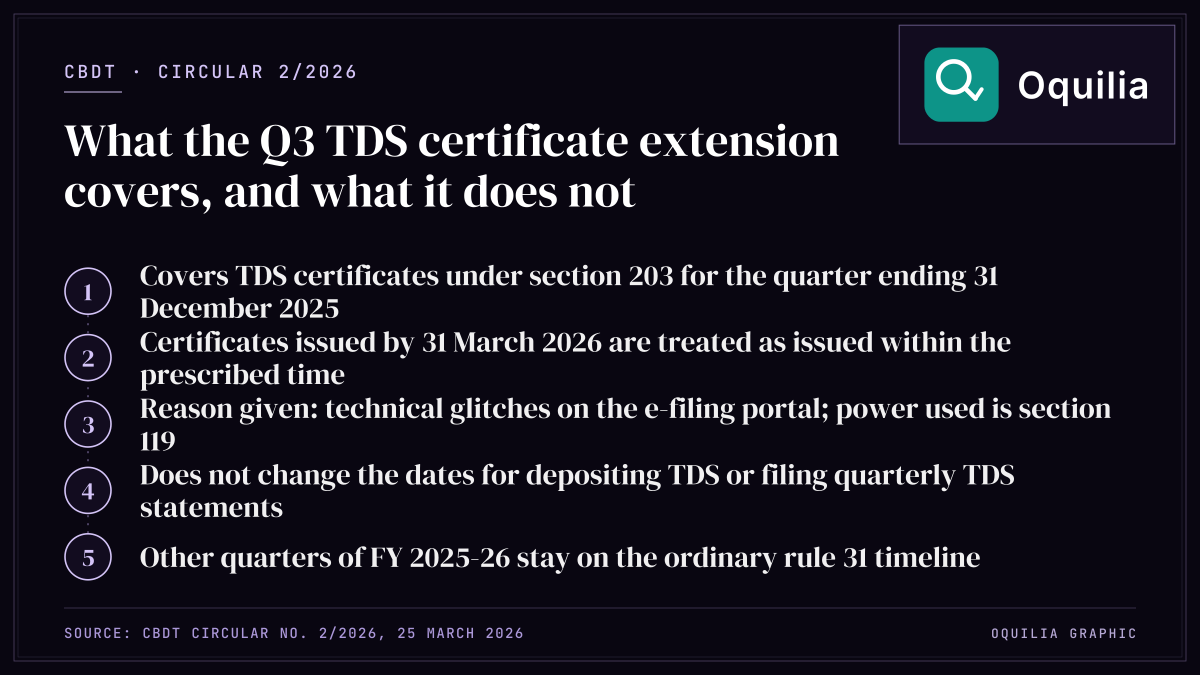
On 25 March 2026 the Central Board of Direct Taxes (CBDT) issued Circular No. 2/2026, F. No. 275/10/2026-IT(B), giving deductors until 31 March 2026 to issue TDS certificates under section 203 of the Income-tax Act, 1961 for the quarter ending 31 December 2025. The order was signed by Rubal Singh, Deputy Secretary, IT-Budget, CBDT, and it does one thing: any certificate for that quarter issued within the extended window is treated as having been issued within the prescribed time.
That matters to two groups. Deductors (the businesses, banks and other payers who cut TDS from payments) got a clean window to catch up after the e-filing portal glitches the Board cited. Deductees (freelancers, consultants, landlords, contractors and depositors on the receiving end) got their certificate for October to December 2025 later than usual, but without that delay counting as a default. With returns for assessment year 2026-27 now being filed and processed, this explainer sets out what the order covered, what it did not, and how to check that your credit for the quarter is in place.
What the Section Says
Section 203 of the Income-tax Act, 1961 places the duty on every person who deducts tax at source to issue a certificate to the person from whose payment the tax was deducted. The section itself does not fix the deadline. As paragraph 1 of Circular 2/2026 records, the time limits for issuing the certificate are prescribed in rule 31 of the Income-tax Rules, 1962.
Section 119 of the Act is the power the Board used. It allows the CBDT to issue orders, instructions and directions to income-tax authorities for the proper administration of the Act, and the Board has long used it to relax timelines when taxpayers face genuine hardship. Paragraph 3 of the circular states that the Board acted "in exercise of its powers under section 119".
Paragraph 2 explains the trigger. The Board received representations that deductors could not generate and issue certificates for the quarter ending 31 December 2025 within the prescribed time "due to technical glitches on the e-filing portal". Citing that genuine hardship, the Board extended the due date for that single quarter.
| Item | What Circular 2/2026 says |
|---|---|
| Circular number | No. 2/2026, F. No. 275/10/2026-IT(B) |
| Date of issue | 25 March 2026 |
| Issued by | CBDT, signed by the Deputy Secretary, IT-Budget |
| Power used | Section 119 of the Income-tax Act, 1961 |
| Provision relaxed | Section 203 read with rule 31 of the Income-tax Rules, 1962 |
| Period covered | Quarter ending 31 December 2025 (Q3 of FY 2025-26) |
| Reason given | Technical glitches on the e-filing portal |
| Extended due date | 31 March 2026 |
| Legal effect | Certificates issued by 31 March 2026 treated as issued within the prescribed time |
Three limits sit inside that text. First, the relief applies to one quarter only: October, November and December 2025. Second, it concerns the issue of the certificate under section 203; the circular says nothing about the deposit of tax deducted or the filing of quarterly TDS statements. Third, the circular does not state the original rule 31 deadline or any penalty amount, so anyone quoting a specific figure for either should take it from the text of rule 31 or section 272A, not from this order.
For most non-salary deductions (professional fees, contract payments, rent, interest and similar), the quarterly certificate is Form 16A. Salaried employees receive an annual Form 16 from their employer, which is a separate certificate on a different cycle; the circular is framed by quarter and names neither form.
Worked Example
Consider an independent consultant, Meera (an illustrative taxpayer), who invoiced three clients between 1 October and 31 December 2025. Each client deducted tax before paying her. The amounts below are illustrative and are not statutory TDS rates; use the TDS calculator to work out the rate that applies to your own payment type.
| Client | Fees paid in Oct-Dec 2025 | TDS deducted | Certificate for Q3 issued on | Within Circular 2/2026 window? |
|---|---|---|---|---|
| Client A | Rs 2,40,000 | Rs 24,000 | 20 March 2026 | Yes |
| Client B | Rs 1,50,000 | Rs 15,000 | 31 March 2026 | Yes (last valid day) |
| Client C | Rs 90,000 | Rs 9,000 | 10 April 2026 | No |
| Total | Rs 4,80,000 | Rs 48,000 |
For Client A and Client B, the circular settles the position. Both certificates were issued on or before 31 March 2026, so paragraph 3 deems them issued within the prescribed time. Neither client is in default under section 203 for the October to December 2025 quarter, even though both issued later than they normally would have.
Client C issued on 10 April 2026, 10 days after the extended date. The circular gives no cover for that delay, so Client C's position is governed by the ordinary rule 31 timeline and whatever consequence the Act attaches to late issue. The circular does not quantify that consequence, and this example does not either.
What about Meera? Her credit for the Rs 48,000 does not turn on the date printed on a certificate. When she files her return for AY 2026-27, the department matches her claim against Form 26AS and the Annual Information Statement, which draw on the TDS statements her clients filed. Her practical checks are:
- Download Form 26AS for FY 2025-26 and confirm all three clients appear against her PAN for the October to December 2025 quarter, with Rs 24,000, Rs 15,000 and Rs 9,000 respectively.
- Compare each Form 16A against the 26AS entry. The deductor's name, TAN, amount paid and tax deducted should match line for line.
- If any of the three entries is missing, ask that client to check its quarterly statement for Q3 before she files, since a missing 26AS entry means the department has no record of the Rs 9,000 or Rs 15,000 to credit.
- Report the full Rs 4,80,000 of fees as income, not the Rs 4,32,000 she actually received after deduction, and then claim the Rs 48,000 as tax already paid.
Step 4 trips up many first-time filers. The TDS is part of her income; it was paid to the government on her behalf. Running her figures through the income tax calculator with Rs 4,80,000 of gross fees, and comparing the old and new regimes with the old vs new regime calculator, gives her the liability against which the Rs 48,000 is set off.
Common Mistakes
Mistake 1: treating the order as a general amnesty. Circular 2/2026 covers one quarter, the one ending 31 December 2025. It does not extend timelines for the quarters ending 30 June 2025, 30 September 2025 or 31 March 2026. A deductor late on any of those quarters cannot rely on this order.
Mistake 2: assuming it extended the deposit or return deadlines. The text relaxes "the due date for issuance of TDS certificate under section 203". It does not mention the date for depositing tax deducted with the government, nor the due date for filing the quarterly TDS statement. Interest or fees linked to those obligations are outside the scope of the 25 March 2026 order.
Mistake 3: reading 31 March 2026 as "by the end of the financial year, whenever". The cut-off was a fixed calendar date. A certificate issued on 1 April 2026 or later, as with Client C above, falls outside paragraph 3's deeming clause.
Mistake 4: quoting a penalty or original deadline from the circular. The circular cites section 203 and rule 31 but states neither the normal deadline nor any penalty amount. Articles and advisory notes that attribute such figures to Circular 2/2026 are misattributing them; the source for any penalty is the Act itself.
Mistake 5: relying on the certificate instead of Form 26AS. A deductee who files using the figures on a Form 16A, without checking 26AS, risks a mismatch if the deductor's quarterly statement is wrong or missing. In the example above, a Rs 9,000 entry absent from 26AS would not be credited at processing, however neatly the certificate is printed.
Mistake 6: claiming only the net receipt as income. Reporting Rs 4,32,000 instead of Rs 4,80,000 while also claiming Rs 48,000 of TDS understates income by exactly the tax claimed. That gap is easy for the department's systems to spot because both figures sit in 26AS.
FAQ
What did CBDT Circular 2/2026 change?
It extended the due date for issuing TDS certificates under section 203, read with rule 31, for the quarter ending 31 December 2025 to 31 March 2026. Certificates issued by that date are treated as issued within the prescribed time.
Why did the CBDT issue the extension?
Paragraph 2 of the circular says the Board received representations that deductors could not generate and issue certificates on time "due to technical glitches on the e-filing portal". The Board cited genuine hardship and acted under section 119.
Does the extension apply to other quarters of FY 2025-26?
No. The order names only the quarter ending 31 December 2025. The quarters ending 30 June 2025, 30 September 2025 and 31 March 2026 remain on the ordinary rule 31 timeline.
Does it change the deadline for depositing TDS or filing TDS returns?
No. The circular deals only with the issue of certificates under section 203. It is silent on the deposit of tax and on quarterly TDS statements, so those due dates were unaffected by the 25 March 2026 order.
I received my Form 16A for October-December 2025 late. Is my tax credit at risk?
The delay in the certificate itself does not decide your credit. Check that the deduction appears against your PAN in Form 26AS for FY 2025-26. If it does, the credit is available when you file for AY 2026-27; if it does not, ask the deductor to correct its quarterly statement.
What happens if a deductor issued the Q3 certificate after 31 March 2026?
The circular gives no relief beyond 31 March 2026, so a later certificate is assessed against the ordinary rule 31 deadline. The circular does not state the penalty; refer to the Act for the consequence of late issue.
Where can I read the circular?
The full text of Circular No. 2/2026 is published on the Income Tax Department's e-filing portal at incometax.gov.in, and the parent provisions are in the Income-tax Act, 1961 on India Code (indiacode.nic.in).
Sources & Citations
- Circular No. 2/2026: Order under section 119 extending the timeline for TDS certificates under section 203 for the quarter ending 31 December 2025 — Central Board of Direct Taxes
- The Income-tax Act, 1961 — India Code, Government of India
- Individual: business and profession help — Income Tax Department