

Authorised Income-tax Practitioner Under Section 515: Revised Form 171 and Registration Window to 31 March 2027
CBDT Notification 120/2026 moves the rule 256(4) date to 31 March 2027 and substitutes Form 171 for authorised income-tax practitioner registration under section 515.
Key points
- CBDT Notification No. 120/2026, dated 17 September 2026, substituted Form No. 171 for registration as an authorised income-tax practitioner under section 515 of the Income-tax Act, 2025.
- The date in rule 256(4) of the Income-tax Rules, 2026 moves from 30 September 2026 to 31 March 2027, giving 195 days from the notification date.
- Applicants must give PAN, full names, an 8-part address, qualification certificates, any 1961 Act registration and disqualification status, and file with only one authority.
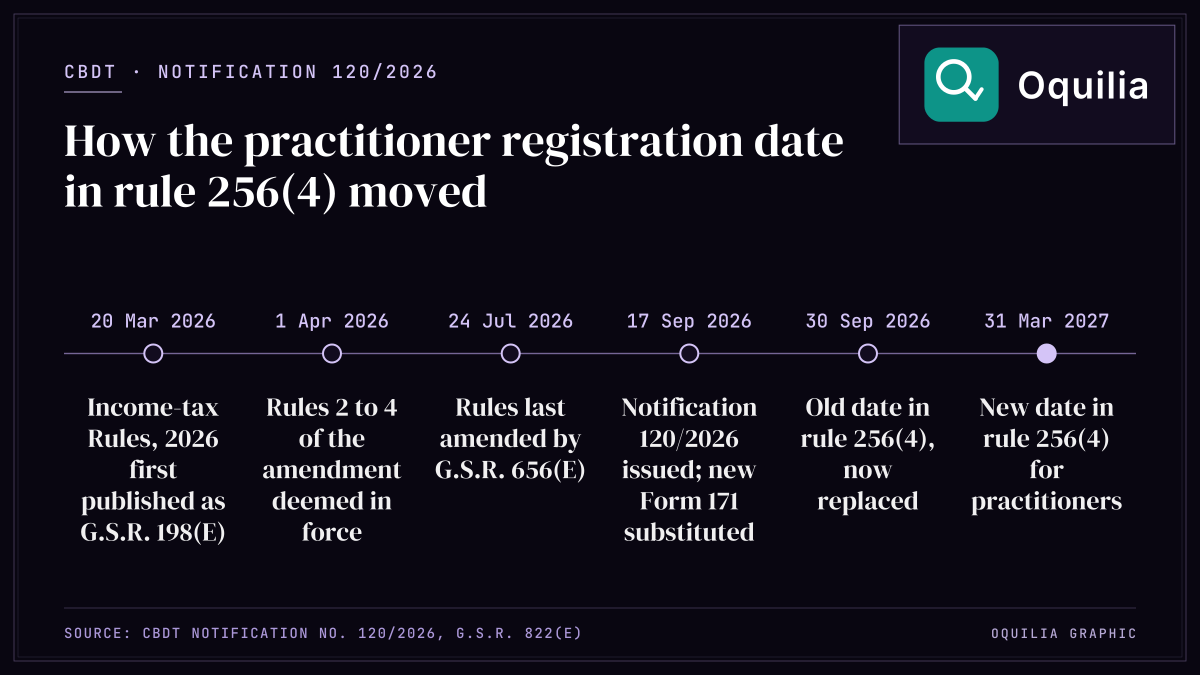
The Central Board of Direct Taxes (CBDT) has given individuals who want to appear before income-tax authorities on behalf of clients another six months. Notification No. 120/2026, issued as G.S.R. 822(E) on 17 September 2026, makes the Income-tax (Fourth Amendment) Rules, 2026. It changes the date in rule 256(4) of the Income-tax Rules, 2026 from 30 September 2026 to 31 March 2027, and it substitutes a new Form No. 171, the application for registration as an authorised income-tax practitioner under section 515 of the Income-tax Act, 2025.
Every figure below comes from the notification published on incometax.gov.in.
What the Section Says
Section 515 of the Income-tax Act, 2025 (30 of 2025) governs who may act as an authorised representative before income-tax authorities. The CBDT made the amendment rules under section 533 of the Act, read with sections 262, 273, 413, 514 and 515. Form 171, as substituted, is the application for registration under four clauses of the section: section 515(3)(a)(v), (vi), (vii) or (viii). The applicant ticks the clause that applies.
The notification makes eight changes to the Income-tax Rules, 2026. Those rules were first published as G.S.R. 198(E) on 20 March 2026 and last amended by G.S.R. 656(E) on 24 July 2026. Rules 2 to 4 of the amendment are deemed to have come into force on 1 April 2026; rules 5 to 8, which include both the date change and the new Form 171, apply from the date of publication in the Official Gazette.
| Item in Notification 120/2026 | What it does | In force |
|---|---|---|
| Rule 5 | Rule 246(4): "30th September, 2026" becomes "31st March, 2027" (valuers) | Date of Gazette publication |
| Rule 6 | Rule 256(4): "30th September, 2026" becomes "31st March, 2027" (practitioners) | Date of Gazette publication |
| Rule 7 | Form No. 169 (valuer registration, section 514) substituted | Date of Gazette publication |
| Rule 8 | Form No. 171 (practitioner registration, section 515) substituted | Date of Gazette publication |
| Rules 2 to 4 | Wording changes in rules 160, 176 and 225 | Deemed from 1 April 2026 |
The same notification moves the valuer deadline in rule 246(4) to the same 31 March 2027 date. Our earlier explainer on registering as a valuer under section 514 and the revised Form 169 covers that track. The two forms are separate: Form 169 is for valuers, and Form 171 is for practitioners.
Who receives the application
Form 171 is addressed to the Chief Commissioner or Commissioner of Income-tax. Form 169, by contrast, is addressed to a Principal Chief Commissioner, Chief Commissioner, Principal Director General or Director General. The Form 171 certification says the applicant has not made an application under the 2025 Act to "any other Chief Commissioner or Commissioner of Income-tax", so one application goes to one authority.
What Form 171 asks for
The revised form has two parts, a certificate and a verification.
| Row | Field | Format |
|---|---|---|
| 1 | Name | Full first, middle and last name, no abbreviations (Note 1) |
| 2 | Gender | Male, Female or Transgender |
| 3 | PAN | Permanent Account Number |
| 4 | Name of father or husband | Full name, no abbreviations (Note 1) |
| 5 and 6 | Permanent and present residential address | 8 components (Note 2), DIGIPIN optional |
| 7 | Mobile number and email | Country code plus number |
| 8 | Principal place of profession in India | Free text |
| 9 | Partner in a firm? | Yes or No; if Yes, firm name and PAN, repeated per firm |
| 10(i) | Prescribed educational qualifications | Free text plus certificate copy (Annexure A-1) |
| 10(ii) | Registered as practitioner under the Income-tax Act, 1961? | Yes or No; if Yes, upload certificate (Annexure A-2) |
| 10(iii) | Any other eligibility details | Annexure A-3 |
| 10(iv) | Disqualified under section 515(4), (5) or (7)? | Yes or No; if Yes, whether permanent; if not permanent, date till which disqualified |
Note 2 lists the 8 address components: country or region; flat, door or building; road, street, block or sector; PIN or ZIP code; post office; area or locality; district; and state. Note 4 says some information "would be pre-filled to the extent possible".
The disqualification row is three layers deep. Row 10(iv)(b) asks whether a disqualification is permanent under section 515(4)(a), section 515(5)(b) or section 515(7). If it is not permanent, row 10(iv)(c) asks for the end date in dd/mm/yyyy format.
Before signing, the applicant certifies two things: practice before income-tax authorities for "not less than one year", and no earlier application under the 2025 Act to any other Chief Commissioner or Commissioner. A separate verification, with the name in block letters, confirms that the contents are true to the best of the applicant's information and belief.
Worked Example
Take a hypothetical tax practitioner, Ms A, who prepares returns for salaried clients from an office in Pune. She holds a registration certificate under the Income-tax Act, 1961, has practised before income-tax authorities for 6 years, and is a partner in one firm. She reads the notification on 11 November 2026.
Step 1: count the days. Before Notification 120/2026, the date in rule 256(4) was 30 September 2026, just 13 days after the notification date of 17 September 2026. The new date gives her considerably more time.
| Reference point | Date | Days to 31 March 2027 |
|---|---|---|
| Notification date | 17 September 2026 | 195 |
| Old date in rule 256(4) | 30 September 2026 | 182 |
| Ms A reads the notification | 11 November 2026 | 140 |
The 140 days run as 19 in November, 31 in December, 31 in January, 28 in February 2027 and 31 in March.
Step 2: assemble the annexures. Because Ms A answers Yes at row 10(ii)(a), she uploads her 1961 Act certificate as Annexure A-2. Her qualification certificate goes in as Annexure A-1. At row 9 she answers Yes and gives the firm's full name and PAN. At row 10(iv)(a) she answers No, so rows 10(iv)(b) and (c) do not apply.
Step 3: check the certification. Her 6 years of practice exceed the one-year minimum in the certificate. She files with one Chief Commissioner or Commissioner only.
Step 4: the work the registration protects. One of Ms A's clients is a salaried employee with gross salary of Rs 12,75,000 for FY 2025-26 under the new regime. The figures below use Oquilia's rate tables for that year.
| Line | Amount (Rs) |
|---|---|
| Gross salary | 12,75,000 |
| Less: standard deduction (new regime) | 75,000 |
| Taxable income | 12,00,000 |
| Tax at 5% on 4,00,001 to 8,00,000 | 20,000 |
| Tax at 10% on 8,00,001 to 12,00,000 | 40,000 |
| Tax before rebate | 60,000 |
| Less: section 87A rebate (new regime, income up to Rs 12 lakh) | 60,000 |
| Tax payable | Nil |
With taxable income exactly at the Rs 12 lakh threshold, the Rs 60,000 rebate wipes out the Rs 60,000 slab tax. Readers can test their own numbers with the income tax calculator or compare regimes using the old vs new regime calculator. Representation before income-tax authorities, not return preparation, is what the section 515 registration covers.
Common Mistakes
Each pitfall below is taken from the rows and notes of Form 171 as published on 17 September 2026.
- Using the wrong form. Form 169 (rules 246 and 247) is for valuers under section 514; Form 171 (rules 256 and 257) is for practitioners under section 515. Both were substituted by the same notification on 17 September 2026, so they are easy to mix up.
- Abbreviating names. Note 1 requires first, middle and last names "in full without any abbreviations". This applies to row 1, row 4 and the firm name at row 9(ii)(a).
- Incomplete addresses. Note 2 lists 8 address components. Leaving out the post office or district on rows 5 and 6 is an avoidable gap.
- Leaving out the 1961 Act certificate. If the answer at row 10(ii)(a) is Yes, row 10(ii)(b) requires the valid certificate as Annexure A-2. The form treats it as an upload, not a declaration.
- Not answering the disqualification follow-ups. A Yes at row 10(iv)(a) triggers row 10(iv)(b) on permanence and, where not permanent, row 10(iv)(c) asking for an end date in dd/mm/yyyy format. All three need answers.
- Filing with two authorities. The certificate states that no application under the 2025 Act has gone to "any other Chief Commissioner or Commissioner". A second application contradicts a signed statement.
- Missing firm details. Row 9(ii) asks for the name and PAN of each firm where the applicant is a partner, repeated as needed. Listing only one of 2 firms leaves the form incomplete.
- Assuming the old date still applies, or ignoring the new one. The 30 September 2026 date in rule 256(4) no longer stands; 31 March 2027 does. That date has also moved once already, so check the income tax portal for any later notification before relying on it.
Practitioners who also run payroll or deduction work for clients can cross-check figures with the TDS calculator. Our glossary entries on the assessment year and the ITR explain the terms the department uses in its notices. The text of the Income-tax Act, 2025 is published on India Code.
FAQ
What does CBDT Notification No. 120/2026 change for practitioners?
It changes the date in rule 256(4) of the Income-tax Rules, 2026 from 30 September 2026 to 31 March 2027. It also substitutes Form No. 171, the application for registration as an authorised income-tax practitioner under section 515 of the Income-tax Act, 2025. The notification is G.S.R. 822(E), dated 17 September 2026.
Which clauses of section 515 does Form 171 cover?
The application covers registration under section 515(3)(a)(v), (vi), (vii) or (viii) of the Income-tax Act, 2025. The applicant states which of these 4 clauses applies.
To whom is Form 171 submitted?
It is addressed to the Chief Commissioner or Commissioner of Income-tax. The applicant certifies that no application under the 2025 Act has been made to any other Chief Commissioner or Commissioner, so only 1 application should be filed.
I was registered under the Income-tax Act, 1961. Do I still need Form 171?
Row 10(ii)(a) of Form 171 asks whether the applicant is registered as an authorised income-tax practitioner under the Income-tax Act, 1961. If the answer is Yes, the applicant uploads the valid certificate as Annexure A-2. The form therefore expects 1961 Act registrants to be among those applying.
How much practice experience is required?
The certificate in Form 171 states that the applicant has been practising before income-tax authorities for not less than 1 year.
Is there a fee for Form 171?
The substituted Form 171 published on 17 September 2026 contains no fee note. By contrast, Note 7 of the substituted Form 169 for valuers sets a fee of Rs 10,000, waived for valuers already registered under the Wealth-tax Act, 1957.
What if I am disqualified for a limited period?
Answer Yes at row 10(iv)(a), then No at row 10(iv)(b) if the disqualification is not permanent under section 515(4)(a), section 515(5)(b) or section 515(7). Row 10(iv)(c) then asks for the date until which the disqualification runs, in dd/mm/yyyy format.
Sources & Citations
- Notification No. 120/2026, Income-tax (Fourth Amendment) Rules, 2026 (G.S.R. 822(E)) — Income Tax Department / CBDT
- Income Tax Department e-filing portal — Income Tax Department
- India Code — Legislative Department, Government of India