

Registering as an Income-tax Valuer Under Section 514: Revised Form 169, 11 Asset Classes and the 31 March 2027 Deadline
CBDT Notification 120/2026 replaces Form 169 for valuer registration under section 514 of the Income-tax Act, 2025: 11 asset classes, Rs 10,000 per form, and a rule 246(4) date moved to 31 March 2027.
Key points
- The CBDT notified the Income-tax (Fourth Amendment) Rules, 2026 on 17 September 2026, substituting Form No. 169 for valuer registration under section 514.
- Each of the 11 asset classes needs a separate form with a Rs 10,000 fee, nil for valuers already registered under the Wealth-tax Act, 1957.
- The date in rule 246(4) moves from 30 September 2026 to 31 March 2027, so valuers should check the rule and prepare one application per class.
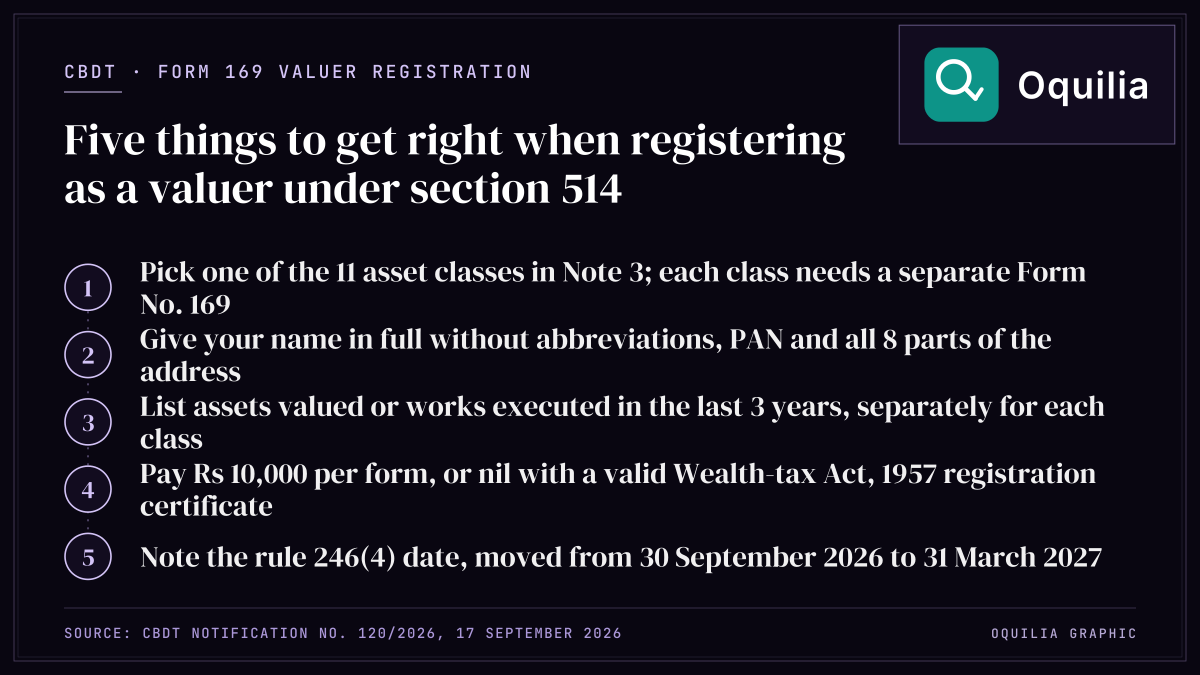
On 17 September 2026 the Central Board of Direct Taxes (CBDT) notified the Income-tax (Fourth Amendment) Rules, 2026 as Notification No. 120/2026, published as G.S.R. 822(E). For anyone who values property, shares, jewellery or machinery for income-tax purposes, two changes matter: a new Form No. 169 for registration as a valuer under section 514 of the Income-tax Act, 2025, and a date in rule 246(4) moved from 30 September 2026 to 31 March 2027. This explainer walks through the form, the 11 asset classes, the Rs 10,000 fee and the errors that most often slow an application down.
The notification was made under section 533 read with sections 262, 273, 413, 514 and 515 of the Income-tax Act, 2025 (30 of 2025), and it amends the Income-tax Rules, 2026, which were first published as G.S.R. 198(E) on 20 March 2026. The full text is on the Income Tax Department portal.
What the Section Says
Section 514 of the Income-tax Act, 2025 is the provision under which a person applies to be registered as a valuer. Rules 246 and 247 of the Income-tax Rules, 2026 set out the procedure, and Form No. 169 is the application itself. Rule 7 of Notification No. 120/2026 substitutes the old Form No. 169 with a new version, and rules 5 to 8 of the notification came into force on the date of publication in the Official Gazette, that is 17 September 2026.
The application is addressed to one of four authorities: the Principal Chief Commissioner, the Chief Commissioner, the Principal Director General or the Director General. The applicant strikes out the three that do not apply, as the asterisk note on the form directs.
The new form has five parts. The table below summarises what each one asks for.
| Part | Heading | What you furnish |
|---|---|---|
| A | Personal Information | Name in full, PAN, address, date of birth (dd/mm/yyyy), mobile number with country code, email ID |
| B | Class of Asset | One class from the 11 listed in Note 3 of the form |
| C | Qualifications | Educational qualifications, former employment, practice as consulting engineer, valuer of real estate, surveyor or architect, any other details; experience as a valuer with a list of assets valued or works executed in the last 3 years; whether registered under the Wealth-tax Act, 1957 and, if so, the certificate |
| D | Disqualifications | Whether any ground in rule 247(4) or rule 247(5) applies, and if yes, the relevant clause |
| E | Verification and Declaration | A signed declaration with PAN, place and date |
Part E is more than a signature line. By signing it, the applicant declares that they will do 4 things: (a) make an impartial and true valuation of any asset they are required to value; (b) furnish the valuation report in the prescribed form; (c) charge fees at a rate not exceeding the rate or rates prescribed by the Board; and (d) not value any asset in which they have a direct or indirect interest.
The 11 classes of asset
Note 3 of Form No. 169 lists the classes for which registration can be sought. Note 6 says a separate form is required for each class, so a valuer covering 3 classes files 3 applications.
| Sl. No. | Class of asset |
|---|---|
| 1 | Immovable property (other than agricultural lands, plantations, forests, mines and quarries) |
| 2 | Agricultural lands, other than coffee, tea, rubber or cardamom plantation |
| 3 | Coffee, tea, rubber or cardamom plantation |
| 4 | Forest |
| 5 | Mines and quarries |
| 6 | Stocks, shares, debentures, securities, shares in partnership firms and business assets including goodwill, excluding items at serial numbers 1 to 5 and 7 to 11 |
| 7 | Machinery and plant |
| 8 | Jewellery |
| 9 | Works of art |
| 10 | Life interest, reversions and interest in expectancy |
| 11 | Any other asset |
Class 6 is the residual class for business and financial assets, and class 11 catches anything not covered elsewhere. If your work feeds into capital gains computations on unlisted shares, class 6 is the relevant one; if it is about land and buildings, where stamp duty values often come into play, class 1 or 2 applies.
Fee and the Wealth-tax Act exemption
Note 7 of the form fixes the fee at Rs 10,000 per application. No fee is payable by a valuer already registered under the Wealth-tax Act, 1957 (27 of 1957). Such a valuer answers "Yes" at item 8(ii) and uploads a valid certificate of registration at item 8(iii). Note 8 adds that some information in the form will be pre-filled to the extent possible.
The rule 246(4) and rule 256(4) date change
Rule 5 of the notification substitutes "31st March, 2027" for "30th September, 2026" in rule 246(4). Rule 6 makes the identical change in rule 256(4), which sits alongside the new Form No. 171 for registration as an authorised income-tax practitioner under section 515. The notification changes only the date; it does not restate the rest of either sub-rule, so read rule 246(4) of the Income-tax Rules, 2026 in full before relying on how the date applies to you. The extension adds 182 days to the earlier date.
Worked Example
Consider three hypothetical valuers preparing applications in November 2026. The amounts follow directly from Note 6 (one form per class) and Note 7 (Rs 10,000 per form, nil for Wealth-tax Act registrants) of Form No. 169.
| Applicant | Classes sought | Forms needed | Wealth-tax Act registration? | Total fee |
|---|---|---|---|---|
| Valuer A, chartered engineer | 1 (Immovable property) and 7 (Machinery and plant) | 2 | No | Rs 20,000 |
| Valuer B, gemmologist | 8 (Jewellery) and 9 (Works of art) | 2 | Yes, both classes | Rs 0 |
| Valuer C, corporate finance professional | 6 (Shares, securities, goodwill), 10 (Life interest) and 11 (Any other asset) | 3 | No | Rs 30,000 |
Valuer A earns, say, Rs 24 lakh a year in fees from plant and property valuations. Registering for both classes costs 2 x Rs 10,000 = Rs 20,000, or about 0.83% of one year's receipts. Each application needs its own list of assets valued or works executed during the last 3 years, so Valuer A should split the experience annexure by class rather than upload one combined list twice.
Valuer B holds Wealth-tax Act certificates for jewellery and works of art. Under Note 7, neither application attracts a fee, saving Rs 20,000, provided the certificate is uploaded at item 8(iii) of each form.
Valuer C seeks 3 classes and pays 3 x Rs 10,000 = Rs 30,000. If Valuer C later adds class 7, a fourth form and a further Rs 10,000 are needed.
On timing, 17 September 2026 to 31 March 2027 is 195 days. From 10 November 2026, the date of this article, 141 days remain to the date now in rule 246(4). Each form needs PAN, a full address in 8 components and 3 years of valuation records, so a valuer applying for 3 classes is assembling 3 separate sets of uploads.
For valuers who are also taxpayers working out their own liability on fee income, the income tax calculator gives a regime-wise estimate, and the TDS calculator helps reconcile tax deducted by clients.
Common Mistakes
The new Form No. 169 is short, but its notes are strict. These are the errors that cause delay or rejection, each tied to a specific note or item in the notification.
- Combining classes in one form. Note 6 requires a separate form for each class of asset. A single application listing "immovable property and machinery" at item 6 does not meet it; 2 classes means 2 forms and, unless exempt, Rs 20,000.
- Abbreviating the name. Note 1 says the first, middle and last name must be given in full without abbreviations. An application in the name "R. K. Sharma" when PAN records show the full name invites a mismatch.
- Incomplete address. Note 2 lists 8 required elements: country or region, flat or building, road or street, PIN or ZIP code, post office, area or locality, district and state. DIGIPIN is optional.
- Paying the fee when exempt, or claiming exemption without proof. A Wealth-tax Act, 1957 registrant pays nil under Note 7, but only if item 8(ii) is answered "Yes" and a valid certificate is uploaded at item 8(iii). An expired certificate leaves the Rs 10,000 fee payable.
- Thin experience records. Item 8(i) asks for full details of experience, including a list of assets valued or works executed during the last 3 years. Listing firm names without the assets valued does not answer the question.
- Free-text class that matches no listed class. Item 6 is a free-text field, but Note 3 says one of the 11 classes "shall be filled". Writing "real estate" instead of the class 1 wording, or "startups" instead of class 6, creates ambiguity.
- Skipping or misreading Part D. Item 9 asks whether any ground in rule 247(4) or (5) applies. A "Yes" requires the relevant clause at item 9(ii). Read both sub-rules in the Income-tax Rules, 2026 before answering.
- Treating the declaration as boilerplate. Clause (d) of Part E bars valuing any asset in which the valuer has a direct or indirect interest, and clause (c) caps fees at the Board's prescribed rates. Both bind every report after registration.
If your valuation work feeds into a client's long-term gains, see the glossary entries on valuation, capital asset and LTCG for how the figures are used downstream.
FAQ
Who issued the new Form No. 169 and when?
The CBDT issued it through Notification No. 120/2026 (G.S.R. 822(E)) dated 17 September 2026, titled the Income-tax (Fourth Amendment) Rules, 2026. Rule 7 of that notification substitutes Form No. 169.
Under which section do valuers now register?
Section 514 of the Income-tax Act, 2025 (30 of 2025). Form No. 169 refers to rules 246 and 247 of the Income-tax Rules, 2026.
How much is the registration fee?
Rs 10,000 per form, under Note 7. Valuers already registered under the Wealth-tax Act, 1957 pay nothing, provided they upload a valid certificate of registration at item 8(iii).
Can I register for more than one class of asset in a single application?
No. Note 6 requires a separate form for each class. There are 11 classes, from immovable property at serial number 1 to "any other asset" at serial number 11.
What changed in rule 246(4)?
Rule 5 of Notification No. 120/2026 replaced "30th September, 2026" with "31st March, 2027" in rule 246(4). Rule 6 made the same change in rule 256(4). Check the full text of each sub-rule to see how the date applies to you.
To whom is the application addressed?
To the Principal Chief Commissioner, Chief Commissioner, Principal Director General or Director General, with the inapplicable 3 designations struck out.
Does the notification also cover income-tax practitioners?
Yes. Rule 8 substitutes Form No. 171, the application for registration as an authorised income-tax practitioner under section 515 of the Income-tax Act, 2025. It asks, among other things, whether the applicant was registered as a practitioner under the Income-tax Act, 1961.
This explainer summarises CBDT Notification No. 120/2026 dated 17 September 2026. It is general information, not professional advice. Read the notification and the Income-tax Act, 2025 on India Code before filing.
Sources & Citations
- Notification No. 120/2026: Income-tax (Fourth Amendment) Rules, 2026 (G.S.R. 822(E)) — Income Tax Department / CBDT
- India Code: Income-tax Act, 2025 — Government of India