

ITAT Rajkot says trust denied registration must still get deduction for expenses
The ITAT Rajkot bench held that a Kutch trust whose registration was rejected cannot be taxed on its full Rs 20,36,678 donations and directed the officer to allow its expenses.
Key points
- The Income Tax Appellate Tribunal, Rajkot, on 29 October 2026 allowed an appeal by Jivdaya Seva Trust, Palansava.
- The tax officer had added the full Rs 20,36,678 in donations to the trust's income after its registration was rejected.
- The tribunal held genuine, documented expenses must be allowed even without charitable registration, as gross receipts cannot be taxed.
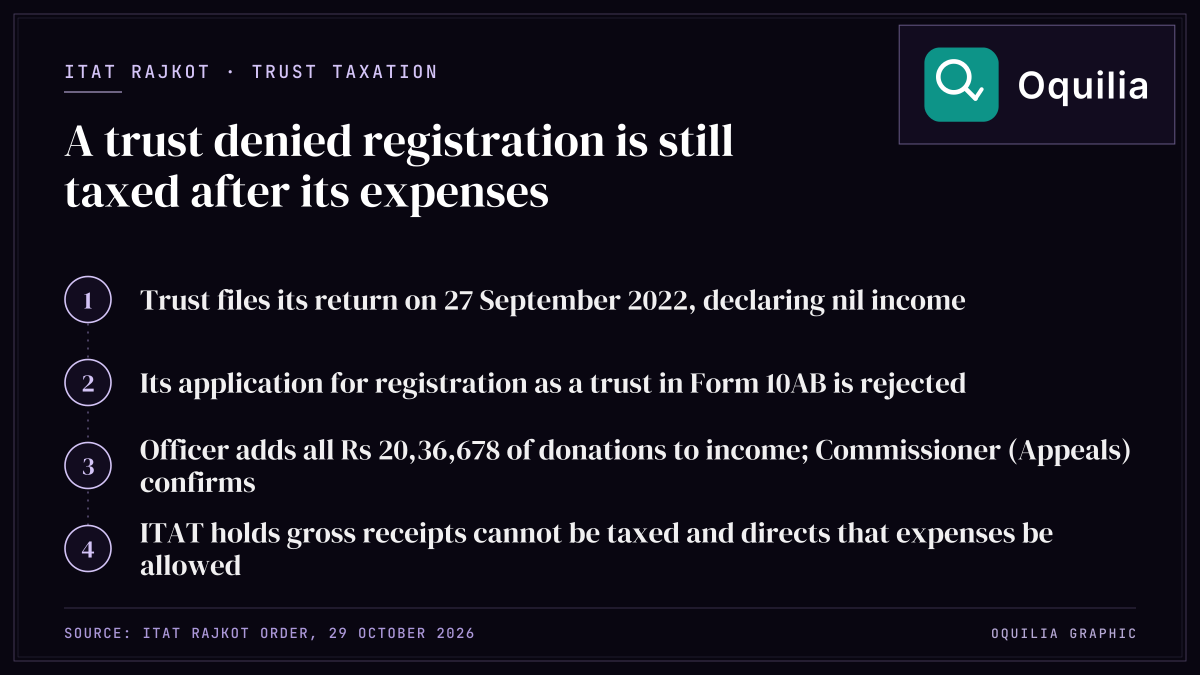
The Rajkot bench of the Income Tax Appellate Tribunal (ITAT) on 29 October 2026 held that a trust whose charitable registration was rejected must still be allowed to deduct the money it actually spent, and cannot be taxed on its gross receipts. It directed the tax officer to allow the expenses of Jivdaya Seva Trust, Palansava in Kutch, Gujarat, for assessment year 2022-23.
What Happened
According to the order, the trust filed its return on 27 September 2022 declaring nil income. It had received Rs 20,36,678 as donations for preservation of the environment. Its case was picked for scrutiny, and its application for registration as a trust (Form 10AB) was rejected.
The assessing officer said the trust could not give documentary evidence for the funds, held that it was not a trust for tax purposes, and refused to allow its environment-preservation expenses. The officer added the full Rs 20,36,678 to its income, taxing it as an association of persons. The Commissioner of Income Tax (Appeals) confirmed this.
The tribunal disagreed. Relying on rulings of the Delhi High Court and the Supreme Court, it held that when a body is denied charitable registration, its genuine expenses must still be allowed under the general provisions of the Income-tax Act, because denying them would mean taxing gross receipts, which is contrary to law. It found that the trust had filed the documents to support its expenses, that the officer never rebutted them, and that the officer disallowed the expenses without giving cogent reasons or rejecting the books of account. It directed the officer to allow the expenses "as if the assessee is running business" at the normal rate, and allowed the appeal.
What It Means
For trusts and charities whose registration under the Income-tax Act is refused or cancelled, the order says their spending does not simply vanish from the tax computation: income is taxed after allowing genuine, documented expenses. The ruling is the tribunal's decision in this case.
Source: ITAT order
Sources & Citations
- ITAT order — Income Tax Appellate Tribunal