

Form 114 replaces Form 10BE: the donation certificate your NGO must issue by 31 May under the new Act
Under the Income-tax Act 2025, Form 113 replaces Form 10BD and Form 114 replaces Form 10BE. Both are due by 31 May after the tax year. How Pre-ARNs, revisions and donor deductions work.
Key points
- The Income Tax Department has mapped Form 10BD to Form 113 and Form 10BE to Form 114 under the Income-tax Act, 2025.
- Form 113 must be filed and Form 114 issued to donors by 31 May after the tax year, under rules 190(6) and 190(8).
- Charities can pre-generate up to 1,000 Pre-ARNs for manual receipts, while donors can claim the deduction only in the old regime.
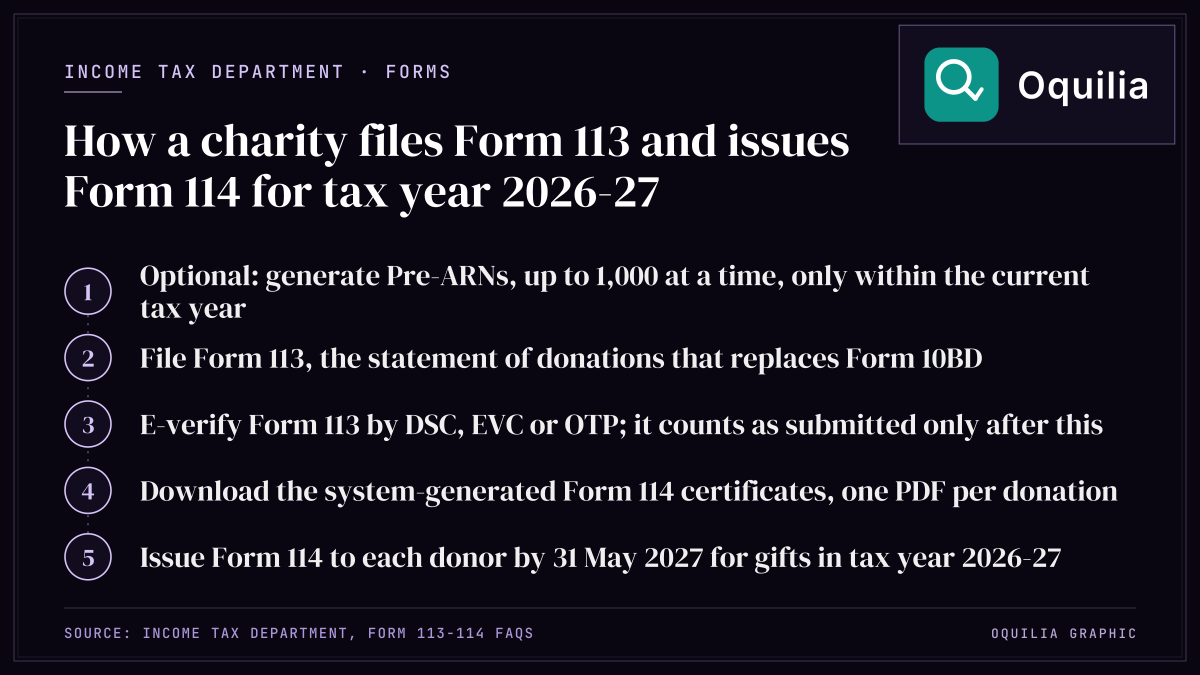
From tax year 2026-27, the first year run under the Income-tax Act, 2025, the donation paperwork that charities and their donors relied on has new names. Form 10BD, the statement of donations, is now Form 113. Form 10BE, the certificate a donor needs to support a deduction claim, is now Form 114. Both deadlines fall on 31 May after the end of the tax year in which the gift was received, under rule 190(6) and rule 190(8), according to the Income Tax Department's Form 113-114 FAQ page.
For a donor, the practical point is simple: a receipt alone is not the end of the trail. The system-generated Form 114 is what ties your gift to the organisation's PAN and its approval number under section 354 of the 2025 Act. For a charity, missing the 31 May date means donors may have nothing on the portal to match against their claim.
| Old form (Income-tax Act, 1961) | New form (Income-tax Act, 2025) | What it is | Who files or issues it | Last date |
|---|---|---|---|---|
| Form 10BD | Form 113 | Statement of donations received | The registered non-profit (donee) | 31 May after the tax year, rule 190(6) |
| Form 10BE | Form 114 | Certificate of donation for each donor | Generated by the portal, issued by the donee | 31 May after the tax year, rule 190(8) |
What the Section Says
The Income Tax Department's FAQ describes Form 113 as a "Statement of Donations" that must be filed by eligible registered non-profit organisations and by persons specified under Schedule VII (Table, Sl. No. 1) of the Income-tax Act, 2025. It captures the details of donations received from donors during the reporting period. If an organisation receives no donation at all during the tax year, the FAQ states that Form 113 is not needed.
The filing deadline is fixed by rule 190(6): the last date to submit Form 113 is 31 May immediately following the end of the tax year in which the donation was received. For gifts received between 1 April 2026 and 31 March 2027, that means 31 May 2027.
Form 114 is the certificate of donation that the portal generates once Form 113 is filed. Under rule 190(8), the last date to issue it to the donor is also 31 May following the end of the tax year. According to FAQ Q17, each Form 114 carries the organisation's PAN and name, its approval or certificate numbers under section 354 of the 2025 Act, and the details of the donation and the donor.
Form 113 is treated as submitted only after e-verification. FAQ Q7 lists three routes: a digital signature certificate (DSC), an electronic verification code (EVC), or an OTP sent to the registered mobile number. An unverified form is, in effect, an unfiled form.
The Pre-ARN route for manual receipts
Many organisations collect cash or cheques at events and need to hand over a receipt on the spot. The FAQ (Q3 and Q8) allows them to generate Pre-Acknowledgement Numbers (Pre-ARNs) in advance, up to a maximum of 1,000 at a time, and quote one Pre-ARN on each manual receipt. The organisation then files Form 113 against the used Pre-ARNs, and the Form 114 certificates are generated carrying the same acknowledgement numbers that were printed on the receipts.
Three limits apply, per FAQ Q10 to Q12:
- A fresh batch of up to 1,000 Pre-ARNs can be generated only after the previous batch has been used and reported through Form 113.
- Pre-ARNs can be generated only during the current, ongoing tax year, so none can be generated for tax year 2026-27 after 31 March 2027.
- Status is tracked on the portal as Consumed, Unconsumed, Expired or Deleted (FAQ Q13).
Using Pre-ARNs is optional. FAQ Q15 confirms that an organisation can file Form 113 directly, under the option "File Statement or Correction Statement to be filed by Donee under section 354(1)", and receive system-generated Form 114 certificates.
| Feature | Direct filing | Pre-ARN route |
|---|---|---|
| When the donor gets a number | After Form 113 is filed | At the time of the gift, on the manual receipt |
| Batch limit | Not applicable | Up to 1,000 Pre-ARNs at a time |
| New batch allowed | Not applicable | Only after earlier Pre-ARNs are reported in Form 113 |
| Generation window | Not applicable | Only within the same tax year (ends 31 March) |
| Form 114 acknowledgement number | System-generated | Same as the Pre-ARN on the receipt |
Where the donor's deduction comes in
On the donor's side, Oquilia's statute brief for section 80G of the 1961 Act records a deduction of 50% or 100% of the donation depending on the institution, available in the old regime only. Under the new regime, the slab bands for tax year 2026-27 run from nil up to Rs 4 lakh to 30% above Rs 24 lakh, with a section 87A rebate of up to Rs 60,000 for income up to Rs 12 lakh, but no donation deduction. You can compare both regimes with the old vs new regime calculator before deciding whether a donation changes your choice.
Worked Example
The organisation. Suppose a registered trust starts tax year 2026-27 by generating 1,000 Pre-ARNs in April 2026 for its fund-raising drives. By December 2026 it has used all 1,000 on manual receipts. It files an original Form 113 reporting those 1,000 entries, e-verifies it by EVC, and can then generate the next batch of up to 1,000 Pre-ARNs.
In February 2027 it files a further original Form 113 for 100 gifts received directly. In April 2027 it finds 10 more February gifts that were missed. Following FAQ Q16, it files another original Form 113 with only those 10 entries, not 110. Its final deadline to file every Form 113 for the year and issue every Form 114 is 31 May 2027.
| Filing | Month | Entries reported | Route |
|---|---|---|---|
| Original Form 113 (1) | December 2026 | 1,000 | Pre-ARN |
| Original Form 113 (2) | February 2027 | 100 | Direct |
| Original Form 113 (3) | April 2027 | 10 | Direct (only the additional entries) |
| Total gifts reported | 1,110 |
The donor. Now take a salaried donor with gross salary of Rs 15,00,000 who files under the old regime and gives Rs 50,000 to this trust. After the old-regime standard deduction of Rs 50,000, taxable salary is Rs 14,50,000, which sits in the 30% band above Rs 10 lakh. The 4% health and education cess applies on top, so each rupee of deduction saves 31.2 paise.
| Scenario (old regime) | Donation | Deduction | Tax saved at 30% + 4% cess |
|---|---|---|---|
| Institution eligible for 50% deduction | Rs 50,000 | Rs 25,000 | Rs 7,800 |
| Institution eligible for 100% deduction | Rs 50,000 | Rs 50,000 | Rs 15,600 |
| Same donor in the new regime | Rs 50,000 | Nil | Nil |
The donor should check that the Rs 50,000 appears on a Form 114 bearing the trust's PAN and section 354 approval number before relying on it. You can model the full liability with the income tax calculator or the old regime calculator. For what counts as a tax deduction, see the glossary.
Common Mistakes
1. Treating the manual receipt as the certificate. A receipt quoting a Pre-ARN is only a reference number. The certificate is the Form 114 generated after Form 113 is filed, and rule 190(8) sets 31 May as the last date to issue it.
2. Re-reporting old entries in a second original Form 113. FAQ Q16 is explicit: if 100 entries were filed earlier and 10 more need adding, the second original return carries 10, not 110. Duplicates must be removed through a revised Form 113.
3. Using the revised form to add donors. A revised Form 113 can update donor name, address or amount, or delete entries, but per FAQ Q16 it cannot add new entries. New gifts always go in a fresh original Form 113.
4. Waiting until April to generate Pre-ARNs. FAQ Q10 says Pre-ARNs can be generated only during the current tax year. For tax year 2026-27, that window closes on 31 March 2027, even though Form 113 itself can be filed until 31 May 2027.
5. Hoarding unused Pre-ARNs. A new batch of up to 1,000 opens only after earlier Pre-ARNs are reported through Form 113 (FAQ Q12). Generating 1,000 and reporting late can stall receipts at the next event.
6. Skipping e-verification. FAQ Q7 states the form is submitted only after e-verification by DSC, EVC or OTP. A form saved but not verified does not meet the 31 May deadline.
7. Claiming the deduction in the new regime. The statute brief records the donation deduction as old regime only. A donor who files under the new regime for tax year 2026-27 gets no deduction for the gift, whatever Form 114 says. Check your ITR form and regime choice first.
8. Losing the ZIP file. FAQ Q17 describes the download path: e-File, then File Income Tax Forms, then View Filed Forms, the "Forms as per Income Tax Act 2025" tab, the Form 113 panel and "Download 114 PDFs". The portal returns a ZIP with one PDF per donation, so an organisation with 1,110 gifts receives 1,110 certificates to send out.
FAQ
What is Form 114 under the Income-tax Act, 2025?
Form 114 is the system-generated certificate of donation that replaces Form 10BE. It is generated after the organisation files Form 113, and it carries the organisation's PAN, name, section 354 approval numbers and the donation and donor details, according to the Income Tax Department's FAQ.
What is the last date to issue Form 114 to donors?
The last date is 31 May immediately following the end of the tax year in which the donation was received, under rule 190(8). For gifts received in tax year 2026-27, that is 31 May 2027.
Does an organisation have to file Form 113 if it received no donations?
No. The Income Tax Department's FAQ states that if no donation is received during the tax year, Form 113 is not needed.
How many Pre-ARNs can be generated at once?
Up to 1,000 at a time. A fresh batch can be generated only after the earlier Pre-ARNs have been used and reported through Form 113, and only during the same tax year, which ends on 31 March.
Can a revised Form 113 add a donor who was left out?
No. Per FAQ Q16, a revised Form 113 can change donor name, address or amount, or delete entries, but new entries must be reported in a fresh original Form 113 containing only the additional entries.
How is Form 113 verified?
Form 113 is treated as submitted only after e-verification using a digital signature certificate, an EVC, or an OTP on the registered mobile number (FAQ Q7).
Can a donor in the new tax regime claim a deduction using Form 114?
No. Oquilia's statute brief records the donation deduction as available in the old regime only, at 50% or 100% depending on the institution. In the worked example above, a Rs 50,000 gift saves Rs 7,800 or Rs 15,600 in the old regime and nothing in the new regime.
Sources: Income Tax Department, Form 10BD-10BE / Form 113-114 FAQs; Income Tax Department e-Filing portal; India Code, central Acts. Tax figures from Oquilia's rate configuration for tax year 2026-27. This explainer is general information, not tax advice.
Sources & Citations
- Form 10BD-10BE / Form 113-114 FAQs — Income Tax Department
- e-Filing portal — Income Tax Department
- India Code — Legislative Department, Government of India