

ITAT Jaipur: unregistered charity's surplus taxed at slab rates, not maximum rate
The Income Tax Appellate Tribunal in Jaipur held on 3 November 2026 that a charitable trust denied exemption for want of registration is taxed at slab rates, not the maximum rate.
Key points
- The Jaipur bench of the Income Tax Appellate Tribunal allowed two appeals by a charitable trust on 3 November 2026.
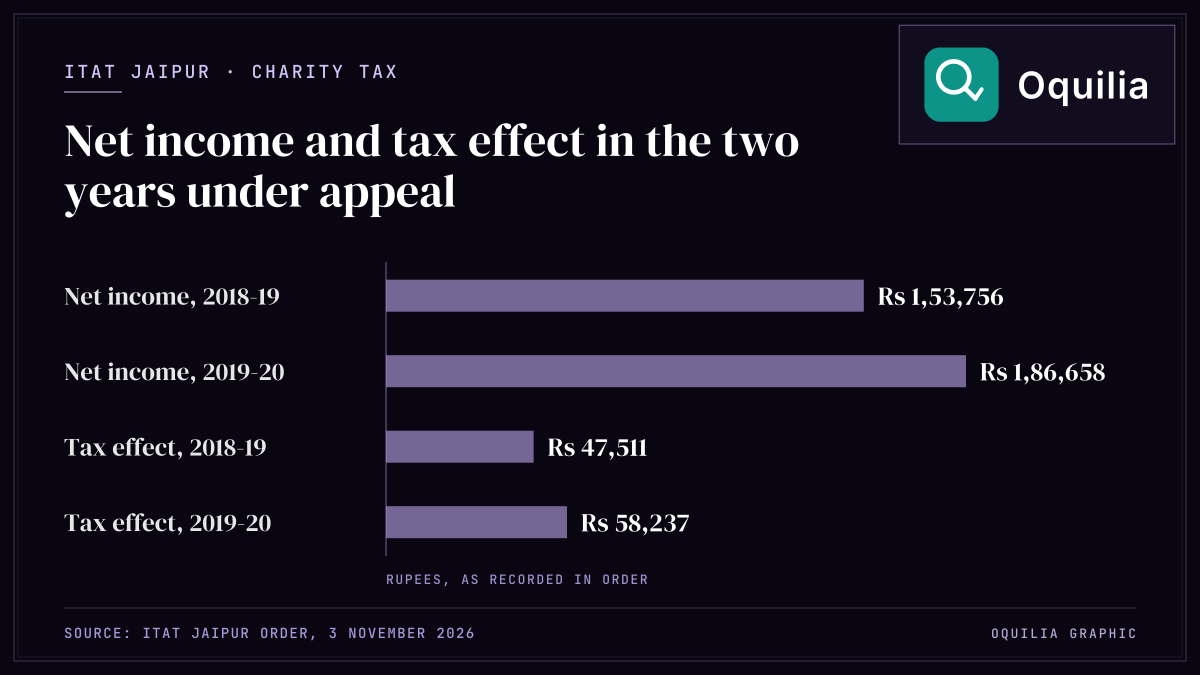
- The tribunal directed the tax officer to recompute tax on net income of Rs 1,53,756 for 2018-19 and Rs 1,86,658 for 2019-20.
- Per the order, such a trust pays the maximum rate only where exemption is lost under Section 13(1)(c) or 13(1)(d).
The Jaipur bench of the Income Tax Appellate Tribunal (ITAT) has held that a charitable trust which is denied income-tax exemption because it is not registered must pay tax at the ordinary slab rates for an association of persons, with the basic exemption, and not at the maximum marginal rate. The order, pronounced on 3 November 2026, allowed two appeals by Shri Chandraprabh Charitable Sanstha, Jaipur, for assessment years 2018-19 and 2019-20.
What Happened
The trust, which the order describes as engaged in medical relief, was not registered under Section 12A of the Income Tax Act in either year, so its exemption under Section 11 was denied. The tax officer charged tax on its net income at the maximum marginal rate. The Commissioner of Income Tax (Appeals) upheld that rate under Section 167B, observing that it was "presumed" the trust fell within that section.
The tribunal disagreed. It held that Section 164(2) is the specific provision for the income of a trust held wholly for charitable or religious purposes that is not exempt, and it taxes that income "as if" it were the income of an association of persons. Parliament, the tribunal said, allowed the maximum marginal rate for such income only where exemption is lost under Section 13(1)(c) or 13(1)(d), and a specific provision prevails over a general one. Section 167B, it held, assumes members with shares in the income, and a charitable institution has none. The tribunal said a tax charge at the highest rate "cannot rest on a presumption", and cited a 1982 circular of the Central Board of Direct Taxes taking the same view.
The tax officer was directed to recompute tax on net income of Rs 1,53,756 for 2018-19 and Rs 1,86,658 for 2019-20 and to grant consequential relief. The order records the tax effect as Rs 47,511 and Rs 58,237. The trust's plea for costs was dismissed.
What It Means
For charitable or religious trusts whose exemption is refused only because they are not registered, the ruling means the surplus is taxed at the rates for an association of persons, with the basic exemption, unless the exemption was lost under Section 13(1)(c) or 13(1)(d). The order follows earlier rulings of the tribunal's Mumbai and Pune benches, which it cites. Trusts facing a similar demand can rely on the reasoning recorded in the order when they seek rectification or file an appeal.
Source: ITAT order
Sources & Citations
- ITAT order — Income Tax Appellate Tribunal