

NCLAT sets aside insolvency order against Polycab India, releases it from CIRP
The NCLAT on 30 October 2026 set aside an NCLT Ahmedabad order that had admitted Polycab India into insolvency over a Rs 2.78 crore supplier claim, holding that a dispute existed.
Key points
- The NCLAT on 30 October 2026 set aside an NCLT Ahmedabad order that had admitted Polycab India into insolvency.
- The supplier, Asier Metals, had claimed an unpaid operational debt of Rs 2.78 crore, according to the order.
- Polycab India's board runs the company again with immediate effect; the NCLAT order may be appealed to the Supreme Court.
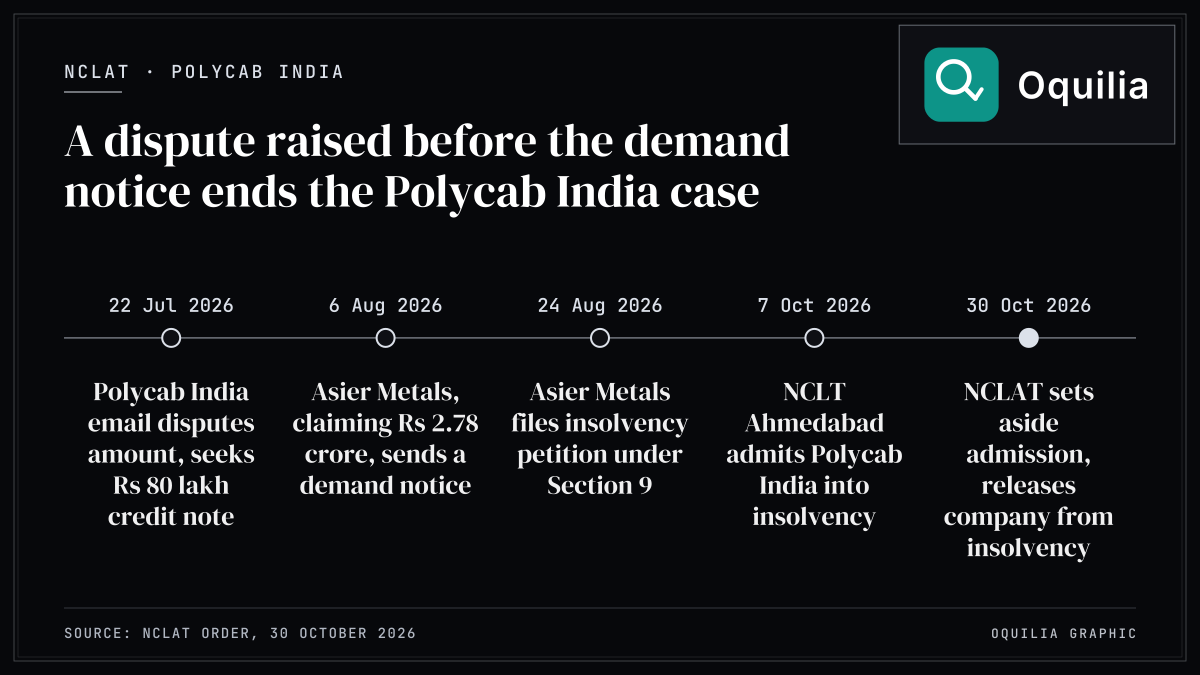
The National Company Law Appellate Tribunal (NCLAT) on 30 October 2026 set aside an order of the National Company Law Tribunal (NCLT), Ahmedabad Bench, that had admitted Polycab India Limited into the corporate insolvency resolution process (CIRP). The appellate tribunal held that a genuine dispute over a claimed operational debt of Rs 2.78 crore existed before the supplier's demand notice, and released the company from insolvency with immediate effect.
What Happened
Asier Metals Private Limited, which supplied aluminium ingots to Polycab India, claimed an outstanding operational debt of Rs 2.78 crore, according to the order. An operational creditor is a supplier of goods or services that says it is owed money. Asier Metals sent a demand notice on 6 August 2026 and filed an insolvency petition under Section 9 of the Insolvency and Bankruptcy Code (IBC) on 24 August 2026. The NCLT admitted the petition on 7 October 2026.
A suspended director of Polycab India appealed. The NCLAT examined emails and WhatsApp messages exchanged before the demand notice, including a 22 July 2026 email in which Polycab India disputed the amount and asked for a detention and demurrage credit note of Rs 80 lakh. The tribunal found that the supplier had assured Polycab India that these charges would be resolved and adjusted, and held that a dispute truly existed over reconciliation of accounts, credit notes and the final amount payable.
Applying the tests laid down by the Supreme Court, the NCLAT held that the NCLT had dismissed this correspondence without analysing it, and that its order suffered from "patent infirmity". Under Section 9(5)(ii)(d) of the IBC, a petition must be rejected when such a dispute exists, the tribunal said.
What It Means
The NCLAT set aside the admission order and all orders passed under it. Polycab India is released from the insolvency process and is allowed to function through its board of directors with immediate effect. No costs were ordered.
For the company's shareholders, employees and suppliers, the ruling ends the insolvency process that began on 7 October 2026. The tribunal did not decide whether the supplier is owed the money; it held only that a plausible dispute existed that needed adjudication elsewhere. The NCLAT's order may be appealed to the Supreme Court.
Source: NCLAT order
Sources & Citations
- NCLAT order — National Company Law Appellate Tribunal