

Madras HC orders sale of Rs 238.90 crore Neomax assets attached by ED to repay investors
The ED said the Madurai Bench of the Madras High Court ordered properties it attached from the Neomax group to be sold under court supervision and the money given to investors.
Key points
- The Madurai Bench of the Madras High Court passed a common order on 30 October 2026 for sale of assets the ED attached in the Neomax case.
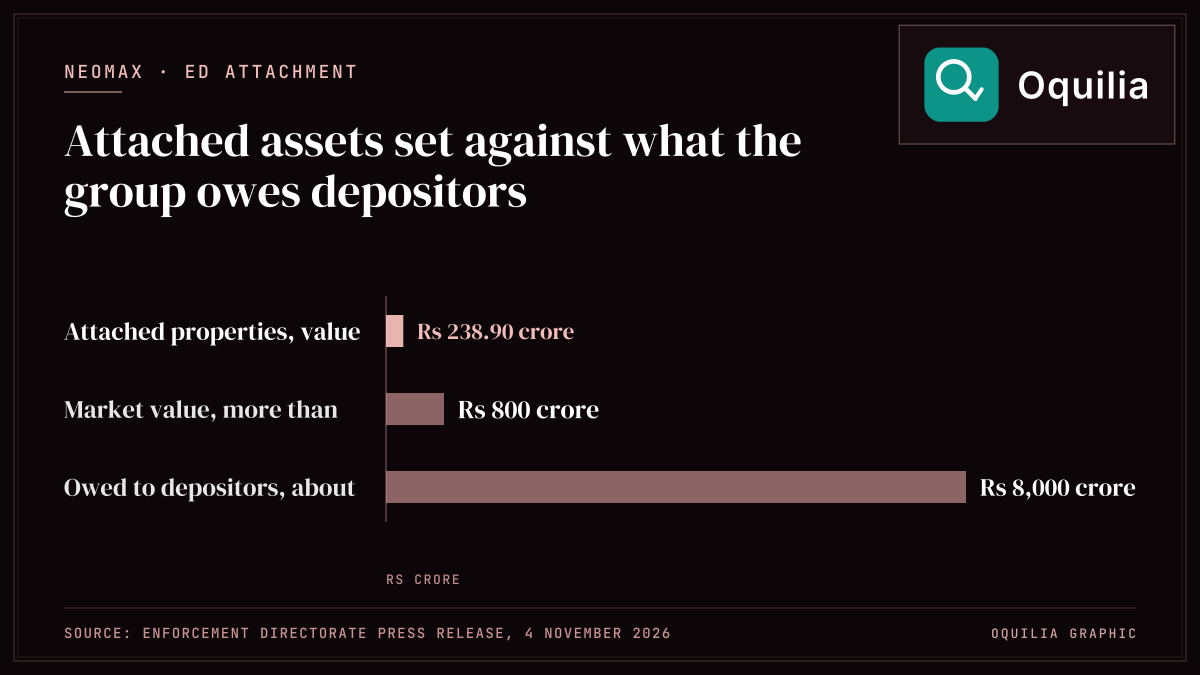
- The ED says the assets are worth Rs 238.90 crore, with a market value of more than Rs 800 crore, and the group owes about Rs 8,000 crore.
- Sale proceeds are to be distributed to investors under the High Court's supervision; the ED's prosecution complaint is on trial in Madurai.
Investors in the Neomax group's real estate schemes in Tamil Nadu are set to get back some of their money. The Enforcement Directorate (ED) said on 4 November 2026 that the Madurai Bench of the Madras High Court, in a common order dated 30 October 2026, held that properties the ED attached in its money laundering case against Neomax Properties Private Ltd and others will be sold and the proceeds distributed to victims under the court's supervision.
What Happened
According to the ED's Chennai Zonal Office II, the attached properties are worth Rs 238.90 crore and have a market value of more than Rs 800 crore. The ED had issued two provisional attachment orders covering immovable properties, bank accounts and shares, and has filed a prosecution complaint before the Special Court (PMLA), Madurai, where the trial is under way.
The ED's case is based on an FIR registered by the Economic Offences Wing, Madurai. The ED alleges that the Neomax group collected large sums, mostly in cash, from thousands of investors for plot development projects by promising returns of 12% to 30%, did not give the promised returns or plots, and diverted the money to shell entities and other businesses. The ED says the group owes about Rs 8,000 crore, including promised returns, to depositors, and alleges it pressed depositors to reinvest their maturity amounts instead of repaying them.
These are allegations, not findings of guilt; the accused are presumed innocent until proven guilty in court, and due process continues.
What It Means
Restitution means returning attached property, or its value, to the people who lost money, before the criminal trial ends. The distribution will happen under the High Court's supervision.
Schemes that promise very high fixed returns on deposits are a common warning sign. Before putting money into any deposit scheme, check whether the entity is authorised; unauthorised deposit schemes can be reported to RBI's Sachet portal at https://sachet.rbi.org.in.
This report describes enforcement actions and allegations on the public record, attributed to the officials cited. An order, FIR or chargesheet is not a conviction; parties are presumed innocent until proven guilty.
Named in this report, or spotted an error? Corrections and responses: editor@oquilia.com. We correct errors promptly and record responses from named parties.
Sources & Citations
- Enforcement Directorate press release — Enforcement Directorate