

Kerala High Court: tenants of mortgaged property must go to DRT in SARFAESI cases
The Kerala High Court held on 12 November 2026 that occupants claiming tenancy of a property Axis Bank is taking over under SARFAESI must approach the Debts Recovery Tribunal.
Key points
- The Kerala High Court dismissed a writ petition by three occupants of premises mortgaged to Axis Bank in Thrissur.
- The court held on 12 November 2026 that tenancy claims cannot be decided in a magistrate's Section 14 possession proceedings.
- The court held that occupants who object to a bank's SARFAESI action must apply to the Debts Recovery Tribunal under Section 17.
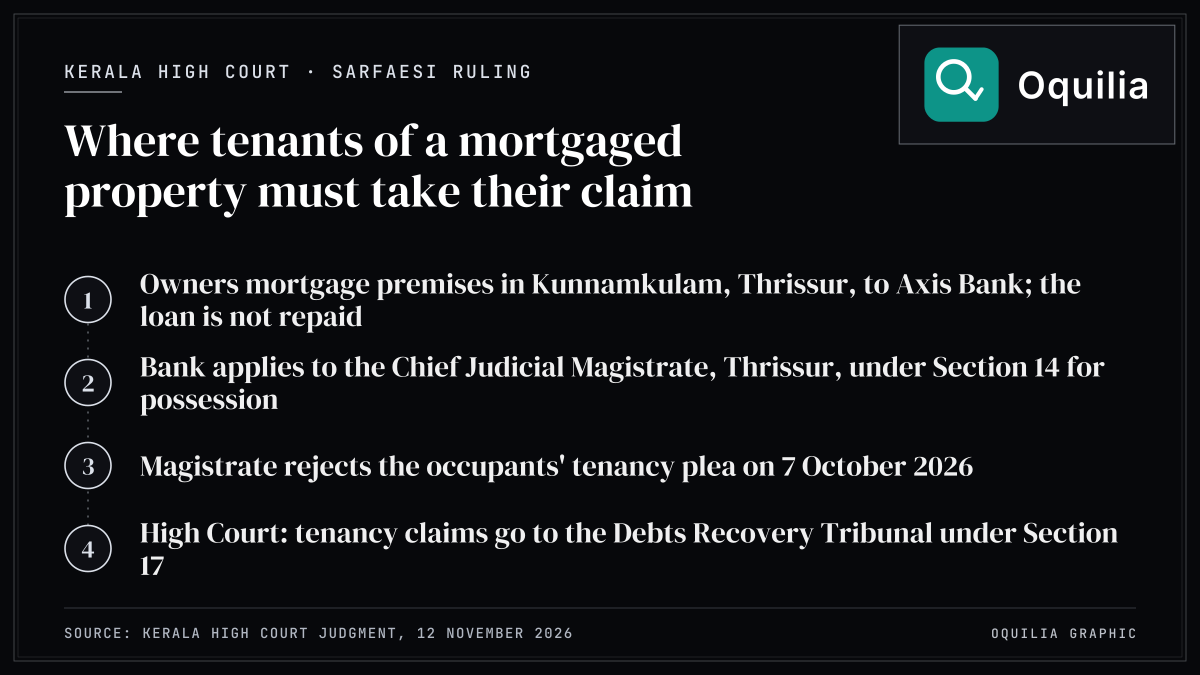
The Kerala High Court on 12 November 2026 held that people who claim to be tenants of a property a bank is taking over under the SARFAESI Act must take their case to the Debts Recovery Tribunal, not to the magistrate handling possession. The court dismissed a writ petition by three occupants of premises in Kunnamkulam, Thrissur, mortgaged to Axis Bank.
What Happened
According to the judgment, the owners of the premises had mortgaged them to Axis Bank to secure a loan. After the loan was not repaid, the bank started recovery under the SARFAESI Act, the law that lets lenders take over and sell secured property without going to a civil court. The bank applied to the Chief Judicial Magistrate, Thrissur, under Section 14 of the Act, and an Advocate Commissioner was appointed to take physical possession.
The three occupants said their leases were made long before the mortgage and that they could be evicted only under the Kerala Buildings (Lease and Rent Control) Act, 1965. The magistrate rejected their plea on 7 October 2026, holding that disputed tenancy claims cannot be decided in Section 14 proceedings and that the statutory remedy must be used.
The High Court found no illegality in that order. It held that the inquiry under Section 14 is limited and that deciding tenancy rights is beyond its scope. It agreed that the words "any person" in Section 17(1) of the Act are wide enough to cover people other than borrowers, so the proper remedy is the Debts Recovery Tribunal. The court said it prima facie found merit in the bank's contention that the documents did not convincingly show valid tenancies. It dismissed the petition without prejudice to the occupants' statutory remedies and said its observations are not conclusive on the merits.
What It Means
For tenants and other occupants of a property that a bank is taking over under the SARFAESI Act, the ruling says the route to challenge the bank's action is an application to the Debts Recovery Tribunal under Section 17, not the magistrate's court or a writ petition. For borrowers, it shows that tenancy claims on a mortgaged property will not by themselves stop a magistrate's possession order.
Source: High Court judgment
Sources & Citations
- High Court judgment — Kerala High Court