

Karnataka High Court refuses to stay City Union Bank sale notice, sends borrower to DRT
The Karnataka High Court dismissed a borrower firm's challenge to a City Union Bank sale notice, holding that changes to a Debts Recovery Tribunal interim order must be sought from the tribunal.
Key points
- The Karnataka High Court on 21 November 2026 dismissed a borrower firm's petition against a City Union Bank sale notice.
- The tribunal had stayed confirmation of the sale if the firm deposits Rs 39,15,600 by 23 November and two more instalments.
- The court held the borrower must ask the Debts Recovery Tribunal itself to vary its interim order.
The Karnataka High Court on 21 November 2026 dismissed a borrower firm's challenge to a City Union Bank sale notice, holding that a borrower who has gone to the Debts Recovery Tribunal must seek any change in the tribunal's interim order from the tribunal itself. The court ruled in Writ Petition No. 35882 of 2026, filed by RP Agency, a Bengaluru partnership firm.
What Happened
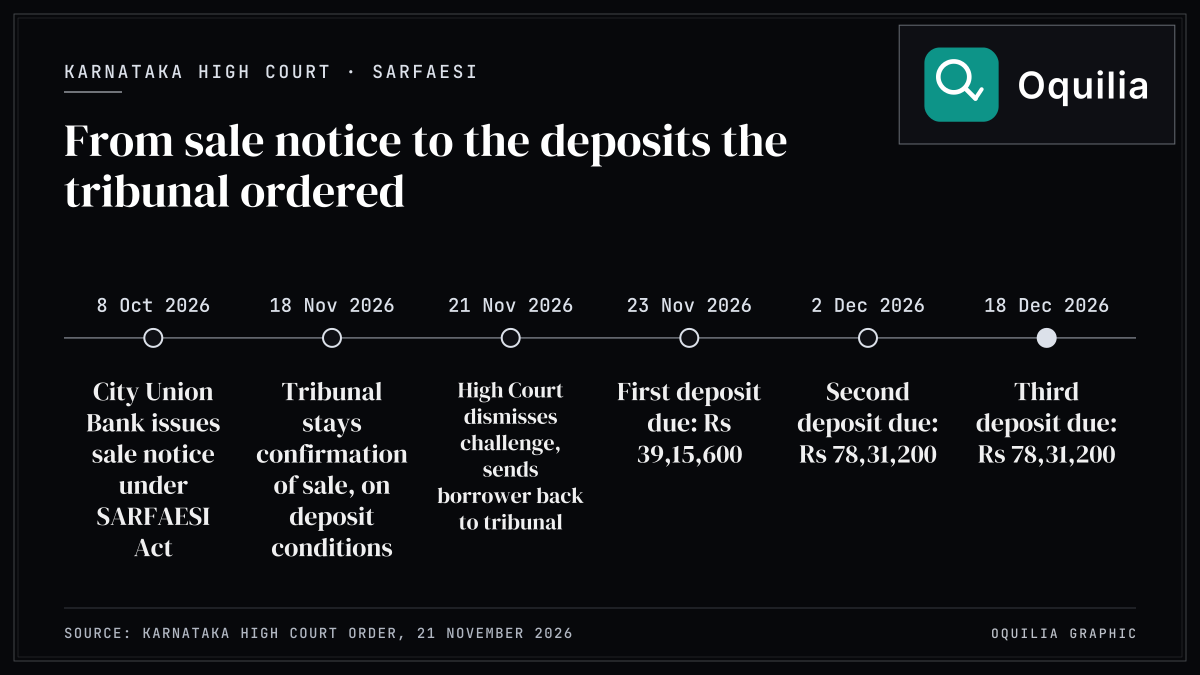
According to the order, the bank issued a sale notice on 8 October 2026 for the firm's mortgaged property under the SARFAESI Act, the law that lets banks sell pledged property to recover a bad loan without going to court. The firm challenged it before the Debts Recovery Tribunal under Section 17 of the Act.
On 18 November 2026 the tribunal stayed confirmation of the sale, on condition that the firm deposit Rs 39,15,600 by 23 November 2026, Rs 78,31,200 by 2 December 2026 and another Rs 78,31,200 by 18 December 2026. The firm said it would make the deposits but wanted the sale notice itself stayed, and asked the High Court to direct the bank to consider a buyer's offer above the reserve price.
The court held that, having used its remedy under the SARFAESI Act and obtained interim relief, the firm had to approach the tribunal for any variation. It said the tribunal's choice to stay only the confirmation of sale, and not the notice, could not be faulted. The order records that the firm was stated to owe Rs 7,83,12,208 as on 5 October 2026, and that the tribunal had ordered a portion paid in three instalments. All rights and contentions were left open before the tribunal.
What It Means
For borrowers facing a bank auction, the ruling shows that once a case is before the Debts Recovery Tribunal, the High Court will rarely step in on its interim conditions. A stay of confirmation means the sale can go ahead but cannot be finalised while the condition is met, so deposits ordered by the tribunal must be paid on time. Requests to change those terms go back to the tribunal. The High Court's order can be appealed.
Source: High Court judgment
Sources & Citations
- High Court judgment — Karnataka High Court