

Karnataka High Court quashes Lokayukta bribery FIR against MUDA Commissioner Mansoor Ali
The Karnataka High Court has quashed a Lokayukta bribery case against the Mangalore Urban Development Authority Commissioner, holding there was no demand or acceptance by him.
Key points
- The Karnataka High Court on 4 November 2026 quashed a Lokayukta bribery FIR against the Commissioner of the Mangalore Urban Development Authority.
- The Lokayukta alleged that Rs 25 lakh was handed to a second accused in a trap; the court held the petitioner neither demanded nor accepted any money.
- The court said a third person's statement that he took the money on another's behalf is not enough to keep investigating a public servant.
The Karnataka High Court has quashed a bribery case registered by the Karnataka Lokayukta police against Mansoor Ali, Commissioner of the Mangalore Urban Development Authority (MUDA). In an order dated 4 November 2026, the court held that the material did not show that he had demanded or accepted any money. The case had been registered in March 2024 under Section 7(a) of the Prevention of Corruption Act, 1988.
What Happened
According to the order, a real-estate businessman complained to the Lokayukta in March 2024 that the MUDA Commissioner had kept a file on Transferable Development Rights (TDR) for his land pending. The complainant alleged that a payment of Rs 25 lakh was sought to clear the file. The Lokayukta police then laid a trap at a stadium parking area in Mangaluru, where, as the order records, the complainant handed Rs 25 lakh to a second accused, who was caught on the spot. The Commissioner was in a meeting at the Zilla Panchayat office at the time and was later taken into custody.
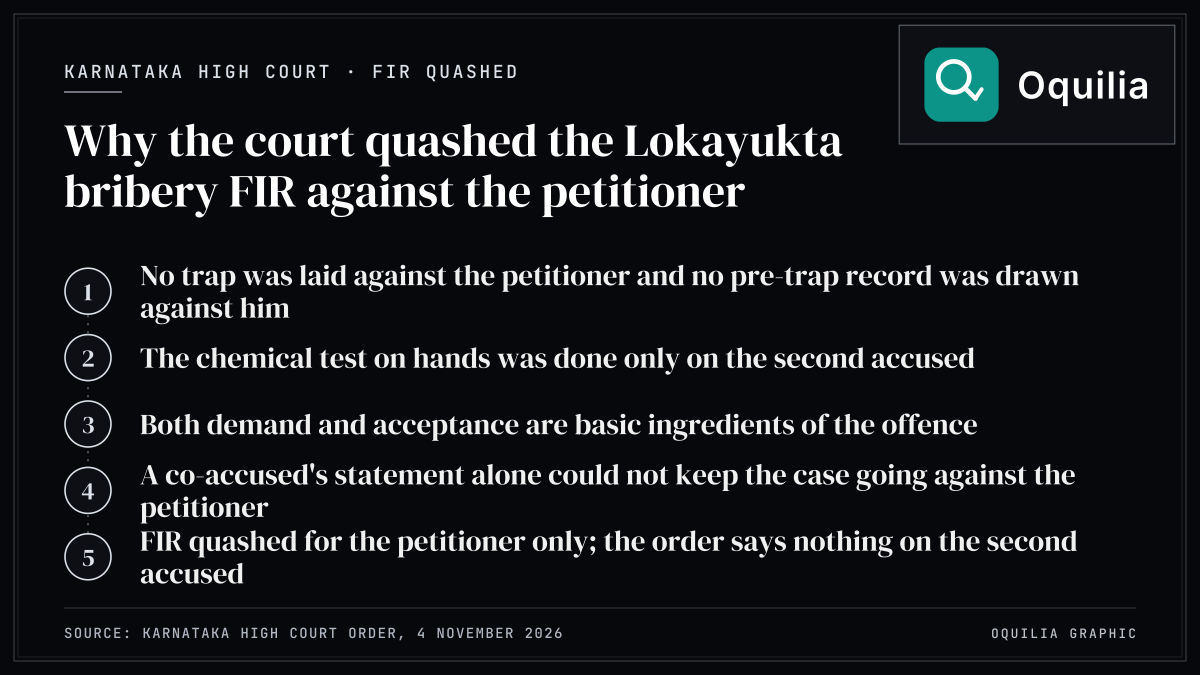
The Lokayukta argued that the second accused took the money on the Commissioner's directions and that the law covers a bribe taken through a third party. The court did not accept this. It held that no trap was laid against the petitioner, no pre-trap record was drawn against him and the chemical test on hands was done only on the second accused. Relying on Supreme Court rulings, it held that both demand and acceptance are basic ingredients of the offence, and that a co-accused's statement alone could not keep the case going against the petitioner. It called further investigation against him an abuse of the process of law and quashed the FIR as far as he is concerned.
What It Means
The ruling applies only to the petitioner; the order says nothing about the case against the second accused. The allegations against the second accused are allegations, not findings of guilt; the accused are presumed innocent until proven guilty in court, and due process continues.
Anyone asked for a bribe by an official can report it to the state anti-corruption authority; Oquilia's guide to every state's helpline is at https://www.oquilia.com/report-a-bribe.
Source: High Court judgment
Sources & Citations
- High Court judgment — Karnataka High Court