

Karnataka HC refuses to quash bribe case against BESCOM supervisor Yoganand
The Karnataka High Court dismissed a BESCOM supervisor's plea to quash a Lokayukta case alleging he took Rs 4,000 to replace a transformer, finding a prima facie case.
Key points
- The Karnataka High Court on 11 November 2026 dismissed a BESCOM supervisor's petition to quash a Lokayukta bribery case.
- The Lokayukta police allege the supervisor demanded Rs 6,000 and accepted Rs 4,000 to replace a transformer quickly.
- The investigation and the case before the Ramanagara sessions court continue; the accused is presumed innocent.
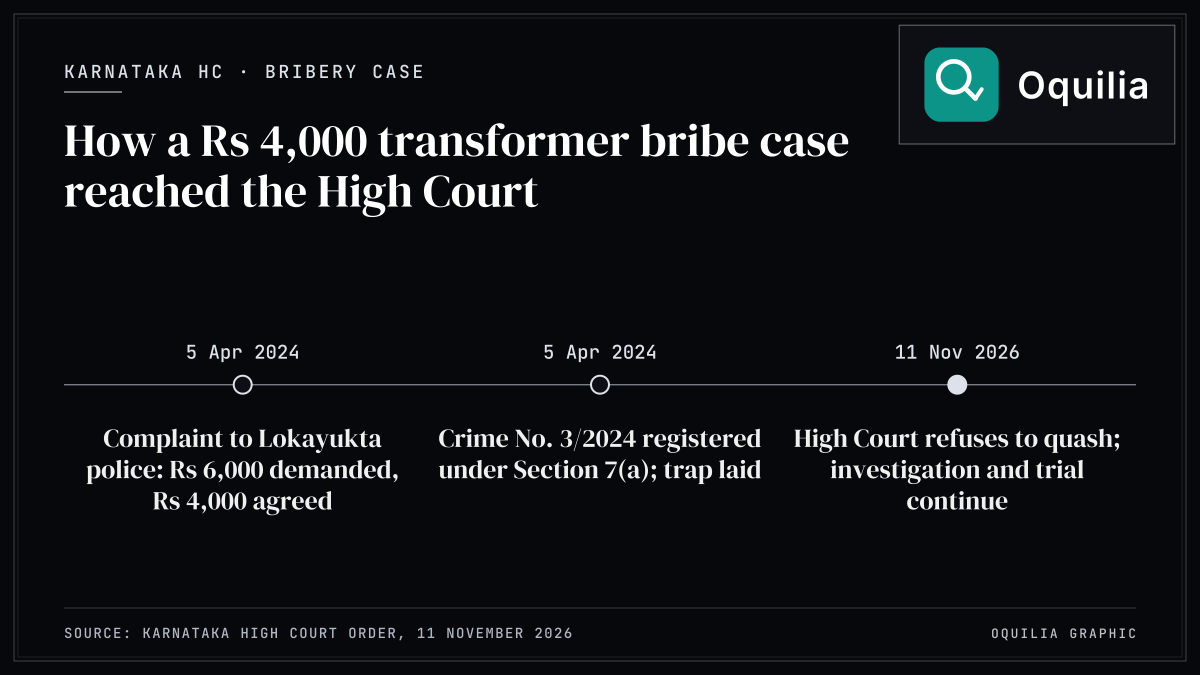
The Karnataka High Court on 11 November 2026 refused to quash a Lokayukta bribery case against Yoganand, office supervisor, BESCOM sub-division, Kudur, Magadi taluk, whom the Lokayukta police accuse of taking Rs 4,000 to replace a village transformer. The court dismissed his petition (Criminal Petition No. 10388 of 2024, 2026:KHC:62165), holding that the record prima facie shows a demand and acceptance of a bribe.
What Happened
According to the order, a resident complained to the Lokayukta police, Ramanagara, on 5 April 2024 that the supervisor, in charge of the BESCOM branch at Kudur, told him replacing a transformer would take about six months, then demanded Rs 6,000 and settled on Rs 4,000 for immediate replacement. The police registered Crime No. 3/2024 the same day under Section 7(a) of the Prevention of Corruption Act, 1988 and laid a trap.
The prosecution's case, as the order records it, is that the complainant handed over Rs 4,000 in powder-treated notes, the supervisor's hand wash turned pink, the notes were recovered and he was arrested.
The petitioner argued that no work of the complainant was pending before him, since the request lay with an assistant executive engineer, and that the call records showed no clear demand. The court held that the complaint, a recorded phone conversation and the trap record together prima facie disclose demand and acceptance. Citing Supreme Court rulings, it said courts must be slow to use their power under Section 482 of the Code of Criminal Procedure to quash cases under the anti-corruption law, especially while the investigation is still incomplete.
What It Means
The investigation and the case before the Principal District and Sessions Judge, Ramanagara, now continue. The court made clear that its observations shall not influence the trial court.
The ruling, which quotes a 2026 Supreme Court judgment, means that an argument that the work belonged to another officer did not end a trap case at the start. These are allegations, not findings of guilt; the accused is presumed innocent until proven guilty in court, and due process continues.
Anyone asked for a bribe by a government employee can report it to the state anti-corruption authority; Oquilia's guide lists every state's helpline at https://www.oquilia.com/report-a-bribe.
Source: High Court judgment
Sources & Citations
- High Court judgment — Karnataka High Court