

Jharkhand High Court refuses bail in ED's Rs 750 crore fake ITC PMLA case
The Jharkhand High Court has dismissed a second bail plea in an ED money-laundering case over an alleged Rs 750 crore fake GST input tax credit network of 135 shell firms.
Key points
- The Jharkhand High Court on 18 November 2026 dismissed a second regular bail application in an ED money-laundering case under the PMLA.
- The ED alleges a network of 135 shell firms passed on about Rs 750 crore of ineligible input tax credit through bogus GST invoices.
- The trial continues before the Special PMLA Court in Ranchi, and the allegations remain unproven until decided on evidence.
The Enforcement Action
The High Court of Jharkhand at Ranchi has refused regular bail to a person the Enforcement Directorate (ED) accuses of running a network of 135 shell companies that allegedly passed on about Rs 750 crore of ineligible Input Tax Credit (ITC) through bogus GST invoices. Justice Sujit Narayan Prasad dismissed the second bail application of the petitioner, Shiva Kumar Deora, in B.A. No. 8815 of 2026, by an order pronounced on 18 November 2026 (neutral citation 2026:JHHC:33137) and uploaded on 20 November 2026.
The petitioner has been in custody since his arrest by the ED on 8 May 2025. He is being tried before the Special Judge, PML Act, Ranchi, in ECIR Case No. 05 of 2025, which arises out of ECIR No. ECIR/RNZO/18/2024 dated 23 September 2024, for the offence under Section 3 of the Prevention of Money Laundering Act, 2002 (PMLA), punishable under Section 4.
The court held that no "relevant change of circumstance (factual or legal)" had been shown since his earlier bail plea was rejected on merit, and that delay in trial and the length of custody could not, on their own, override the bail conditions in Section 45 of the PMLA. The order expressly states that its observations are "confined solely to the issue of consideration of bail" and will not influence the merits at trial.
Before the court, the petitioner's counsel contended that he is innocent, has been falsely implicated with mala fide intent, has cooperated with the investigation and has no criminal antecedents. Those contentions will be tested at trial.
How the Scheme Worked
The description of the alleged scheme in the order comes from the ED's case and from three complaint cases (Nos. 678, 1280 and 1281 of 2024) filed by the Directorate General of GST Intelligence (DGGI), Jamshedpur, before the Court of Economic Offences, Jamshedpur. None of it has yet been proved at trial.
According to those complaints, as recorded in the order, a syndicate operating in Jharkhand, West Bengal, Delhi and other states created and managed fake companies and firms to pass on ineligible ITC by issuing GST bills without any actual supply of goods or services. The order records the allegation that bogus invoices were generated in Delhi and "traveled to Jharkhand via West Bengal in three to four layers", and that part of the bogus credit moved on to Tamil Nadu, Telangana, Andhra Pradesh, Maharashtra and Odisha.
The mechanism the prosecution describes depended on ordinary people. The order records the allegation that poor and needy people were offered "jobs" at Rs 10,000 to Rs 15,000 a month, were not required to attend office, and were instead asked to provide OTPs and PINs whenever required. Firms and companies were then allegedly floated in their names, using their identity documents, without their knowledge or consent. A staff member was allegedly paid Rs 30,000 a month to create digital signature certificates and rent agreements, and to help open bank accounts.
The ED alleges that the petitioner and two associates were the beneficial owners of the 135 shell entities, and that the petitioner was himself a director in seven companies through which ITC worth Rs 55.83 crore was availed. The order records that the investigation found direct cash deposits of Rs 74,60,878 into bank accounts linked to him between 2020 and 2024. It also records the ED's case that statements recorded under Section 50 of the PMLA in May 2025 contained admissions, and that the proceeds of crime were "at least 201 Crores", including a commission of about Rs 67 crore.
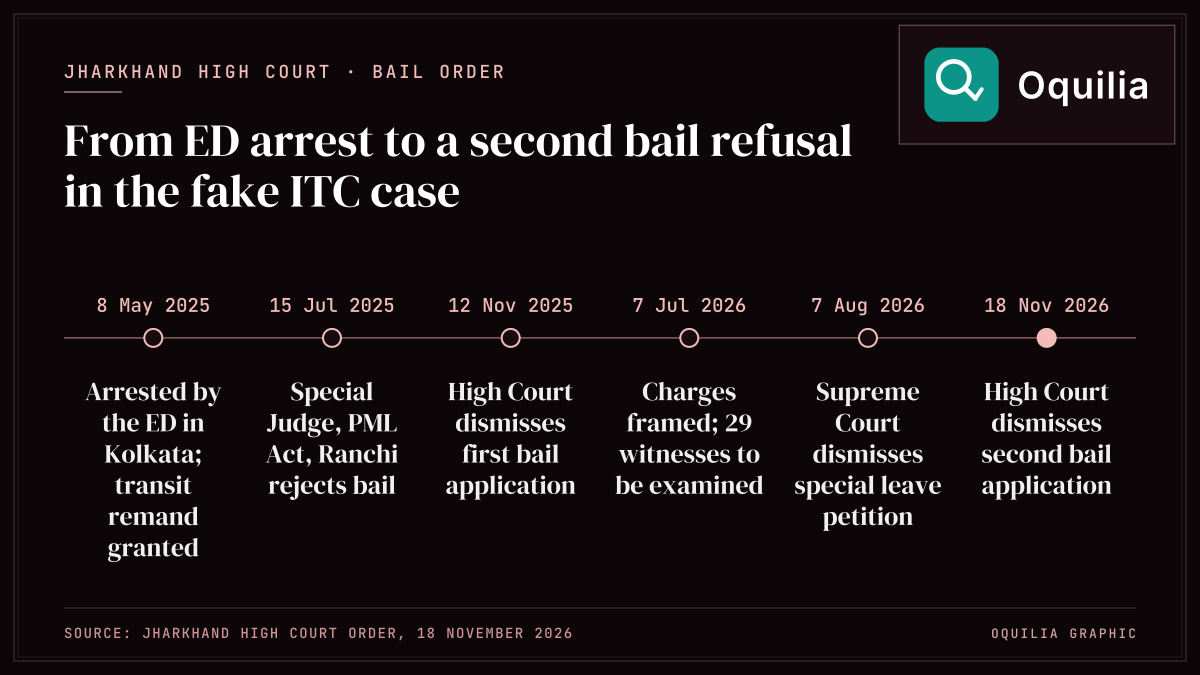
After his arrest in Kolkata on 8 May 2025, a Chief Judicial Magistrate in Calcutta granted transit remand the same day. The Special Judge rejected bail on 15 July 2025, the High Court dismissed his first bail application (B.A. No. 8570 of 2025) on 12 November 2025, and the Supreme Court dismissed his special leave petition on 7 August 2026. A fresh plea before the Special Judge was rejected on 22 August 2026. Charges were framed on 7 July 2026, and according to the order 29 witnesses are to be examined, one of whom has been partly examined.
The Law Invoked
The bail application was filed under Sections 483 and 484 of the Bharatiya Nagarik Suraksha Sanhita, 2023, read with Section 45 of the PMLA. Section 45 is the provision that makes bail difficult in money-laundering cases: it sets out the so-called twin conditions, under which a court must be satisfied that there are reasonable grounds to believe the accused is not guilty and is not likely to commit an offence while on bail. The order also deals with the proviso to Section 45(1), which the petitioner invoked on medical grounds, and holds that the proviso is discretionary rather than an automatic right.
The underlying charge is under Section 3 of the PMLA, which defines the offence of money laundering, and Section 4, which prescribes its punishment. Money laundering under the PMLA needs a "scheduled offence" that generated the proceeds. Here the order records that the ED treated Sections 420, 467 and 471 of the Indian Penal Code (cheating, and forgery-related offences) as scheduled offences under Part A, Paragraph 1 of the PMLA Schedule.
The petitioner also challenged his arrest under Section 19 of the PMLA, which requires the grounds of arrest to be communicated. The court held that the requirement had been met, noting his signed acknowledgement of the arrest memo, the grounds of arrest and the "reasons to believe".
What Happens Next
The trial continues before the Special Judge, PML Act, Ranchi, where the prosecution will lead evidence and the defence will be able to cross-examine witnesses and present its case. The order records the ED's assurance that earnest efforts are being made to conclude the trial quickly. The petitioner can still seek to challenge this bail refusal before the Supreme Court, and a further bail application can be considered if a genuine change of circumstance arises.
The order notes that a co-accused was granted bail by the Supreme Court on 17 July 2026. The High Court held that parity is "role-based" and cannot be the sole ground for bail, and declined to extend it to the petitioner.
A refusal of bail is not a finding of guilt. The allegations in the ED's prosecution complaint and the DGGI complaints remain allegations until a court decides them on evidence at trial, and the accused are presumed innocent until proven guilty.
What It Means
For most readers, the practical lesson lies in how the alleged scheme was built rather than in the bail ruling itself. According to the order, the shell entities were registered in the names of economically vulnerable people who handed over identity documents, OTPs and PINs in return for a modest monthly "salary". Lending your identity this way can leave you on record as the director or proprietor of a firm you have never seen, and potentially facing tax demands or questioning when investigators trace the invoices.
A few habits reduce that risk. Never share an Aadhaar or bank OTP, PIN or digital signature with an employer or anyone else, whatever the stated reason; genuine employers do not need them. If you suspect your PAN has been misused, the GST portal's public taxpayer search allows a search by PAN, which shows whether GST registrations exist in your name. Directors can similarly check the companies linked to their Director Identification Number on the Ministry of Corporate Affairs portal.
For businesses, the case shows why buyers are expected to check that suppliers are genuine and actually deliver goods. The ITC system depends on invoices reflecting real supplies, and claiming credit on paper-only invoices, even through intermediaries, can draw a business into an investigation.
FAQ
Does this order mean the people the ED named are guilty?
No. A provisional attachment, chargesheet or prosecution complaint contains allegations, not findings of guilt; the accused are presumed innocent until proven guilty, and due process continues. The High Court decided only whether bail should be granted. Its order states that its observations are confined to bail and will not prejudice the merits of the case at trial, where the prosecution must prove its case.
What exactly did the High Court decide?
On 18 November 2026 Justice Sujit Narayan Prasad dismissed B.A. No. 8815 of 2026, a second regular bail application. The court found no relevant change in factual or legal circumstances since the first bail application was rejected on merit, held that parity with a co-accused and delay in trial were not enough, and found that the medical conditions cited could be managed in custody.
Can the order be challenged?
Yes. Bail orders of a High Court can be challenged before the Supreme Court, and the petitioner previously approached it after his first bail plea was refused. The trial court proceedings continue separately, with charges framed on 7 July 2026 and witness examination under way.
How can I check whether my identity has been used to register a firm?
The GST portal's public taxpayer search lets you search by PAN to see any GST registrations linked to it. The Ministry of Corporate Affairs portal shows companies associated with a Director Identification Number. If you find a registration you did not authorise, report it to the GST department and file a police complaint.
Where can I read the official order?
The full judgment, Shiva Kumar Deora @ Shiva Ratan Deora v. Union of India (2026:JHHC:33137), is available on Indian Kanoon at the link below.
This report is based on the official Jharkhand High Court order dated 18 November 2026 in B.A. No. 8815 of 2026. It was surfaced via coverage in LiveLaw.
This report describes enforcement actions and allegations on the public record, attributed to the officials cited. An order, FIR or chargesheet is not a conviction; parties are presumed innocent until proven guilty.
Named in this report, or spotted an error? Corrections and responses: editor@oquilia.com. We correct errors promptly and record responses from named parties.