

Jharkhand High Court denies bail to AHTU officer Sulekha Kumari Sapna in ACB trap case
The Jharkhand High Court rejected bail for an Anti-Human Traffic Unit officer-in-charge accused by the ACB of accepting a Rs 50,000 bribe, and asked for the sanction decision to be expedited.
Key points
- The Jharkhand High Court on 19 November 2026 rejected the bail plea of an Anti-Human Traffic Unit officer-in-charge held in an ACB trap case.
- The ACB alleges she accepted a bribe of Rs 50,000; she has been in custody since 31 July 2026 and a chargesheet was filed on 25 September 2026.
- She may renew her bail plea after six months or once charges are framed, and the court asked for the sanction decision to be taken at the earliest.
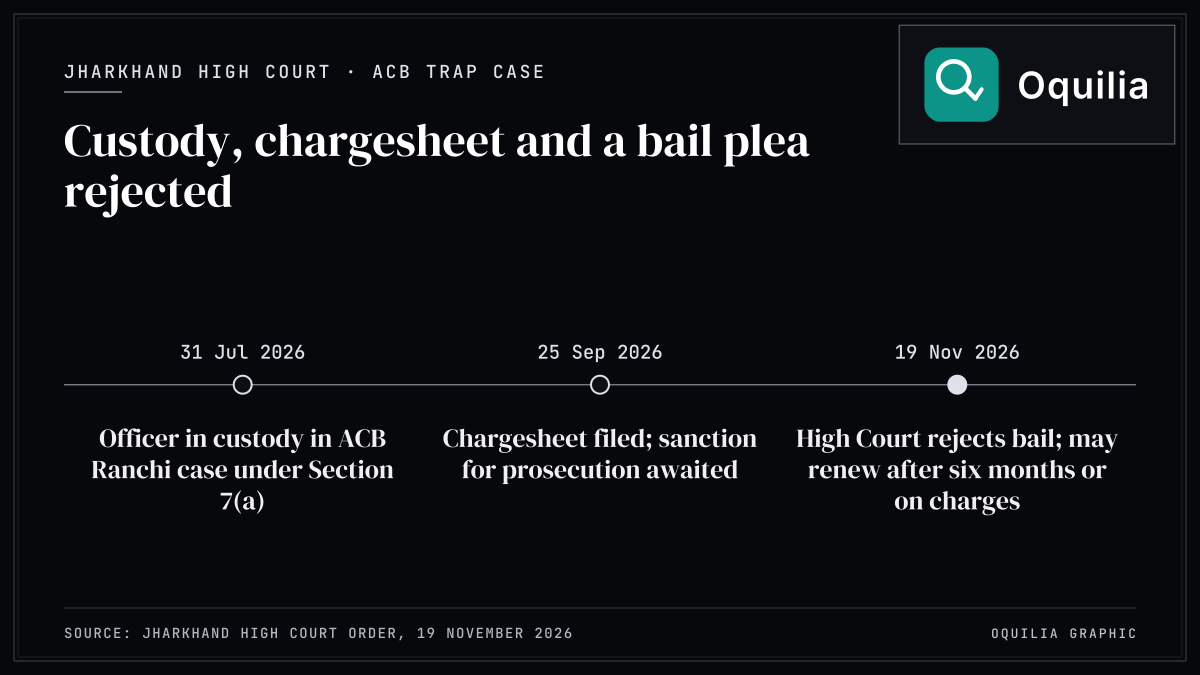
The Jharkhand High Court on 19 November 2026 rejected the bail plea of Sulekha Kumari Sapna, officer-in-charge of the Anti-Human Traffic Unit, who is in custody in an Anti-Corruption Bureau (ACB) trap case in which, according to the prosecution, she accepted a bribe of Rs 50,000. The court said she may renew her plea after six months or once charges are framed, whichever is earlier, and directed the State to send its order to the sanctioning authority.
What Happened
According to the order, she has been in custody since 31 July 2026 in ACB Ranchi Police Station Case No. 15 of 2026, registered under Section 7(a) of the Prevention of Corruption Act, the provision on a public servant taking a bribe. The case is pending before the Special Judge, Anti-Corruption Bureau, Ranchi.
The allegation, as recorded in the order, is that she demanded money to remove the complainant's name from the list of accused persons in another case. Her counsel argued that a court had already issued a warrant of arrest against the complainant, that only the supervisory authority had the power to remove a name from the accused column, and that a demand therefore could not arise.
The State opposed bail. Its counsel told the court that a chargesheet was filed on 25 September 2026 and that, according to the prosecution, there was demand, acceptance and recovery of the bribe money from her possession. Sanction for prosecution is still awaited, the State said; its counsel added that under Section 19 of the Act the sanctioning authority has three months from receipt to decide, extendable by one month.
Considering that she was apprehended with bribe money in a trap case, the court held that it was not inclined to grant bail.
These are allegations, not findings of guilt; the accused are presumed innocent until proven guilty in court, and due process continues.
What It Means
A bail order does not decide guilt; the charges will be tested at trial before the special court. The High Court's direction to send its order to the sanctioning authority is meant to ensure that the pending decision on sanction for prosecution is taken at the earliest.
Anyone asked for a bribe by an official can report it to the state anti-corruption bureau. Oquilia's guide lists every state's helpline at https://www.oquilia.com/report-a-bribe.
Source: High Court judgment
Sources & Citations
- High Court judgment — Jharkhand High Court