

Delhi consumer commission orders Metro Hospital to pay Rs 15 lakh over ambulance lapse
The Delhi State Consumer Disputes Redressal Commission held Metro Hospital & Heart Institute liable for failing to arrange a life-support ambulance for a stroke patient.
Key points
- The Delhi State Consumer Disputes Redressal Commission held Metro Hospital & Heart Institute liable for deficiency in service on 6 November 2026.
- The commission ordered the hospital to pay Rs 15 lakh as compensation and Rs 50,000 as litigation costs by 6 January 2027.
- If the hospital does not pay in time, interest at 9% a year runs from the date the complaint was filed; the order may be appealed.
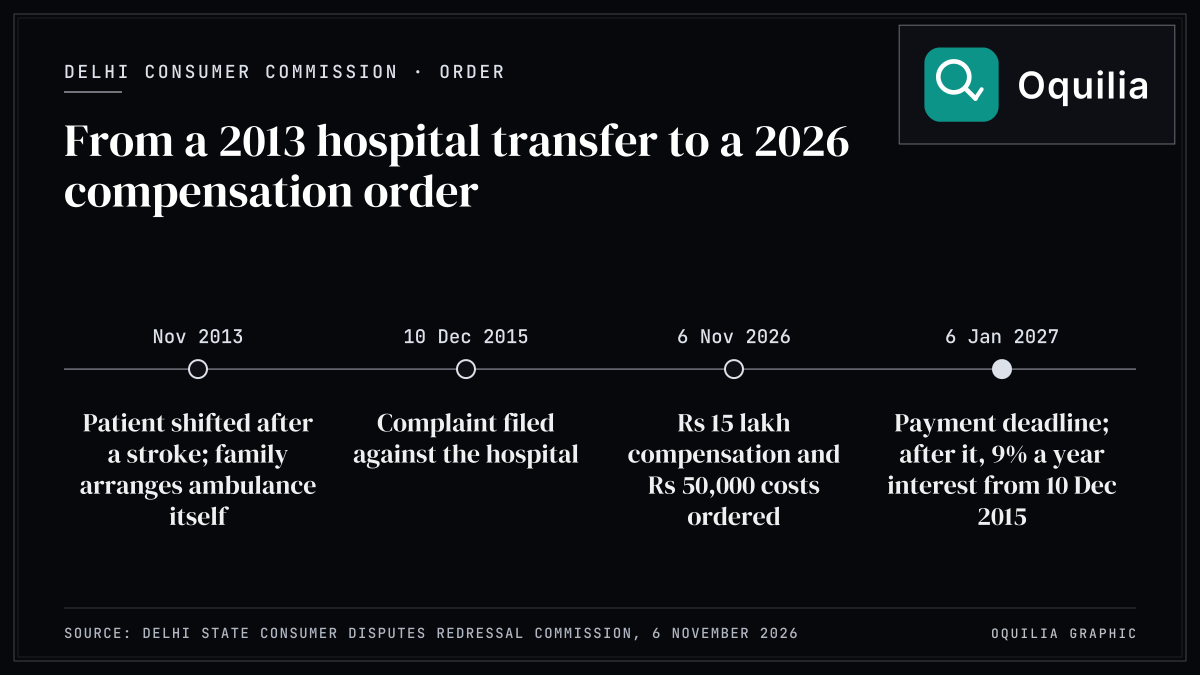
The Delhi State Consumer Disputes Redressal Commission has ordered Metro Hospital & Heart Institute in Lajpat Nagar, New Delhi, to pay Rs 15 lakh in compensation to a patient's family. In its judgment of 6 November 2026, the commission held that the hospital failed to arrange a life-support ambulance and an accompanying doctor when the patient had to be moved after a stroke in November 2013. It also awarded Rs 50,000 as litigation costs.
What Happened
The patient, who had earlier undergone heart valve surgery, was admitted to the hospital in November 2013 with a blocked valve and given a clot-dissolving injection. According to the order, a clot then travelled to his brain, leaving his right side weak and his speech affected, and he had to be shifted to another hospital. The family said the hospital told them no equipped ambulance or doctor was available, and they arranged an ambulance themselves.
On the medical treatment, the commission relied on an expert medical board and the Delhi Medical Council, which found the treatment followed standard protocol and that a stroke is a known complication. It held that no medical negligence was made out against the treating doctor.
On the transfer, however, the commission held that the hospital failed to make adequate arrangements, wasting critical time, and gave no explanation for this. It said a properly equipped ambulance and qualified staff for a patient transfer are not optional for a hospital, and held the hospital liable for deficiency in service under the Consumer Protection Act, 1986.
The hospital must pay Rs 15 lakh and Rs 50,000 by 6 January 2027. If it does not, the whole amount carries interest at 9% a year from the date the complaint was filed, 10 December 2015.
What It Means
The order says a hospital's duty to a patient continues during a transfer to another facility, and that families should not have to arrange essential emergency transport themselves. It shows that a consumer commission can find deficiency in service even where it finds no negligence in the treatment itself. The commission's order may be appealed. Patients with a complaint against a hospital or other service provider can contact the National Consumer Helpline on 1915 or file a complaint through e-Daakhil.
Source: Consumer commission order
Sources & Citations
- Consumer commission order — Consumer commission