

Court convicts ex-Syndicate Bank manager V.N. Mathur, four others under PMLA
A Ghaziabad Special Court convicted a former Syndicate Bank branch manager and four co-accused of money laundering and gave each three years in jail, the ED said.
Key points
- A Special Judge in Ghaziabad convicted five accused, including a former Syndicate Bank branch manager, under the PMLA, the ED said.
- Each was sentenced on 3 November 2026 to three years' rigorous imprisonment and a fine of Rs 50,000.
- According to the ED, two of the five had been acquitted in the original CBI case but were now convicted of money laundering.
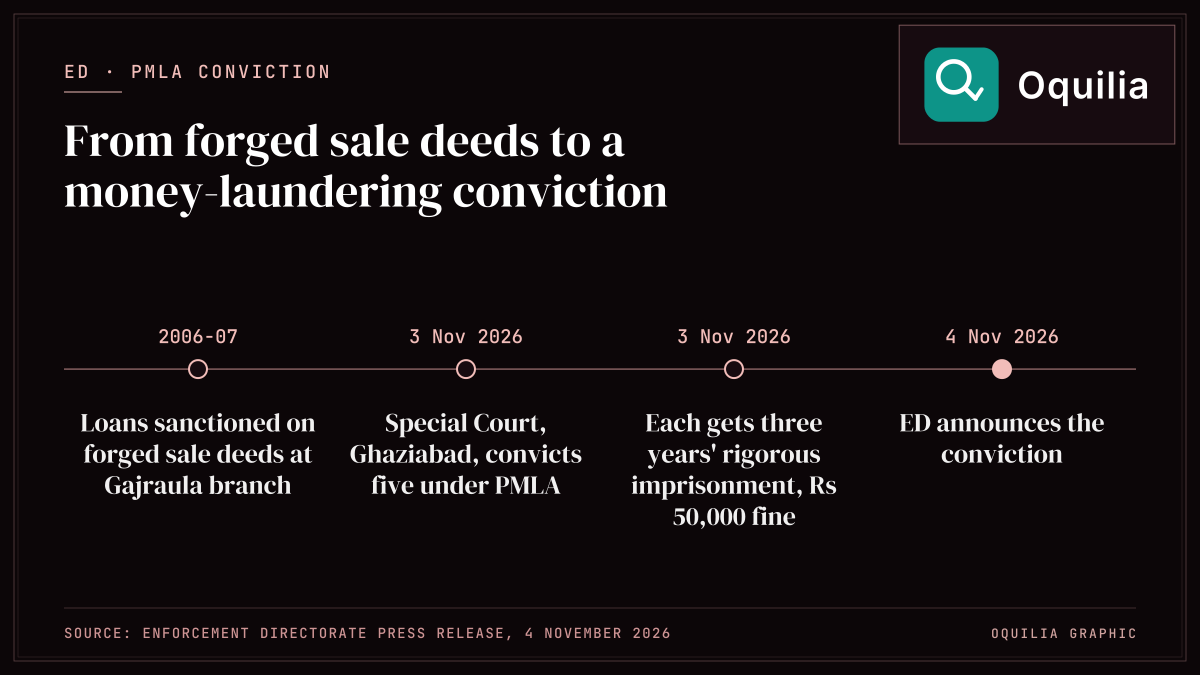
A Special Court in Ghaziabad has convicted V.N. Mathur, the then branch manager of Syndicate Bank's Gajraula branch, and four co-accused of money laundering under the Prevention of Money Laundering Act (PMLA), 2002, the Enforcement Directorate (ED) said on 4 November 2026. By a judgment dated 3 November 2026, the Special Judge, Ghaziabad, sentenced each of the five to three years' rigorous imprisonment and a fine of Rs 50,000, with three months' simple imprisonment if the fine is not paid.
What Happened
According to the ED's Lucknow Zonal Office, the court convicted V.N. Mathur along with four private persons who were accused in the same case: Rajeev Kumar, Arvind Chaudhary, Ankit Chaudhary and Pramod Kumar. They were found guilty of money laundering under Section 3 of the PMLA, punishable under Section 4, in Case No. 5/23.
The ED's investigation began from two FIRs registered by the Central Bureau of Investigation (CBI), ACB Ghaziabad, on a complaint by Syndicate Bank's Chief Vigilance Officer. In that original case, the Special Judge, CBI Court No. 2, Ghaziabad, convicted V.N. Mathur under the IPC and the Prevention of Corruption Act, 1988, and acquitted Rajeev Kumar and Pramod Kumar. The ED said those two have now been convicted of money laundering on the evidence and material it placed on record.
According to the ED, during 2006-07 the branch manager conspired with Arvind Chaudhary, another person since deceased, and others, and sanctioned loans and overdraft limits to them, their firms and associates on the basis of forged sale deeds of non-existent properties, false non-encumbrance certificates and false valuation reports. The ED said the loan money was withdrawn in cash, moved through savings bank accounts and demand drafts to hide its origin, and then used to buy property, including a plot at Alipur in J.P. Nagar district and a plot at Dehradun.
What It Means
The judgment is a conviction by a court, not an allegation. It also shows, as the ED pointed out, that an acquittal in the original case did not end the money-laundering case: two accused cleared in the CBI case were convicted under the PMLA. Customers who suspect wrongdoing in a bank loan or account can complain to their bank and then to the RBI at https://cms.rbi.org.in.
This report describes enforcement actions and allegations on the public record, attributed to the officials cited. An order, FIR or chargesheet is not a conviction; parties are presumed innocent until proven guilty.
Named in this report, or spotted an error? Corrections and responses: editor@oquilia.com. We correct errors promptly and record responses from named parties.
Sources & Citations
- Enforcement Directorate press release — Enforcement Directorate