

Calcutta High Court declines to order Indian Bank to fix borrower's CIBIL record
The Calcutta High Court dismissed a company's plea to remove a 'Loss' tag from its CIBIL report, holding that its dispute with Indian Bank over a one-time settlement belongs before the DRT.
Key points
- The Calcutta High Court on 16 November 2026 dismissed a company's writ petition seeking correction of its CIBIL credit report.
- The company said it paid the full settlement sum of Rs 4,11,02,726; Indian Bank says the settlement stands cancelled.
- The court held an OTS is a contract, not an entitlement, and left the company free to raise all issues before the DRT.
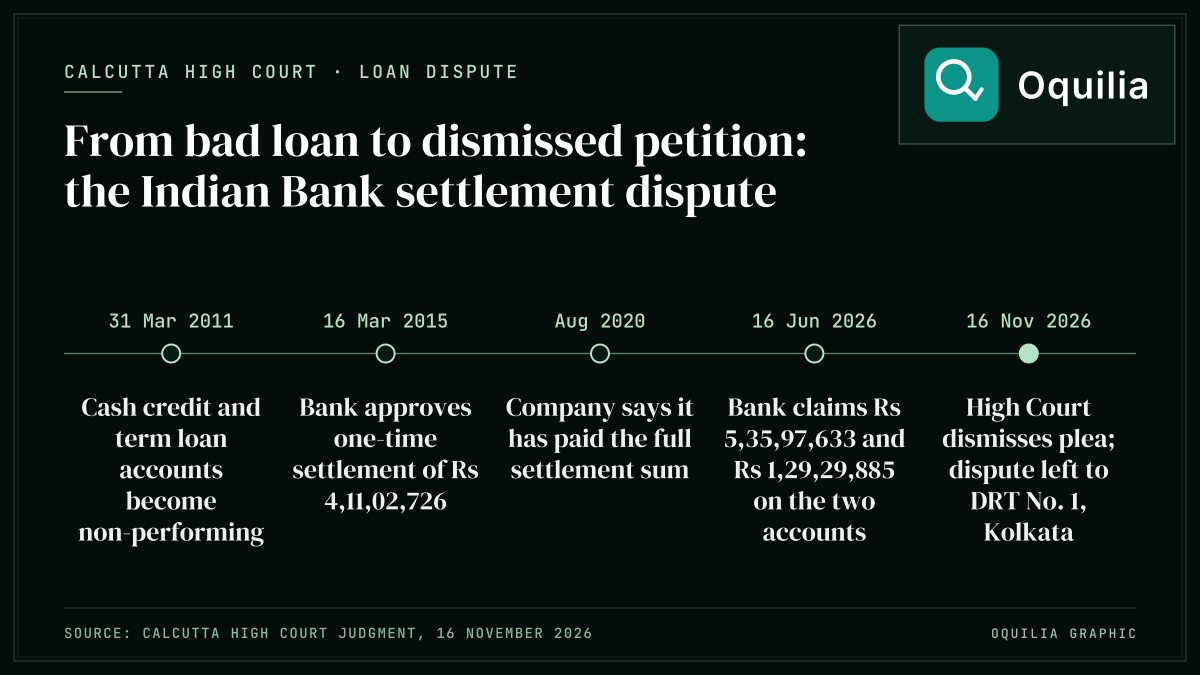
The Calcutta High Court on 16 November 2026 refused to order Indian Bank to change the "Loss" classification of a company borrower's two loan accounts in its CIBIL credit report. The court held that whether the company had honoured a one-time settlement with the bank is a disputed question of fact for the Debts Recovery Tribunal (DRT), not for a writ petition.
What Happened
Kejriwal Miining Pvt Ltd, a Kolkata company, had a cash credit account and a term loan with Allahabad Bank, now merged into Indian Bank. The accounts became non-performing on 31 March 2011. On 16 March 2015 the bank approved a one-time settlement (OTS), a compromise to close the loan for a fixed sum, of Rs 4,11,02,726, payable through 19 quarterly instalments with interest at the bank's base rate.
The company told the court it had paid the full Rs 4,11,02,726 by August 2020 and was ready to pay the outstanding interest of Rs 1,46,98,630, but the bank refused it. The bank said the OTS stood cancelled and claimed Rs 5,35,97,633 and Rs 1,29,29,885 on the two accounts as on 16 June 2026. The bank's 2015 OTS letter, quoted in the judgment, said it had classified the account as fraud and filed a police or CBI complaint, and that the settlement covered civil liability only. These are allegations, not findings of guilt; the accused are presumed innocent until proven guilty in court, and due process continues.
The court said an OTS "is a contract, not an entitlement". It noted that a division bench had in 2022 set aside the bank's wilful-defaulter declaration against the company, but held that the claim and counter-claim could not be decided in a writ petition while the bank's recovery case was pending before DRT No. 1, Kolkata. It dismissed the petition, leaving the company free to raise every issue before the tribunal.
What It Means
For borrowers, the ruling shows that a High Court may not order a lender to correct a credit report while the lender disputes whether a settlement was honoured and a recovery case is pending. The tribunal hearing that case is where such disputes are likely to be decided.
Borrowers with a complaint about how a bank has handled their loan or credit information can approach the RBI at https://cms.rbi.org.in.
Source: High Court judgment
Sources & Citations
- High Court judgment — Calcutta High Court