

Calcutta High Court declines to order Indian Bank to fix borrower's CIBIL entry
The Calcutta High Court refused to order Indian Bank to remove a "Loss" tag from a borrower's credit report, saying the dispute over a one-time settlement must first be decided by the Debts Recovery Tribunal.
Key points
- The Calcutta High Court on 16 November 2026 dismissed a company's plea to have a "Loss" tag removed from its credit report.
- The company said it paid the full Rs 4,11,02,726 settlement sum; Indian Bank says the settlement stands cancelled.
- The court held the dispute must be decided by the Debts Recovery Tribunal, where the bank's recovery case is pending.
The Calcutta High Court on 16 November 2026 refused to order Indian Bank to remove a "Loss" classification from a borrower company's credit report, holding that the dispute over whether the company kept to its one-time settlement must first be decided by the Debts Recovery Tribunal. The court dismissed W.P.O. No. 704 of 2025, filed by Kejriwal Miining Pvt. Ltd.
What Happened
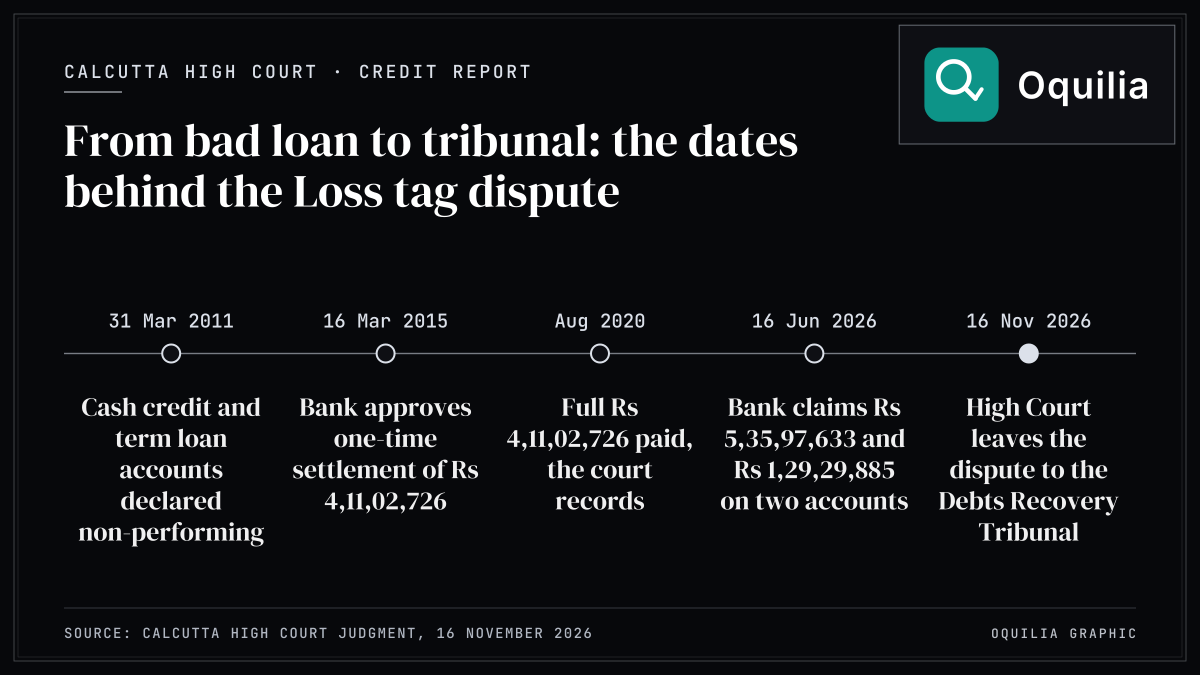
According to the judgment, the company's cash credit and term loan accounts with Allahabad Bank, now merged with Indian Bank, were declared non-performing on 31 March 2011. On 16 March 2015 the bank approved a one-time settlement (OTS) of Rs 4,11,02,726, payable as a down payment and 19 quarterly instalments, with interest at the base rate until the last payment.
The court recorded that the company had paid the full Rs 4,11,02,726 by August 2020 and was willing to pay the interest, which an earlier appeal order put at Rs 1,46,98,630. The bank refused, saying the OTS stood cancelled and claiming Rs 5,35,97,633 and Rs 1,29,29,885 on the two accounts as on 16 June 2026. The company asked the court to have its credit report corrected under the Credit Information Companies (Regulation) Act, 2005.
The court said an OTS "is a contract, not an entitlement" and that no borrower can compel a bank to accept less than its contractual dues. It noted that the bank had accepted the payments without objection and that interest was part of the settlement. But since the bank's recovery case, O.A. No. 291 of 2018, is pending before the Debts Recovery Tribunal, the court held that the rival claims raise disputed facts it cannot decide in a writ petition. The company may raise every issue before the tribunal, which is to decide them without being influenced by the court's remarks.
What It Means
For borrowers, the ruling shows that a credit report entry tied to a live dispute over a settlement may stay until the tribunal hearing the recovery case decides it. Keep every settlement letter and payment record. Complaints about how a bank reports a loan can be made to the bank and then to the RBI at https://cms.rbi.org.in. The order can be appealed.
Source: High Court judgment
Sources & Citations
- High Court judgment — Calcutta High Court