

Bombay High Court quashes Canara Bank's fraud classification of a borrower's loan account
The Bombay High Court has set aside Canara Bank's declaration classifying Carnival Technopark's loan account as fraud, holding that the bank did not show any intent to deceive.
Key points
- The Bombay High Court on 4 November 2026 quashed Canara Bank's proceedings classifying Carnival Technopark's loan account as fraud.
- The bank had declared the account fraud on 1 April 2026 over a Rs 130 crore term loan sanctioned by Syndicate Bank in 2017.
- The court held that non-disclosure alone is not fraud without an intent to deceive, which a bank must establish.
A division bench of the Bombay High Court on 4 November 2026 quashed Canara Bank's proceedings that classified the loan account of Carnival Technopark Private Limited as 'fraud'. The court held that a borrower's failure to disclose another loan does not amount to fraud unless there was an intent to deceive, and found no such intent here.
What Happened
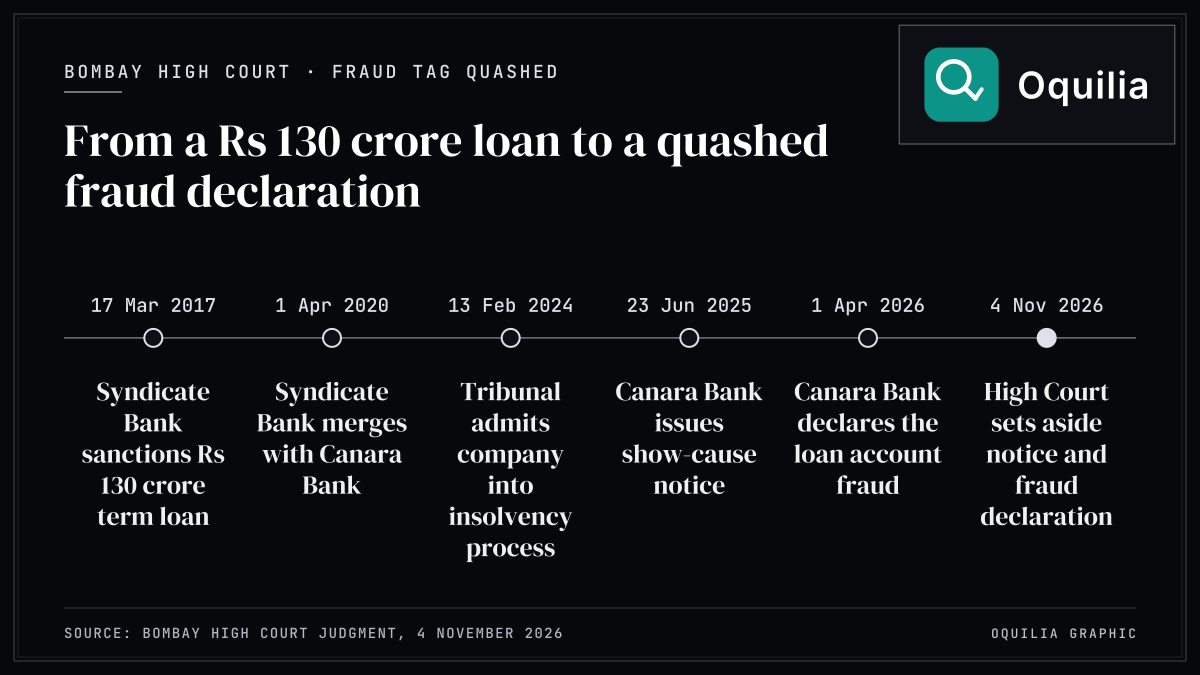
According to the judgment, Syndicate Bank sanctioned a Rs 130 crore term loan against lease rentals on the company's technology park property in Thiruvananthapuram on 17 March 2017. Syndicate Bank merged with Canara Bank on 1 April 2020. The company was admitted into the corporate insolvency resolution process by the National Company Law Tribunal on 13 February 2024, and the bank filed a claim of more than Rs 116 crore.
Canara Bank issued a show-cause notice on 23 June 2025 and, on 1 April 2026, declared the account fraud under the RBI's Master Directions on Fraud Risk Management. The bank argued that the company had not disclosed a Rs 75 crore loan from Reliance Capital Ltd when it sought the Syndicate Bank loan.
The petition was filed by a director of the company's suspended board. The court noted that the company's audited financial statements showed the other loan, that the bank's own e-mail of 16 April 2021 showed it knew of the loan, and that the loan agreement gave the bank powers to inspect records and recall the loan, which it did not use. The court held that the other loan "was not a secret document" and that it did not find intent on the part of the company to commit fraud on the bank. It set aside the show-cause notice and the declaration.
What It Means
A fraud classification can shut a borrower and its promoters out of fresh bank credit. This ruling says that a bank must show an intent to deceive, judged from the circumstances, before it tags an account as fraud, and that a bank which knew of a fact and did not act on it cannot later treat that fact alone as fraud. Borrowers with a complaint about a bank's conduct can approach the RBI at https://cms.rbi.org.in.
Source: High Court judgment
Sources & Citations
- High Court judgment — Bombay High Court