

Bombay High Court lets Kotak take card dues to arbitration without signed form
The Bombay High Court held on 4 November 2026 that using a credit card can show acceptance of Kotak Mahindra Bank's arbitration clause, even without a signed application.
Key points
- The Bombay High Court held that Kotak Mahindra Bank can refer four credit card disputes to arbitration though it had no signed application.
- The court relied on a clause in the bank's cardholder agreement that treats use of the card as acceptance of its terms.
- The court left open for the arbitrator whether each card was used, whether each transaction was authorised and how much is due.
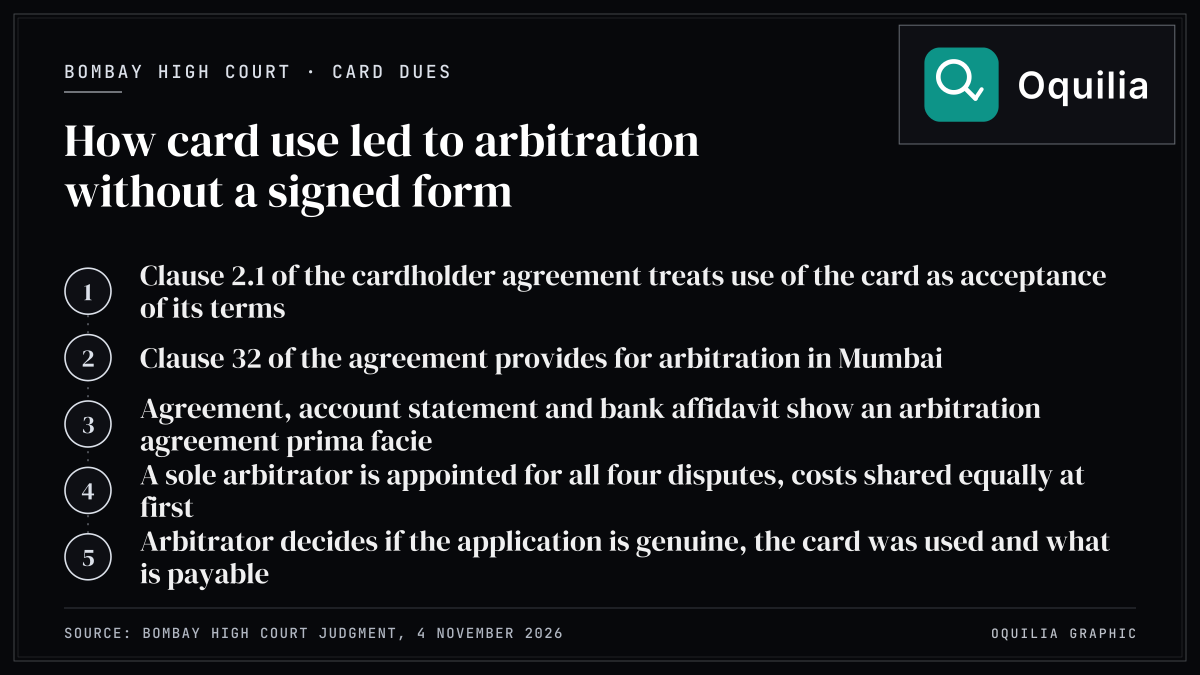
The Bombay High Court on 4 November 2026 held that Kotak Mahindra Bank can take unpaid credit card dues to arbitration even though it could not produce a signed or digitally accepted application from the cardholder. Deciding four applications by the bank together, the court said use of the card can amount to acceptance of the cardholder agreement, which contains the arbitration clause.
What Happened
Kotak Mahindra Bank asked the court, under Section 11 of the Arbitration and Conciliation Act, 1996, to appoint an arbitrator in disputes with four credit card customers. In the lead case, the bank said the customer applied digitally and used the card, and its statement of account showed Rs 5,46,655.34 due. The bank admitted in an affidavit that the original digital application and the electronic record of how the customer accepted the terms were with a former vendor and were not available.
The court said the law does not require every arbitration agreement to carry both parties' signatures, but consent must be shown from some record. It noted that Clause 2.1 of the bank's cardholder agreement treats use of the card as acceptance of its terms, and Clause 32 provides for arbitration in Mumbai. Reading the agreement, the statement of account and the bank's affidavit together, the court found that an arbitration agreement exists prima facie, that is, on a first look. It added that RBI's digital lending directions, and the bank's argument that public money was involved, cannot by themselves prove that a customer accepted an arbitration clause. The court appointed a sole arbitrator for all four disputes, with costs shared equally in the first instance.
What It Means
For credit card holders, the ruling means a bank may be able to take a dispute over dues to an arbitrator on the strength of card use, even without a signed form. The court kept every factual question open for the arbitrator: whether the digital application is genuine, whether the customer actually used the card, who authorised each transaction, whether the statement is correct and how much is payable. The arbitrator may ask the bank for its original digital records, the full transaction history and proof of card delivery and activation, and may weigh any failure to produce them. The court said its findings are not final on the merits. A customer with a complaint about a bank's service can approach the RBI at https://cms.rbi.org.in.
Source: High Court judgment
Sources & Citations
- High Court judgment — Bombay High Court