

Using a credit card can bind you to its arbitration clause, Bombay High Court holds
The Bombay High Court held that Kotak Mahindra Bank's cardholders accepted its arbitration clause by using their cards, even though no signed application was produced.
Key points
- The Bombay High Court on 4 November 2026 referred four Kotak Mahindra Bank credit card disputes to a sole arbitrator.
- The court held that a missing physical or digital signature on a card application does not by itself mean there is no arbitration agreement.
- Cardholders can still dispute the digital application, card use, transactions and amounts claimed before the arbitral tribunal.
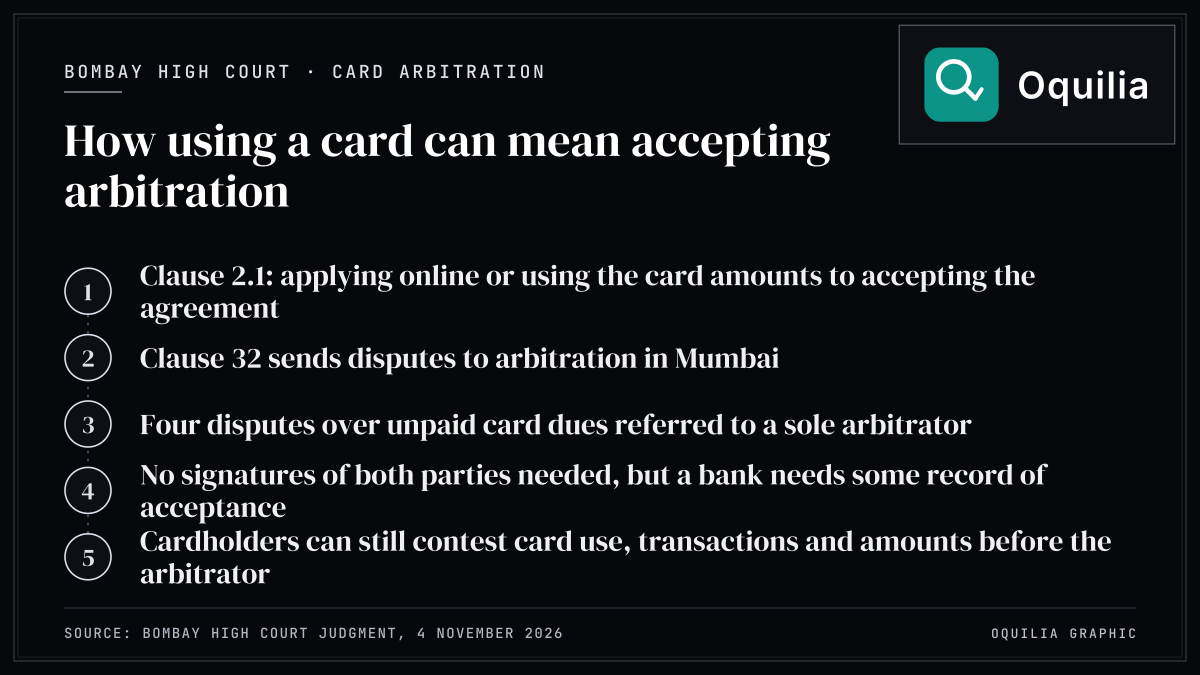
The Bombay High Court has held that a credit card holder can be bound by the arbitration clause in the bank's cardholder agreement by using the card, even if no signed application is produced. In a common judgment pronounced on 4 November 2026, the court referred four disputes over unpaid credit card dues between Kotak Mahindra Bank and its cardholders to a sole arbitrator. Arbitration is a private process in which an appointed arbitrator, not a court, decides the dispute.
What Happened
The bank asked the court to appoint an arbitrator, relying on Clause 32 of its cardholder agreement, which sends disputes to arbitration in Mumbai. In one case the statement of account showed Rs 5,46,655.34 as due. The bank admitted that the original digital applications, and the electronic records showing how the cardholders accepted the terms, were not available with it because they were held by a former vendor.
The court held that the law does not require every arbitration agreement to carry the physical or digital signatures of both parties. It pointed to Clause 2.1 of the agreement, which says that applying online or using the card amounts to acceptance of its terms. Taking the statement of account and the bank's affidavit together, the court found prima facie, meaning on a first look, that the cardholders had accepted the agreement by using their cards.
The court also said a bank cannot bind a customer to an arbitration clause without some record of acceptance, and that RBI's digital lending directions do not by themselves prove a customer agreed to arbitration.
What It Means
The court expressly left open the genuineness of the digital applications, whether the cards were actually used, the authority for each transaction, the accuracy of the statements and the amounts claimed. Cardholders may raise all of these before the arbitral tribunal, which may ask the bank for the original records, the full transaction history and proof of card delivery and activation, and may weigh any failure to produce them. The court said its findings are not final on the merits.
Cardholders with a complaint about a bank's credit card practices can approach the bank first and then the RBI at https://cms.rbi.org.in.
Source: High Court judgment
Sources & Citations
- High Court judgment — Bombay High Court